The company that owns the file formats, priced for the first time as vulnerable.
Adobe turned standards into a business three times — PostScript, PDF, Photoshop — and then executed the cleanest subscription transition in software history. Its current chapter asks whether owning the tools still matters when the tools can generate the work.
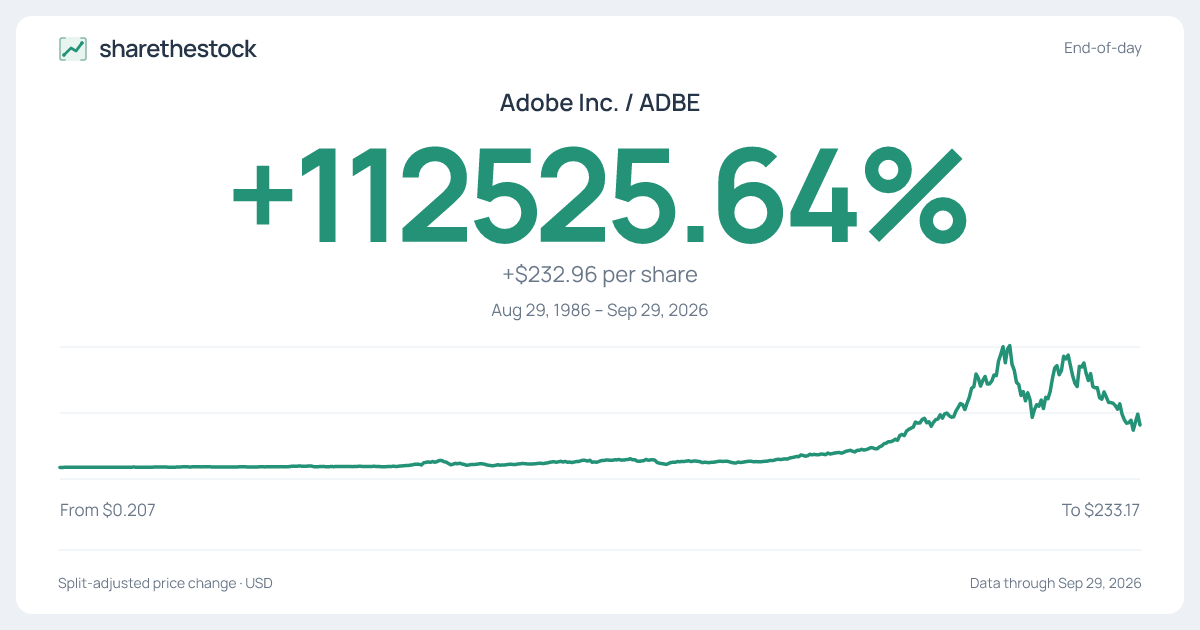
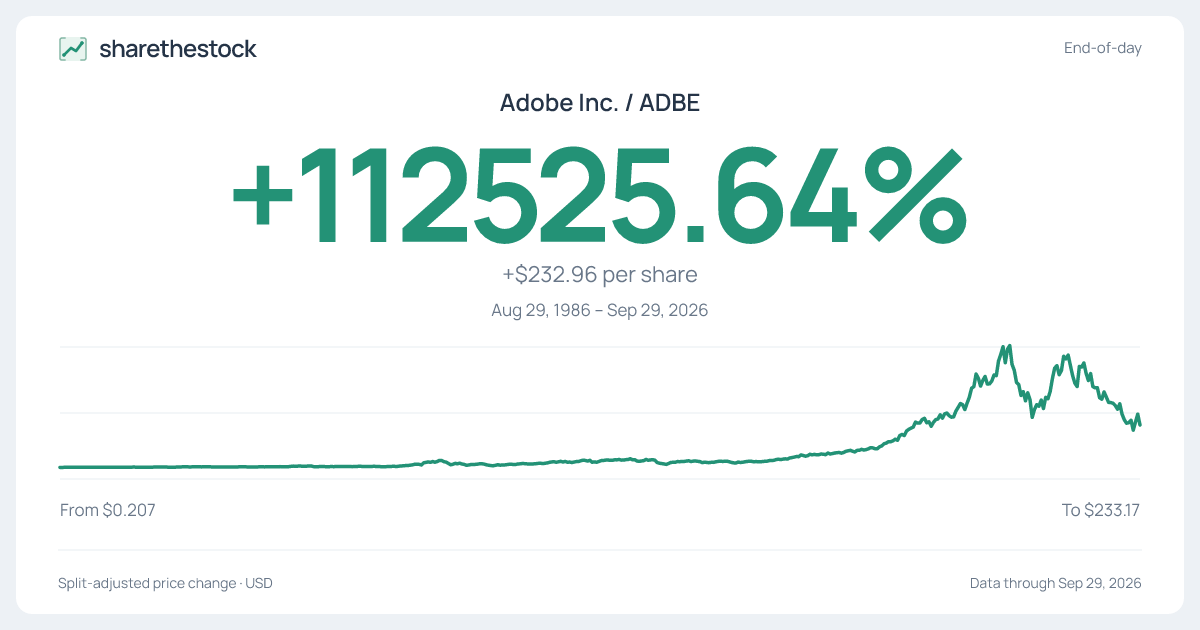
$0.207first monthly close, Aug 1986$233.17latest, Sep 29, 2026+112525.64%since Aug 1986$1,000 → $1,126,256.44first close to now
Selling a language, then the applications that used it
Two Xerox PARC researchers built a page-description language, licensed it to Apple’s LaserWriter, and created desktop publishing. Illustrator and Photoshop followed because the company needed software to demonstrate what its language could do.
Warnock and Geschke leave Xerox PARCFounding
Frustrated that Xerox will not commercialise their printing research, they start Adobe in Warnock’s garage and name it after the creek behind it.
Private company — no public price yet
Steve Jobs buys 19% and licenses PostScriptDeal
Apple pays for a stake and a five-year licence, the LaserWriter ships, and desktop publishing becomes the first must-have application for the Macintosh.
Private company — no public price yet
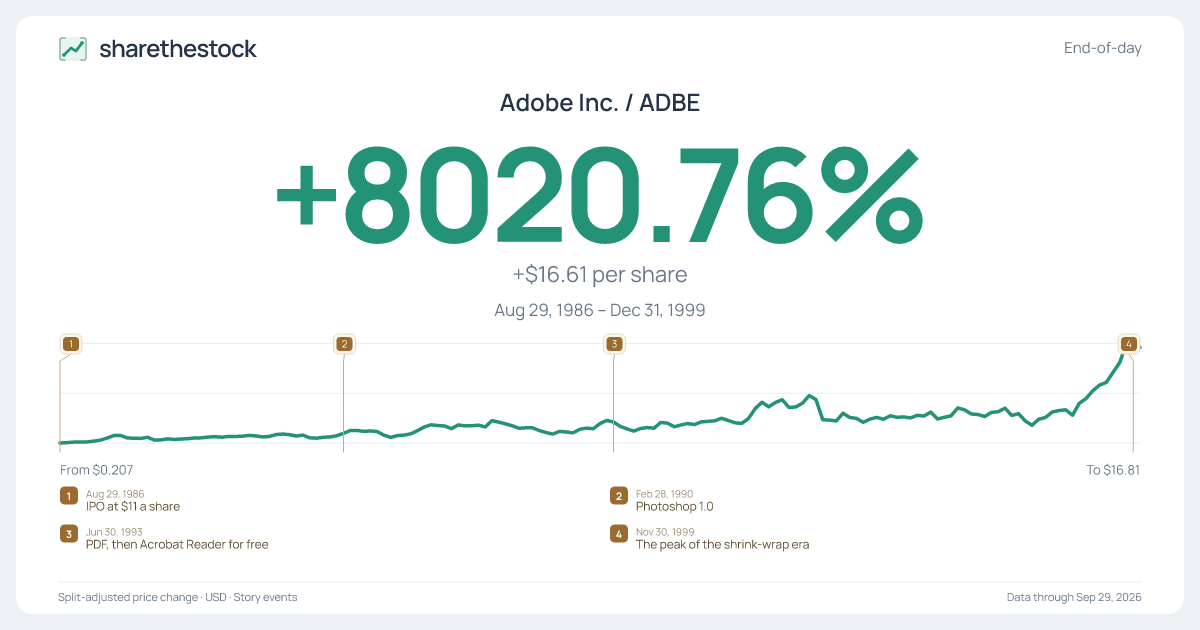
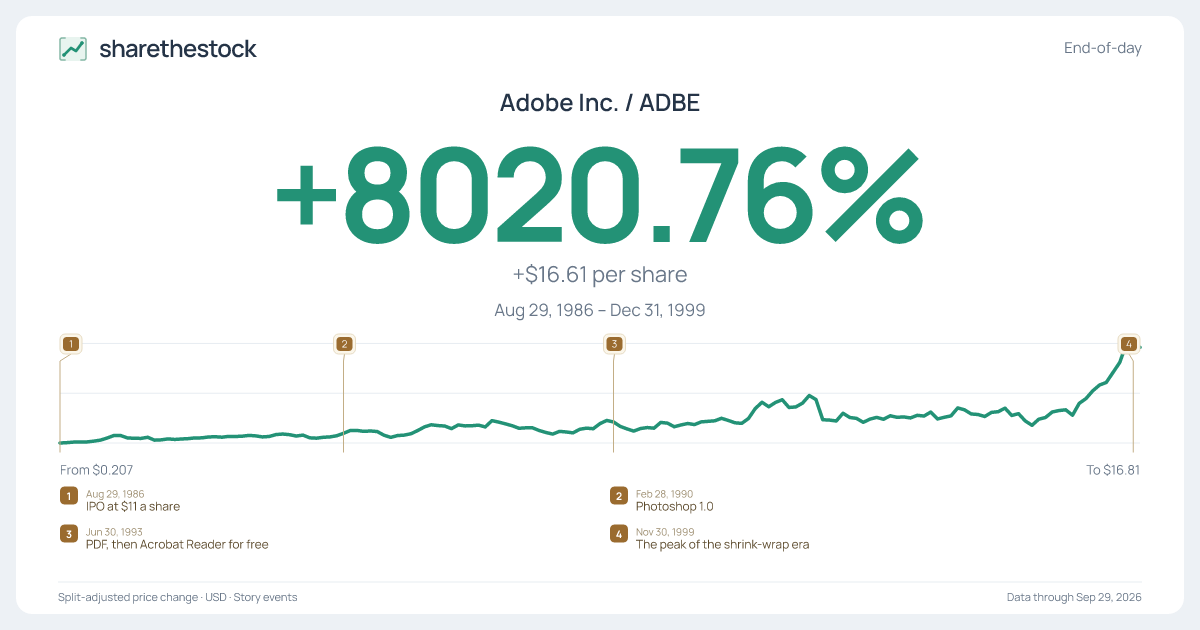
IPO at $11 a shareMarket
One of the first software companies to go public on the strength of a licensing business rather than a product catalogue.
Closed $0.207 that month
Photoshop 1.0Product
Licensed from two brothers who wrote it to display grayscale images. It becomes the only piece of professional software whose name is also a verb.
Closed $1.89 that month
PDF, then Acrobat Reader for freeProduct
Adobe gives away the reader to make the format universal and sells the tools to create it. Thirty years later PDF is an ISO standard and still an Adobe business.
Closed $3.86 that month
The peak of the shrink-wrap eraMarket
Creative software is sold in boxes at full price, and the stock reflects the best economics that model ever produced.
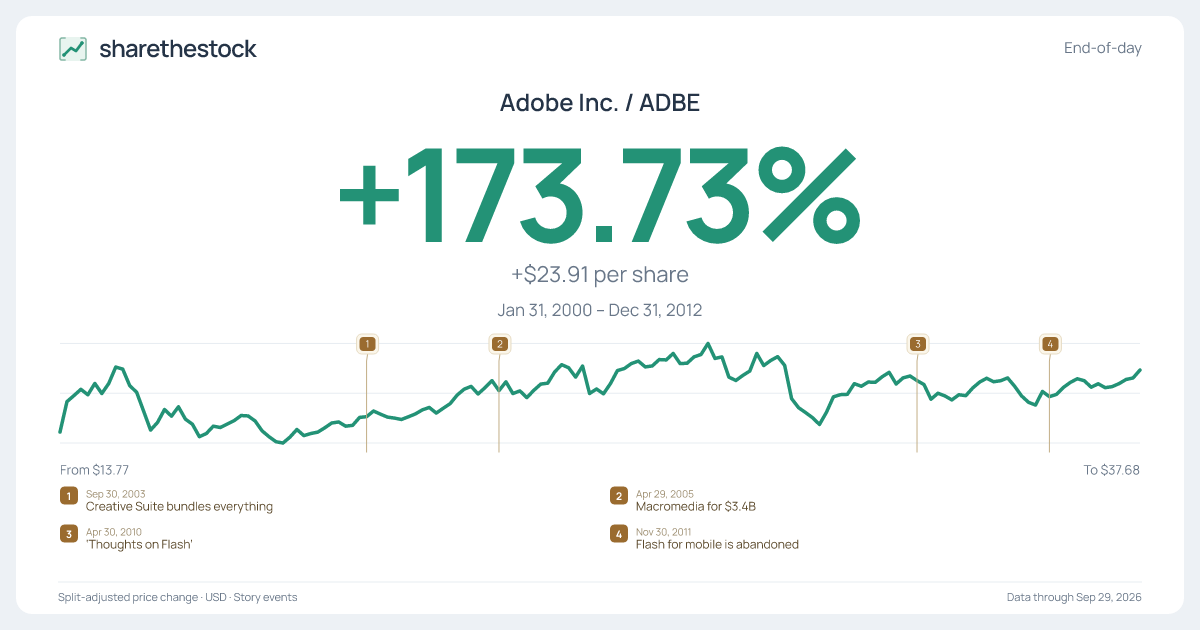
Adobe packaged its applications together, bought the only real competitor in Macromedia, and lived on eighteen-month upgrade cycles — a model that produced lumpy revenue, piracy, and a permanent incentive to withhold features.
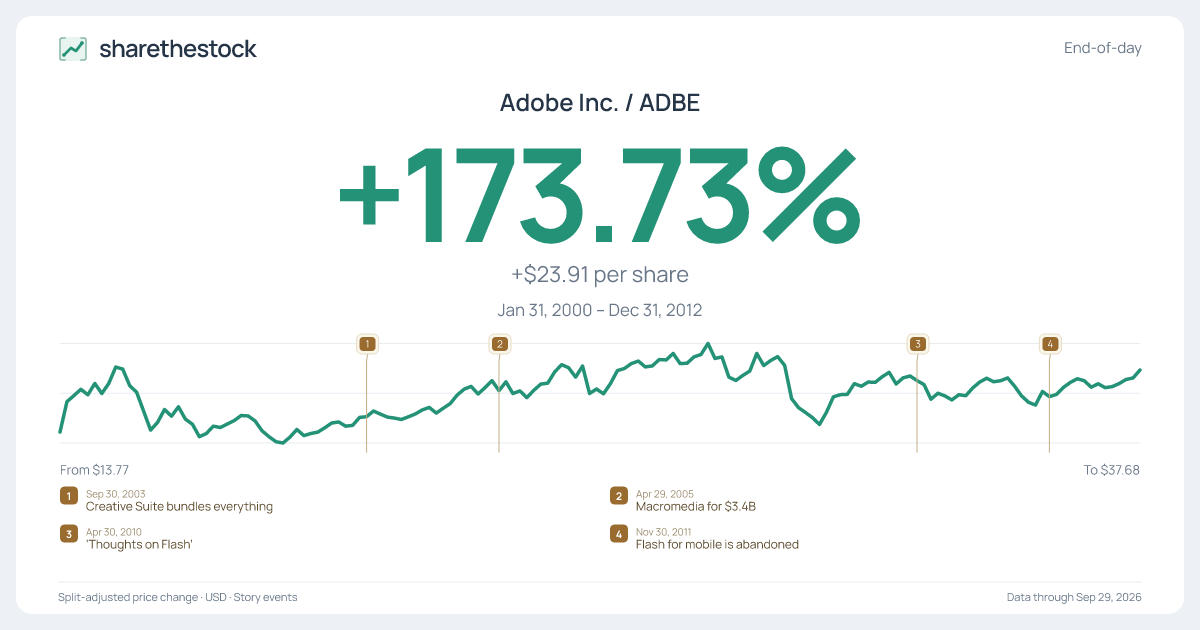
Creative Suite bundles everythingProduct
Photoshop, Illustrator and InDesign ship together at a price that makes buying any single application look irrational. The bundle is the moat.
Closed $19.70 that month
Macromedia for $3.4BDeal
Adobe buys Flash, Dreamweaver and the end of its only credible competitor in creative tools.
Closed $29.74 that month
‘Thoughts on Flash’Crisis
Steve Jobs publishes an open letter refusing to allow Flash on iOS. The platform Adobe had just paid billions for has no future on the fastest-growing screen.
Closed $33.60 that month
Flash for mobile is abandonedProduct
Adobe concedes, pivots to HTML5 tooling, and starts building the case internally for selling software as a service instead of a licence.
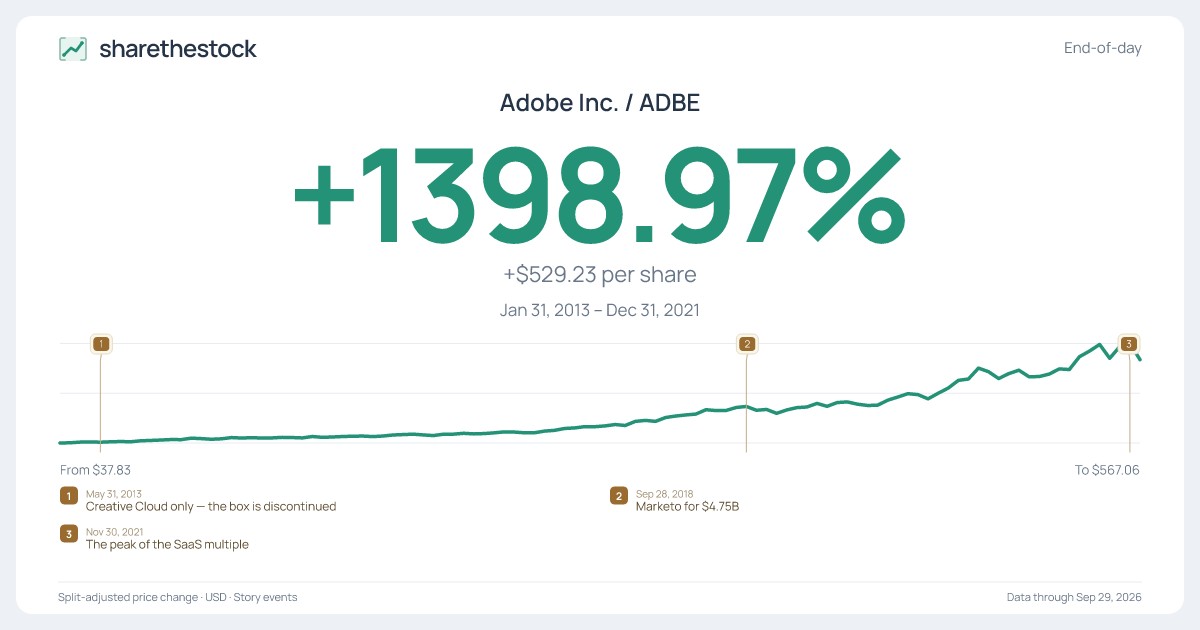
Adobe stopped selling licences and forced its entire base onto Creative Cloud, absorbing a revenue decline it had told investors to expect. It became the case study every software company cited, and the stock went up more than tenfold.
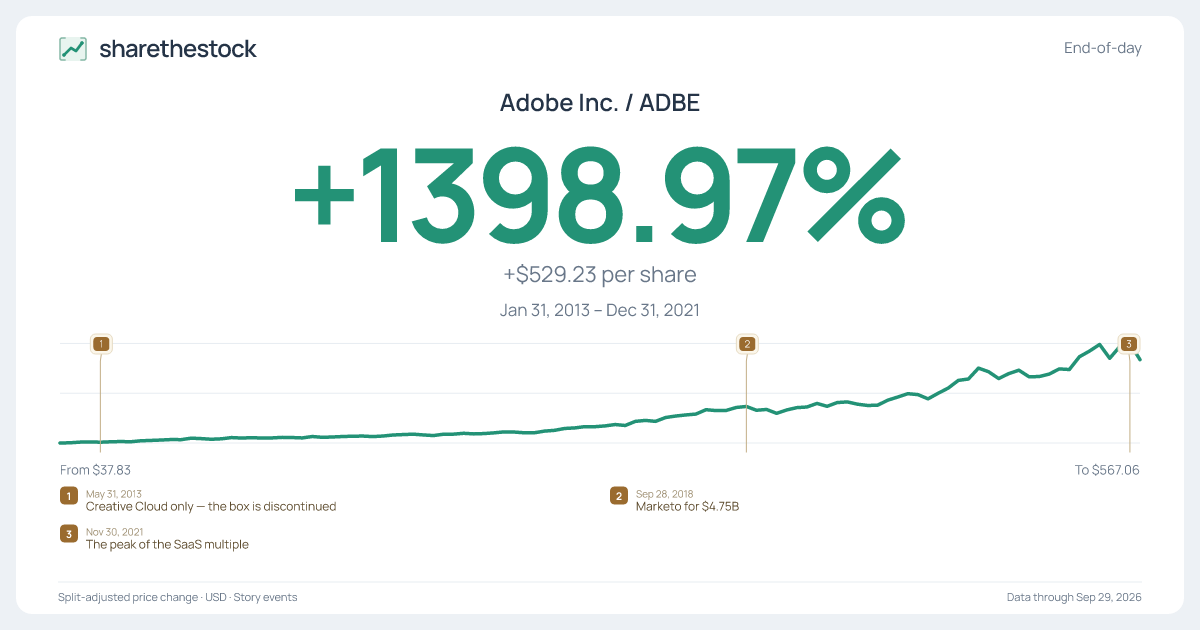
Creative Cloud only — the box is discontinuedProduct
Adobe stops selling perpetual licences entirely, in the face of petitions and a temporary revenue decline. Within three years recurring revenue is higher than the licence business ever was.
Closed $42.91 that month
Marketo for $4.75BDeal
The marketing-software arm becomes a second business, sold to a completely different buyer inside the same customer.
Closed $269.95 that month
The peak of the SaaS multipleMarket
Adobe reaches an all-time high on the same multiple expansion lifting every subscription business, weeks before rates begin the repricing.
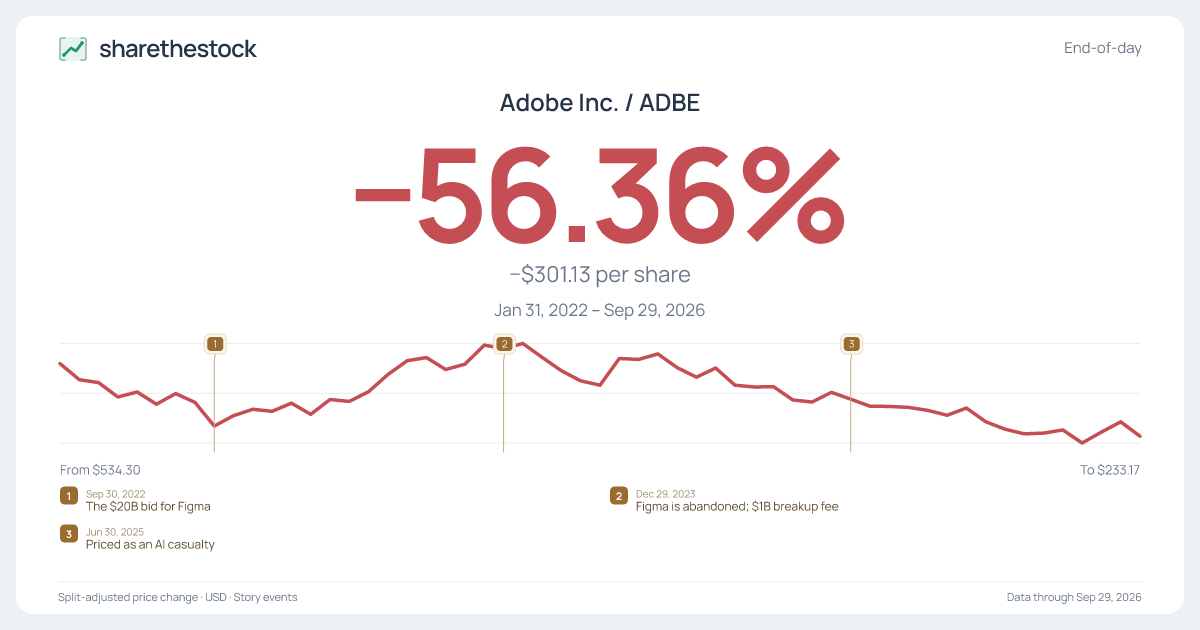
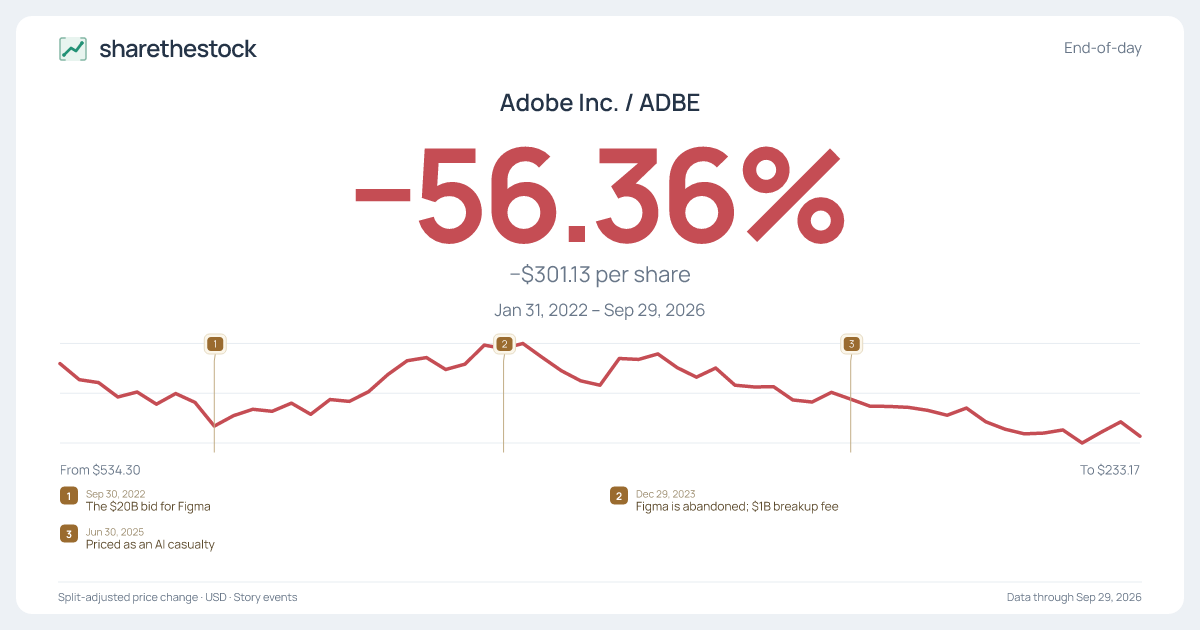
A $20B attempt to buy Figma was abandoned under regulatory pressure, and then image and video generation arrived as a capability anyone could rent. Adobe shipped its own models and still spent years trading as if the moat were gone.
The $20B bid for FigmaDeal
Fifty times revenue for a collaborative design tool that had taken a market Adobe wanted. The price shocks investors and the stock falls 17% in a day.
Closed $275.20 that month
Figma is abandoned; $1B breakup feeCrisis
UK and EU regulators refuse to clear it. Adobe pays to walk away and has to argue that its own products can win the category instead.
Closed $596.60 that month
Priced as an AI casualtyCrisis
Generative image and video models make content creation cheap, and the market de-rates Adobe despite growing revenue — the multiple, not the business, does the falling.