It invented the integrated circuit and got rich selling the boring ones.
Texas Instruments has been an oil-services company, a defence contractor, a calculator brand and a mobile-chip supplier. It became one of the best-performing industrials in America only after it deliberately gave up trying to be exciting.
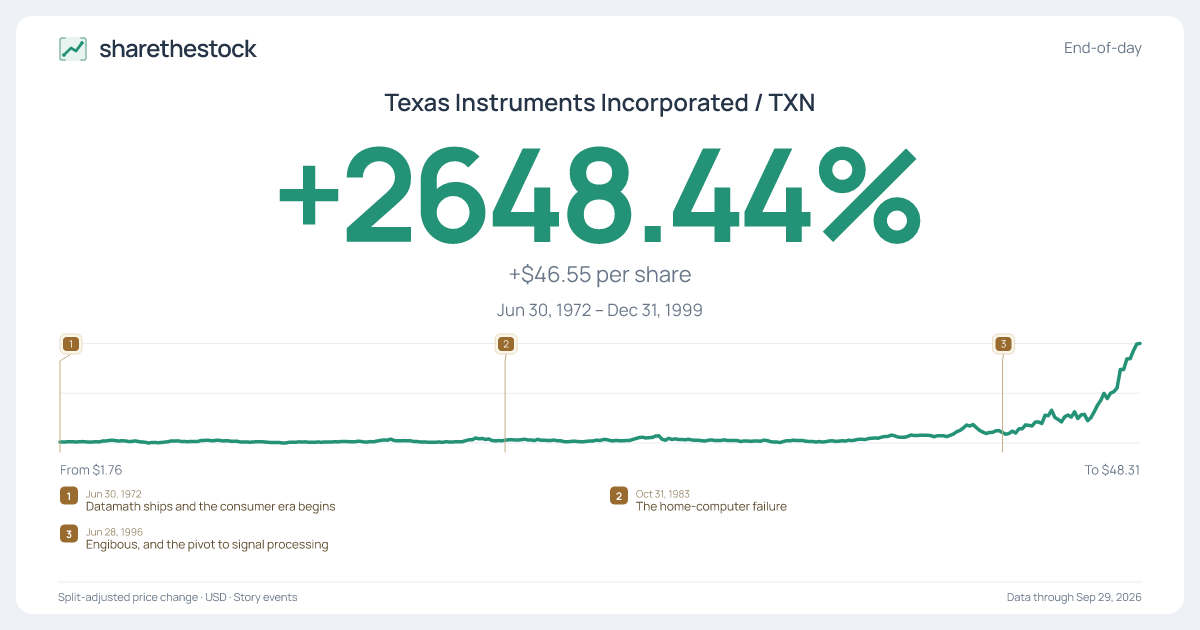
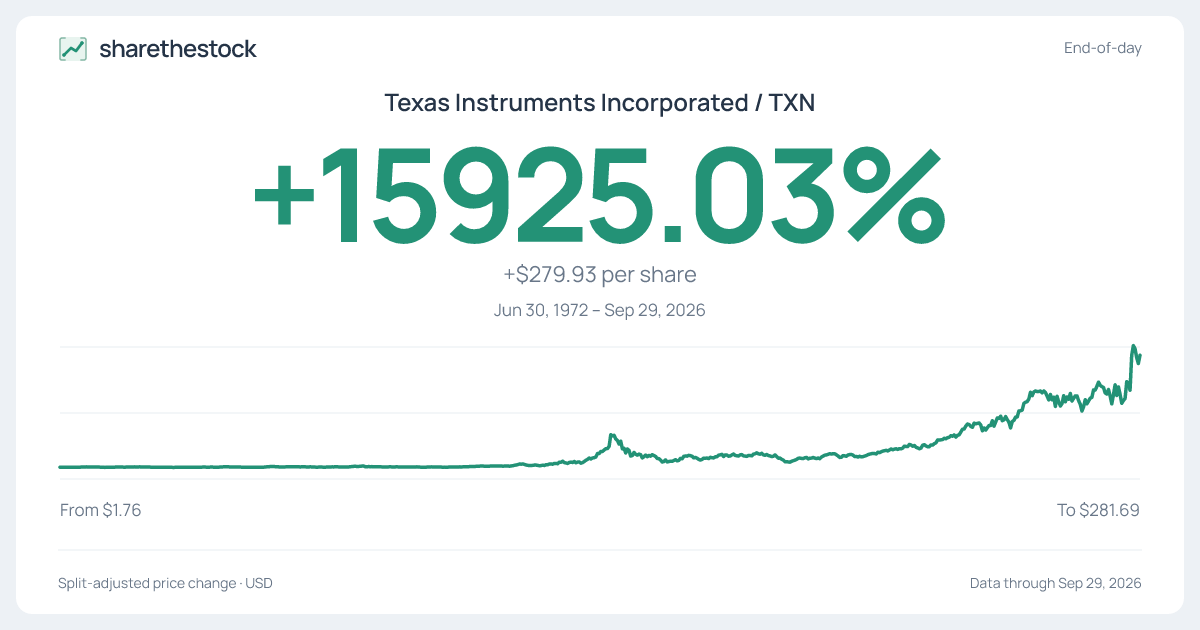
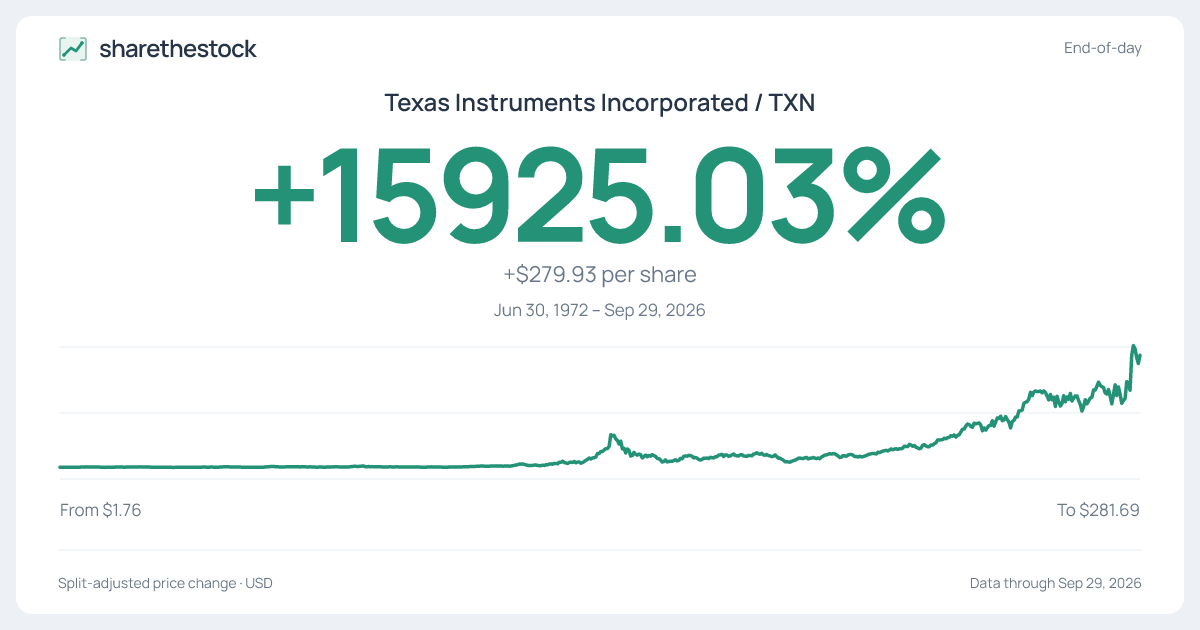
$1.76first monthly close, Jun 1972$281.69latest, Sep 29, 2026+15925.03%since Jun 1972$1,000 → $160,250.27first close to now
Inventing the industry, then selling consumer electronics
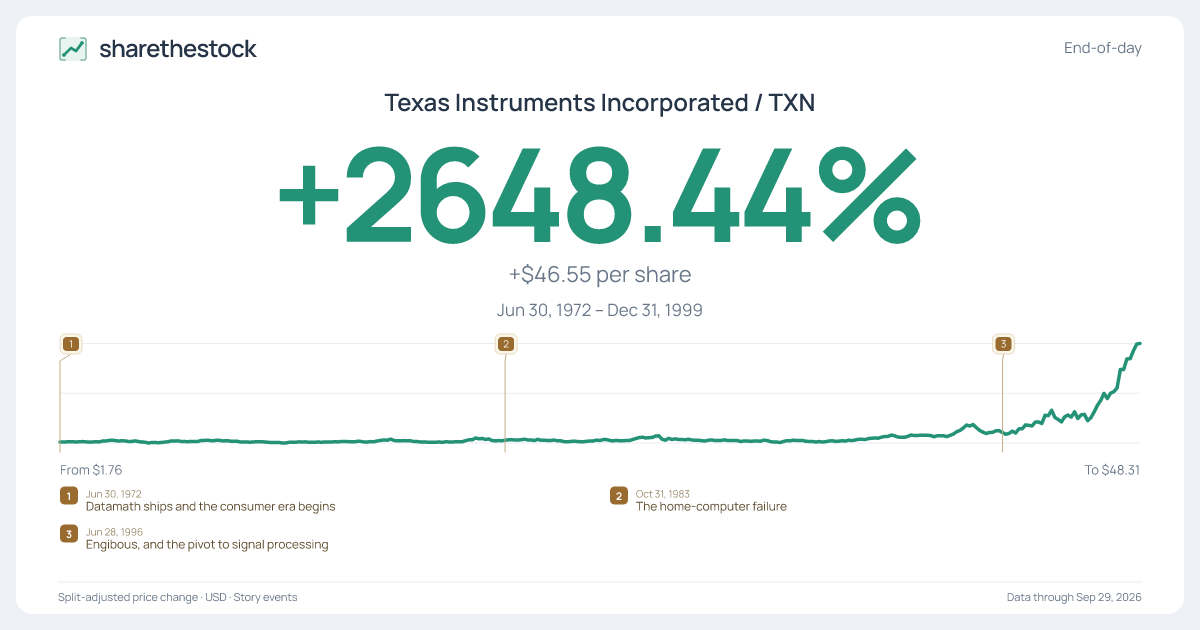
Jack Kilby built the first integrated circuit at TI in 1958 and won a Nobel Prize for it. The company spent the following decades trying to turn that lead into consumer products — calculators, home computers, digital watches — and mostly failing at the retail end while the components business quietly compounded.
Founded as Geophysical Service, looking for oilFounding
A seismic-survey company for petroleum exploration. Its instrument division becomes the actual business, and the name changes to Texas Instruments in 1951.
Private company — no public price yet
The first commercial silicon transistorProduct
TI beats the rest of the industry to silicon and puts transistors into a consumer radio to prove they work — the first mass-market use of the technology.
Before monthly price data begins
Jack Kilby builds the integrated circuitProduct
A single piece of germanium containing a whole circuit, developed during a summer when everyone else was on holiday. It earns a Nobel Prize forty-two years later.
Before monthly price data begins
The handheld calculatorProduct
TI invents the category and then sells into it directly, which puts it in competition with its own component customers for the next twenty years.
Before monthly price data begins
Datamath ships and the consumer era beginsProduct
A $150 four-function calculator becomes a mass product, and TI becomes a household brand — a position it will spend the next two decades discovering is not worth much.
Closed $1.76 that month
The home-computer failureCrisis
A price war with Commodore produces the largest loss in TI’s history and the exit from consumer computing. The lesson — compete where you have cost advantage, not where the brand is — becomes company doctrine.
Closed $2.59 that month
Engibous, and the pivot to signal processingLeadership
TI sells defence to Raytheon, exits memory, and reorganises around digital signal processors and analog. The portfolio is rebuilt in four years.
Selling the businesses with customers, keeping the ones with margins
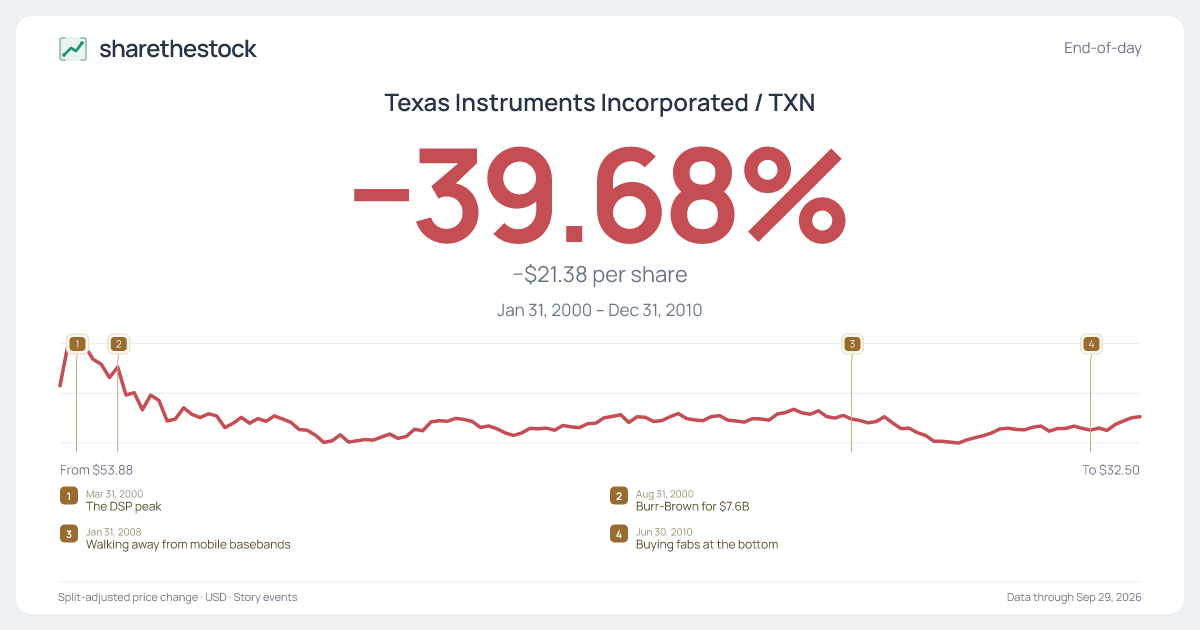
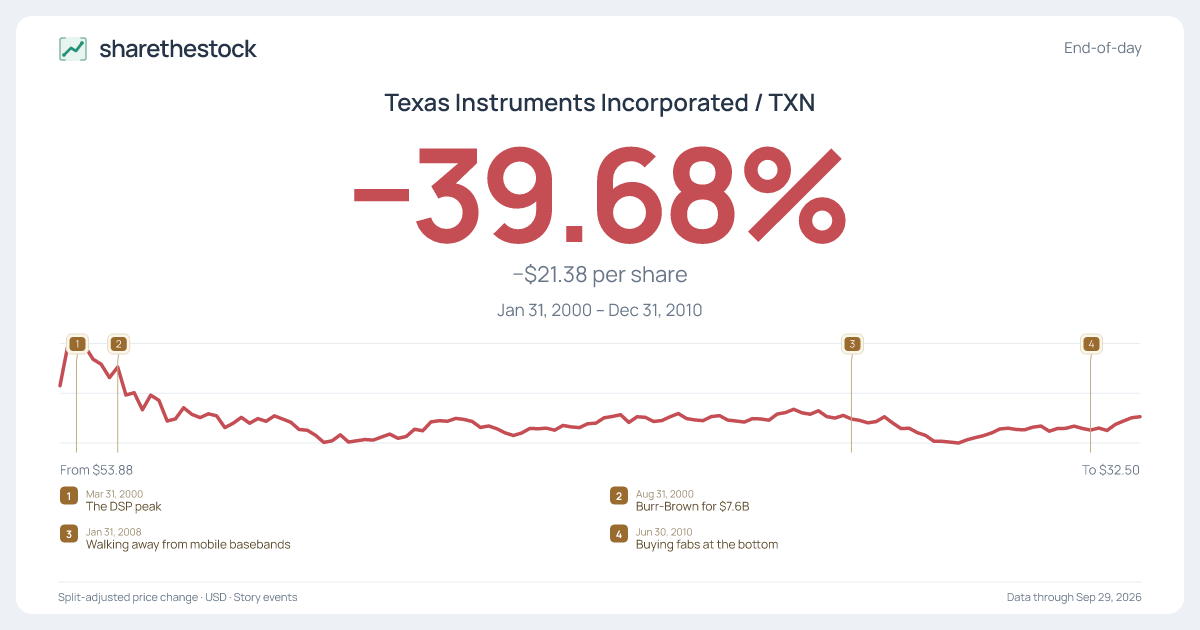
TI sold defence, exited memory, rode the DSP boom into the dot-com peak, and then walked away from mobile basebands at the height of the smartphone build-out — because the customers were too large and the margins too thin.
The DSP peakMarket
Every mobile phone needs a signal processor and TI supplies most of them. The stock reaches a level it will not revisit for sixteen years.
Closed $80.00 that month
Burr-Brown for $7.6BDeal
An expensive, prescient purchase of high-performance analog at the top of the market. Analog becomes the majority of TI’s profit within a decade.
Closed $66.75 that month
Walking away from mobile basebandsCrisis
TI exits the chip that goes into every phone, arguing the customer concentration and margins are unattractive. The smartphone boom happens without it, and the decision is vindicated on returns.
Closed $30.95 that month
Buying fabs at the bottomMarket
TI acquires used 300mm equipment and idle plants for a fraction of replacement cost during the downturn — the source of its cost advantage for the next fifteen years.
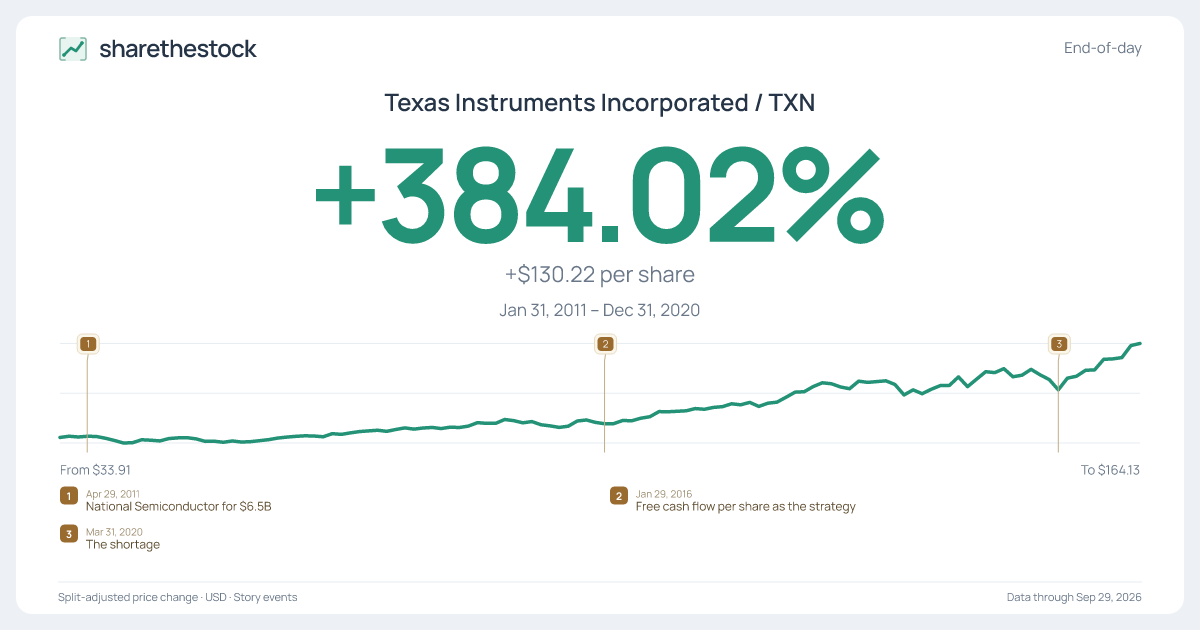
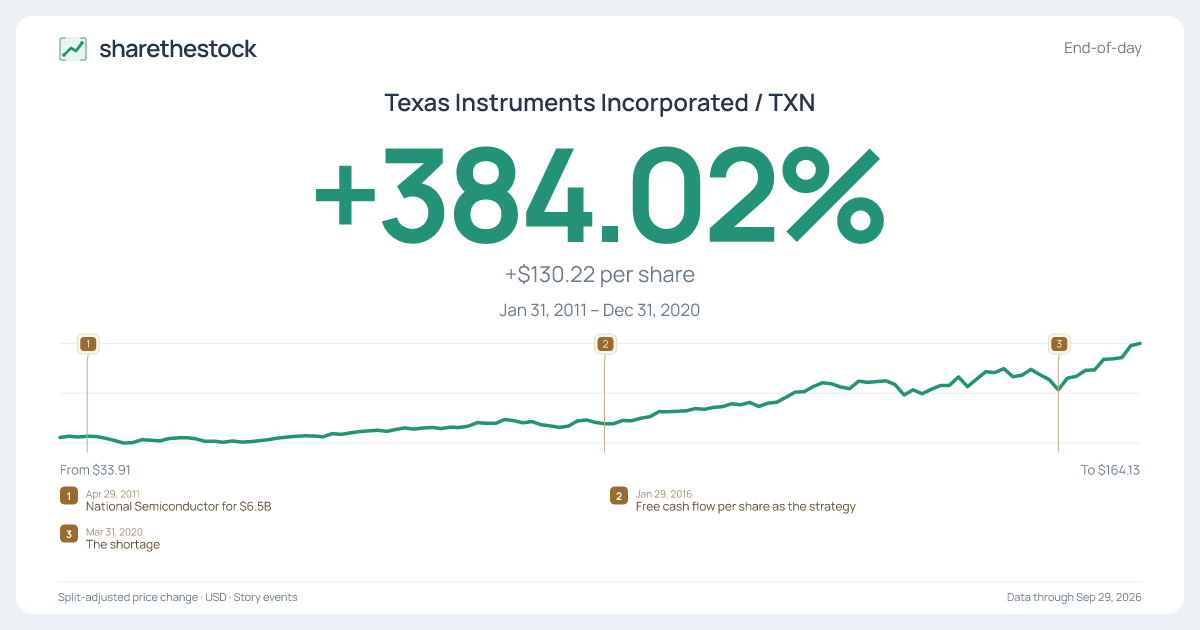
Analog and embedded chips sold to industrial and automotive buyers, manufactured in fabs bought at the bottom of cycles, with free cash flow per share as the stated objective. It produced one of the most consistent capital-return records in the market.
National Semiconductor for $6.5BDeal
The last large acquisition. It adds a sales force and a catalogue of analog parts, and completes the transformation into a components company.
Closed $35.53 that month
Free cash flow per share as the strategyMarket
TI publishes a capital-allocation policy so explicit it reads like a mission statement, and returns nearly all free cash flow through dividends and buybacks for a decade.
Closed $52.93 that month
The shortageMarket
Pandemic supply chaos makes commodity analog parts scarce and TI’s owned capacity valuable. Automotive and industrial demand outruns the industry’s ability to supply it.
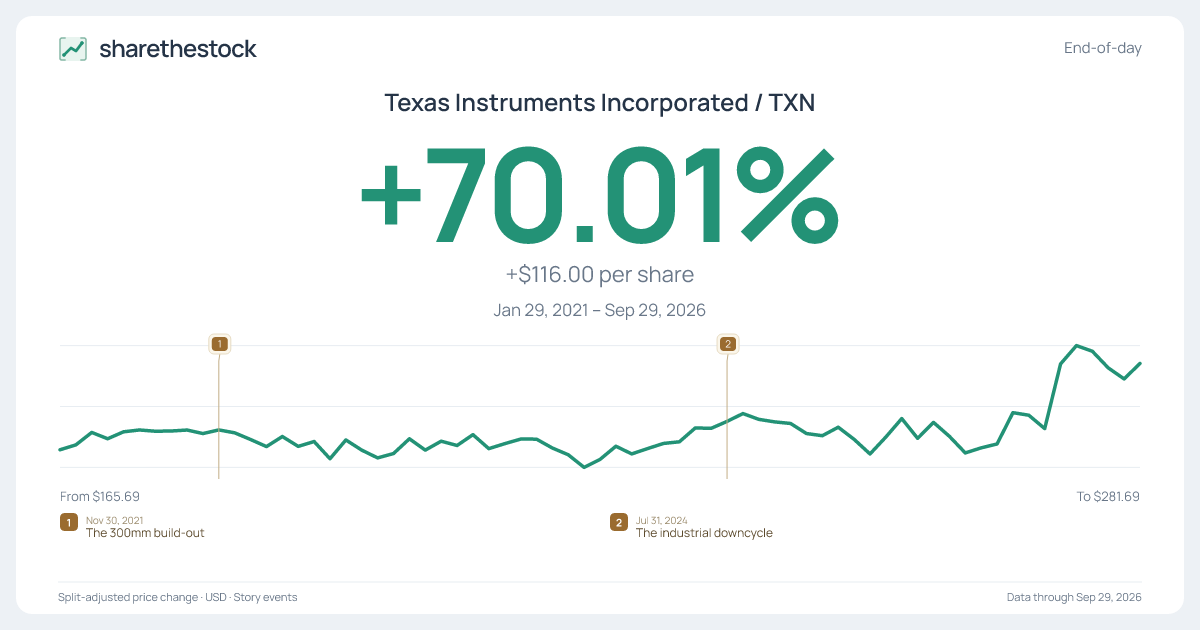
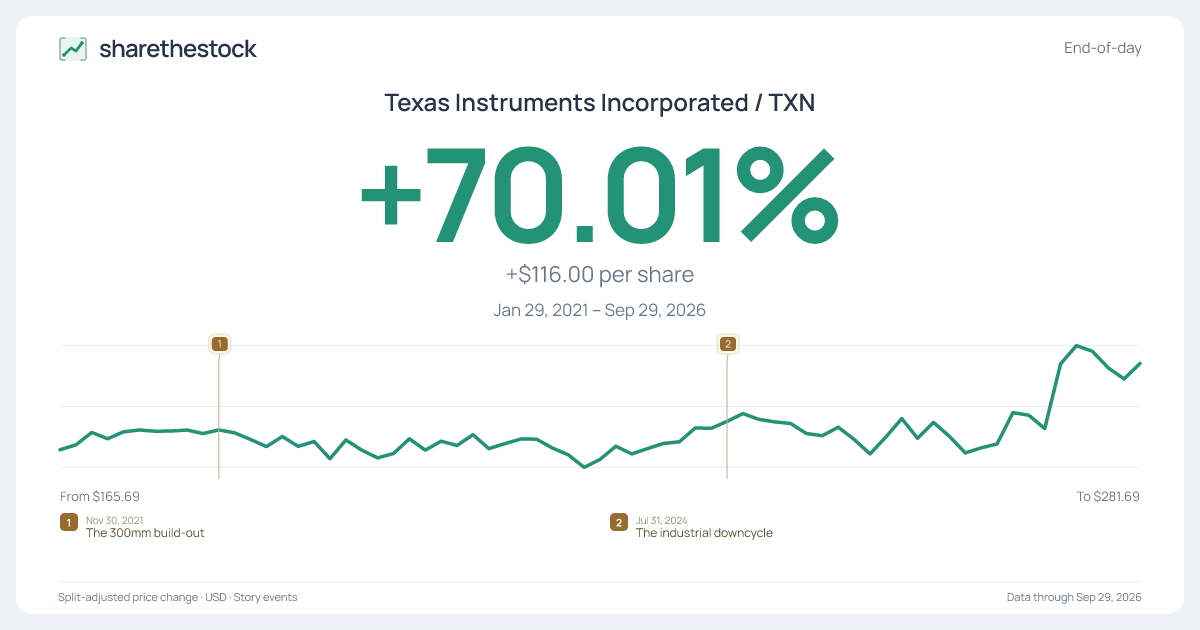
TI committed tens of billions to new 300mm capacity in Texas, compressing free cash flow for years in exchange for structurally lower costs — a genuinely contrarian bet made while an industrial downcycle was underway.
The 300mm build-outProduct
TI commits to Sherman, Texas and a multi-decade capacity plan, telling investors free cash flow will fall for years in exchange for lower cost per chip.
Closed $192.37 that month
The industrial downcycleCrisis
Inventory corrections in automotive and industrial markets cut revenue sharply while the capex commitments continue — the hardest part of the strategy to hold.