sharethestock

The company story

QUALCOMM Incorporated

XNAS: QCOM · USD · split-adjusted

Qualcomm won a standards fight nobody thought it could win, then discovered that the profitable part of its business was not the chips but the patents — and that everyone who paid the royalty would eventually sue to stop.

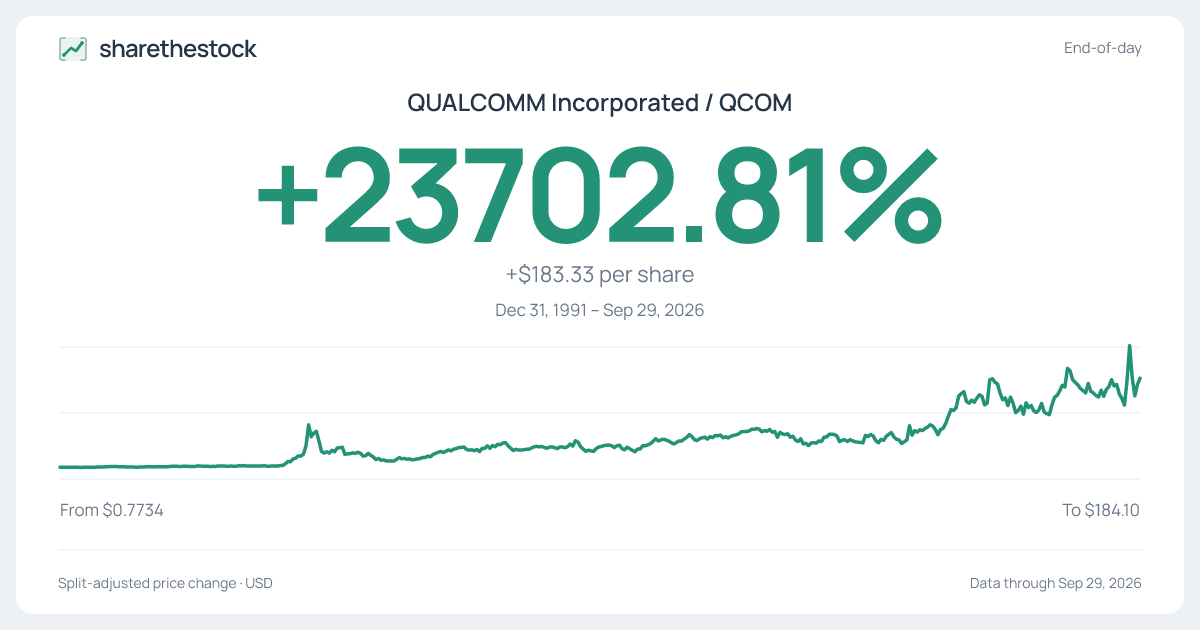
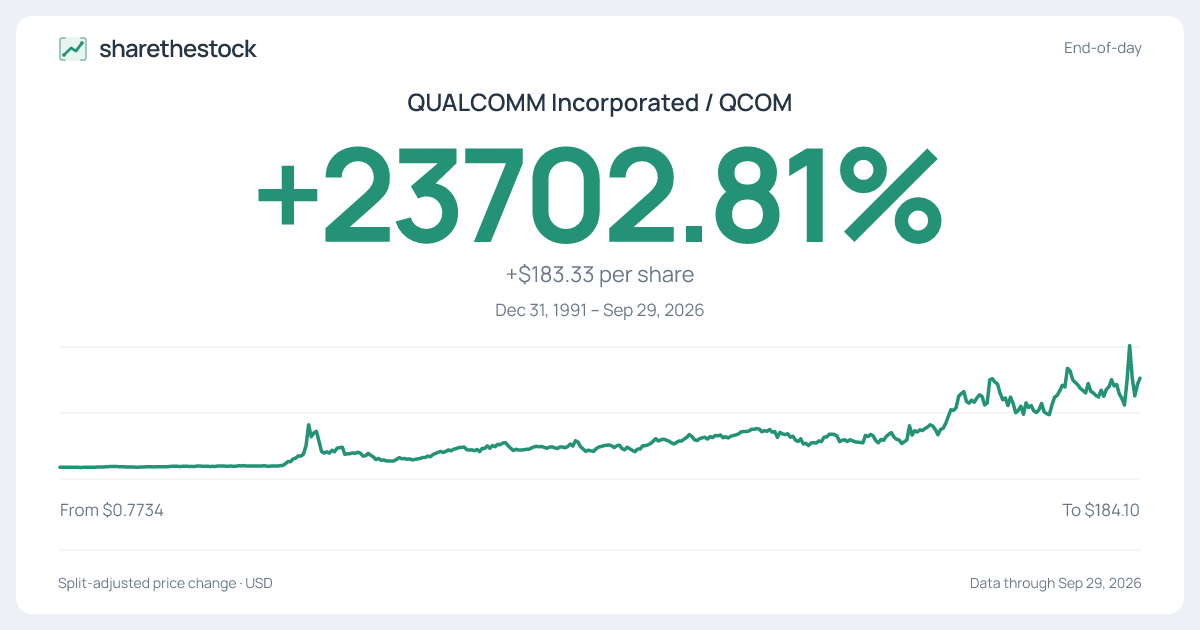
$0.7734first monthly close, Dec 1991 $184.10latest, Sep 29, 2026 +23702.81%since Dec 1991 $1,000 → $238,028.14first close to now
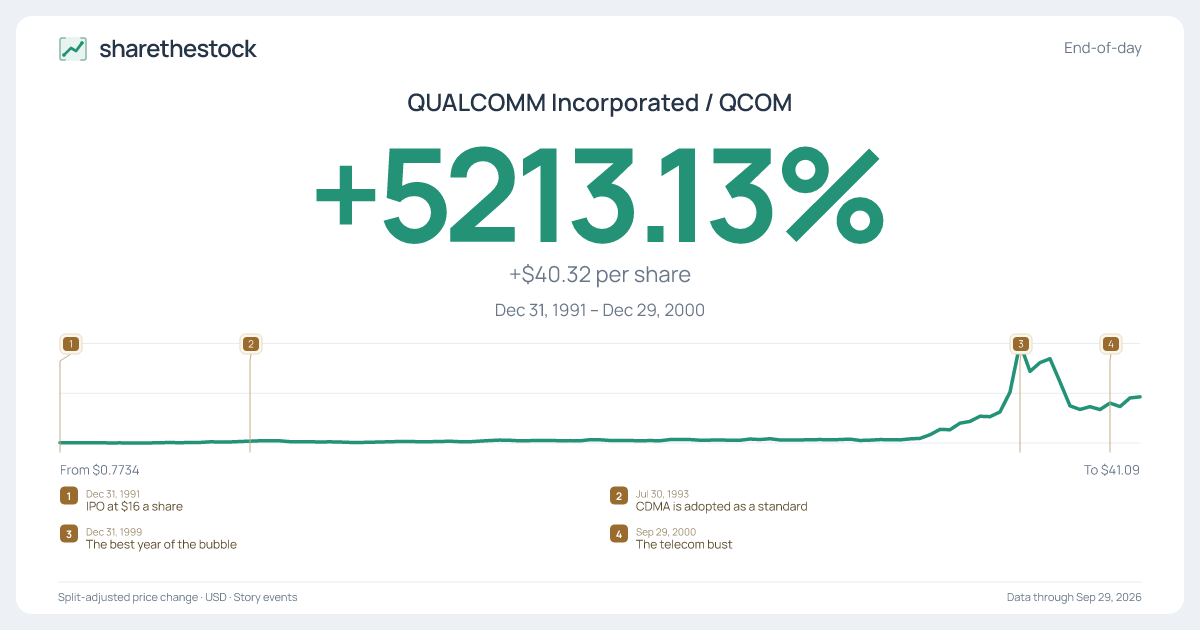
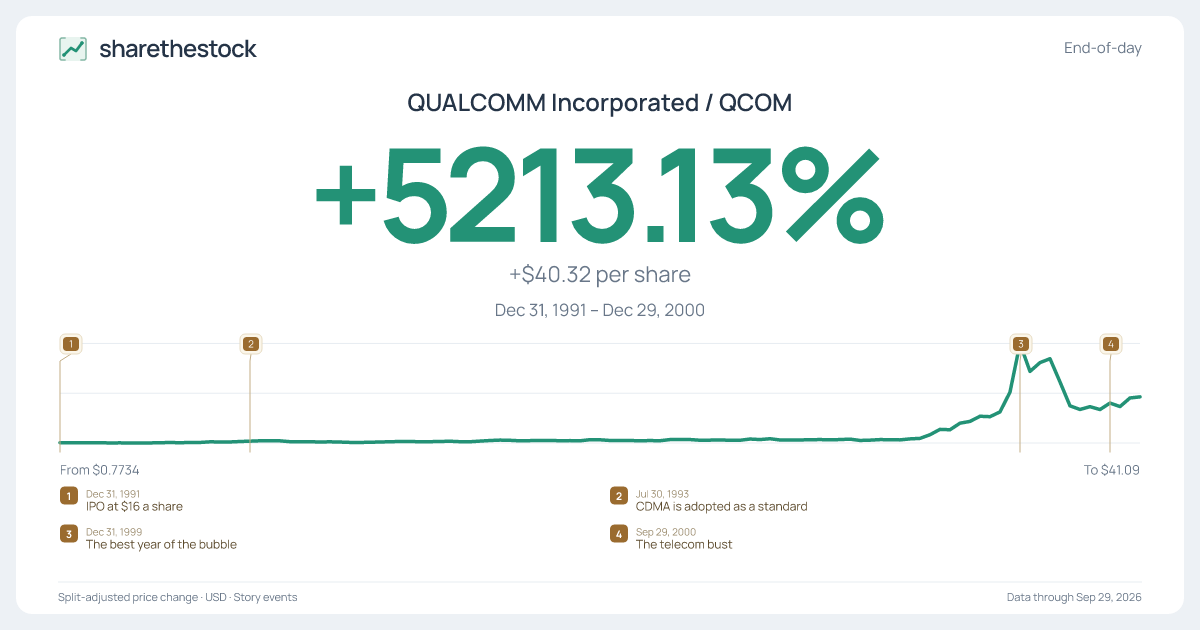
  1. 1CDMA against the worldDec 1991 – Dec 2000+5213.13%
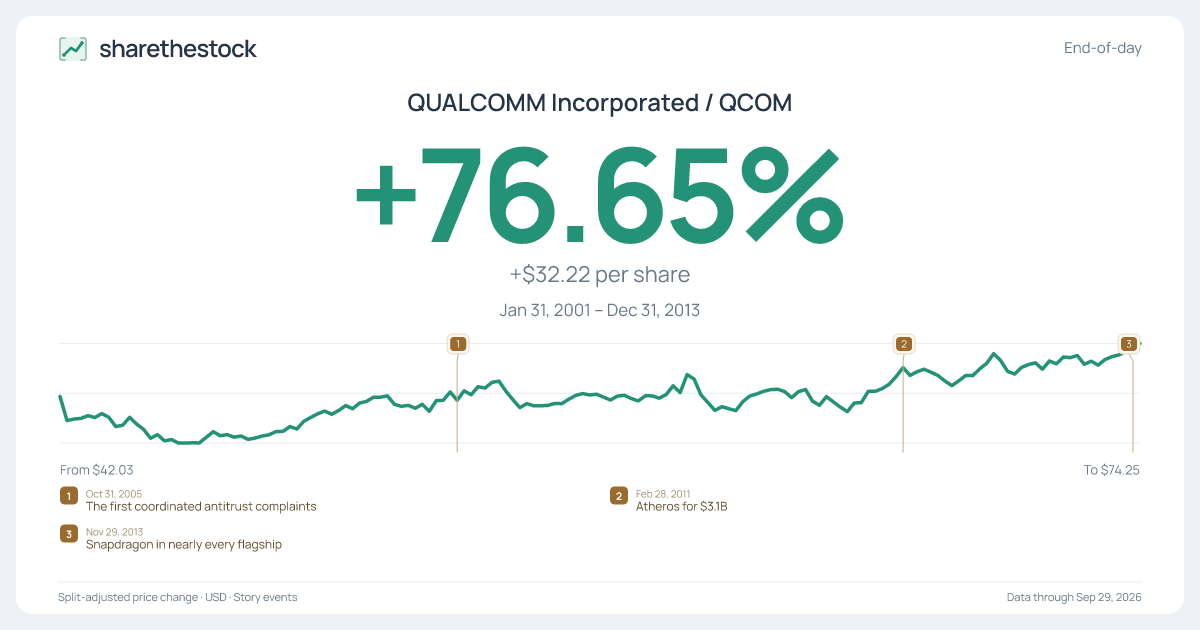
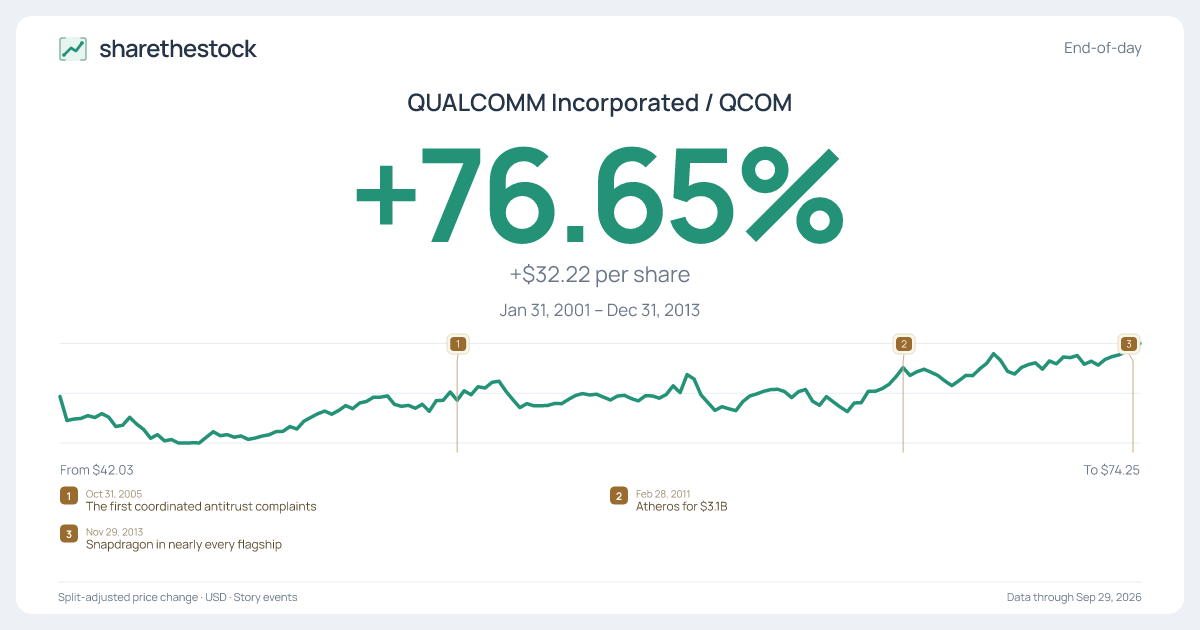
  2. 2The licensing machineJan 2001 – Dec 2013+76.65%
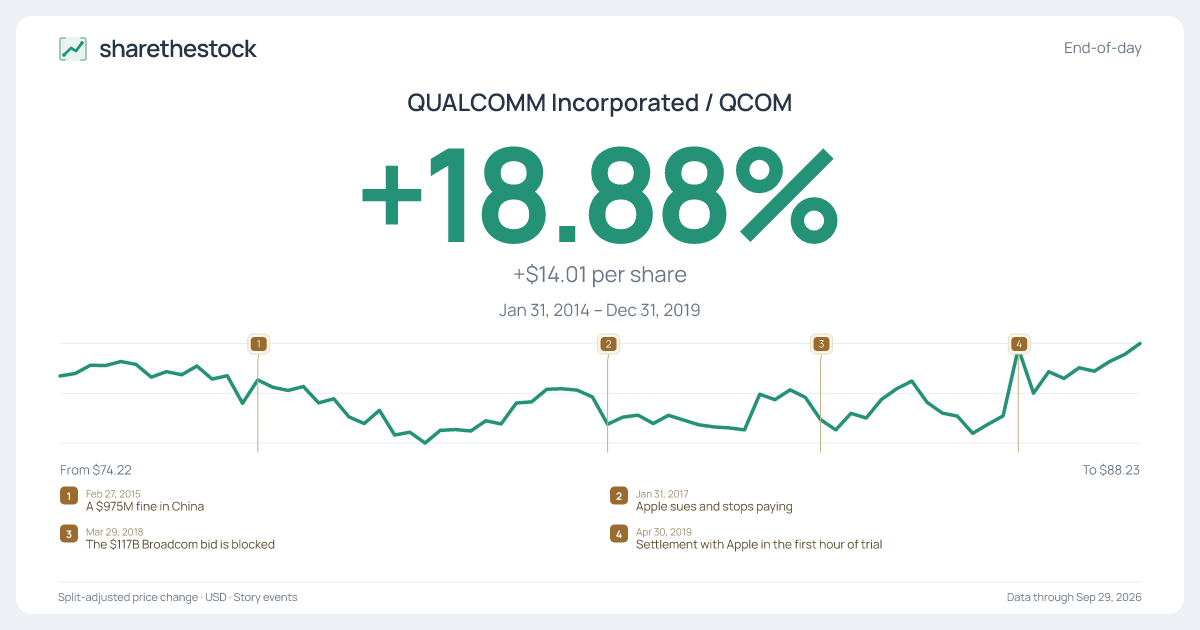
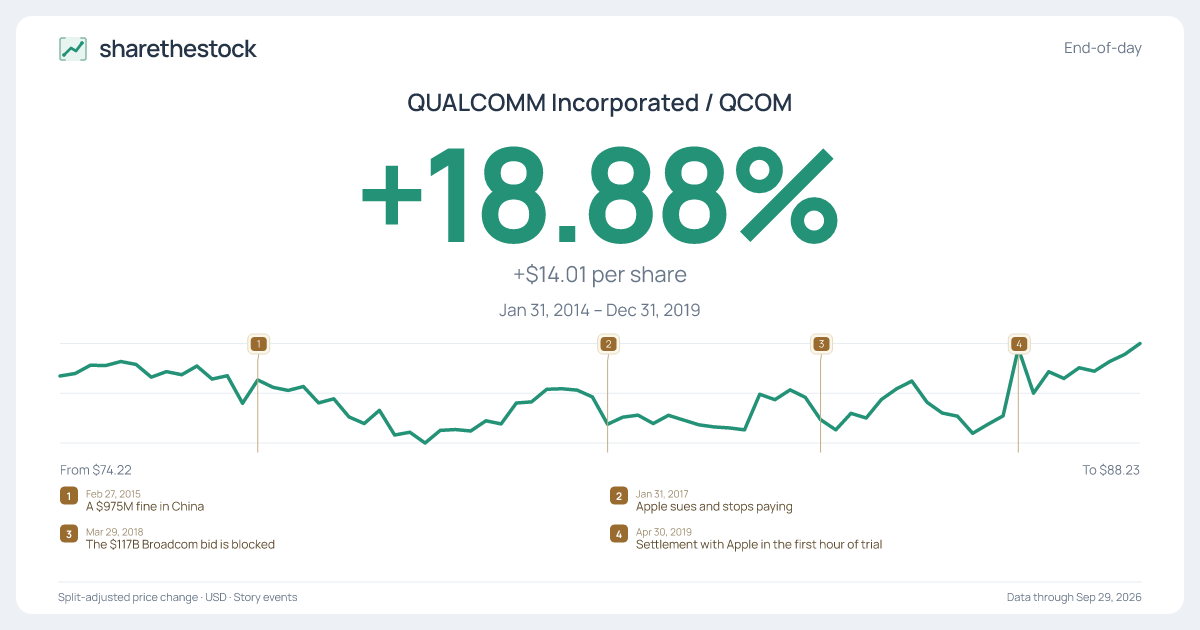
  3. 3The royalty warsJan 2014 – Dec 2019+18.88%
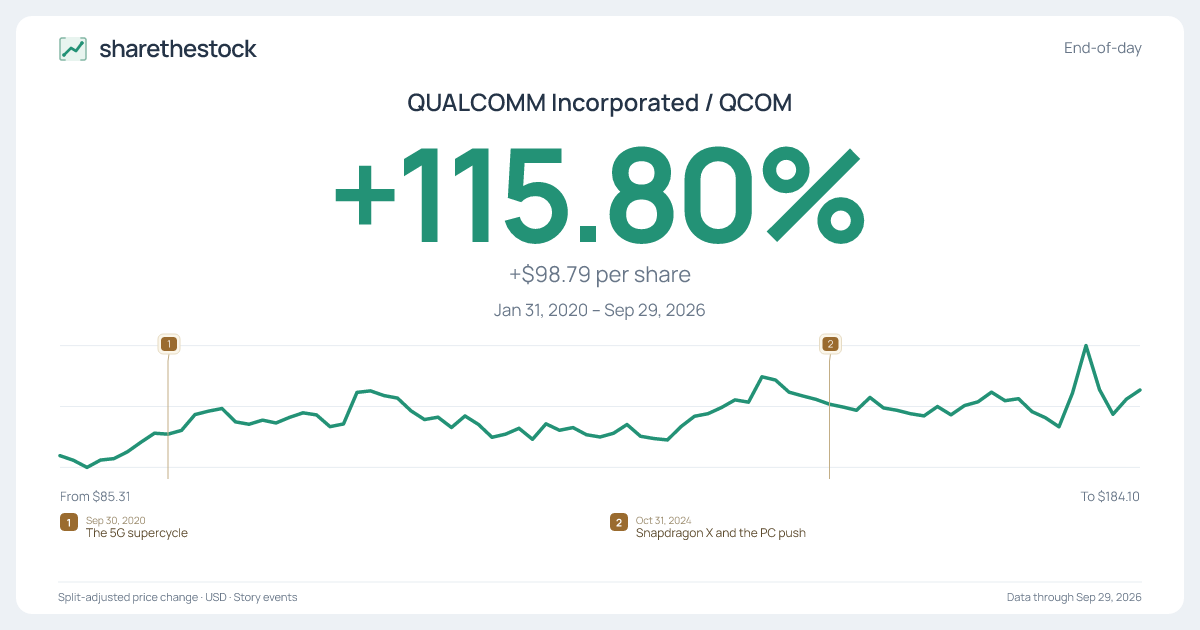
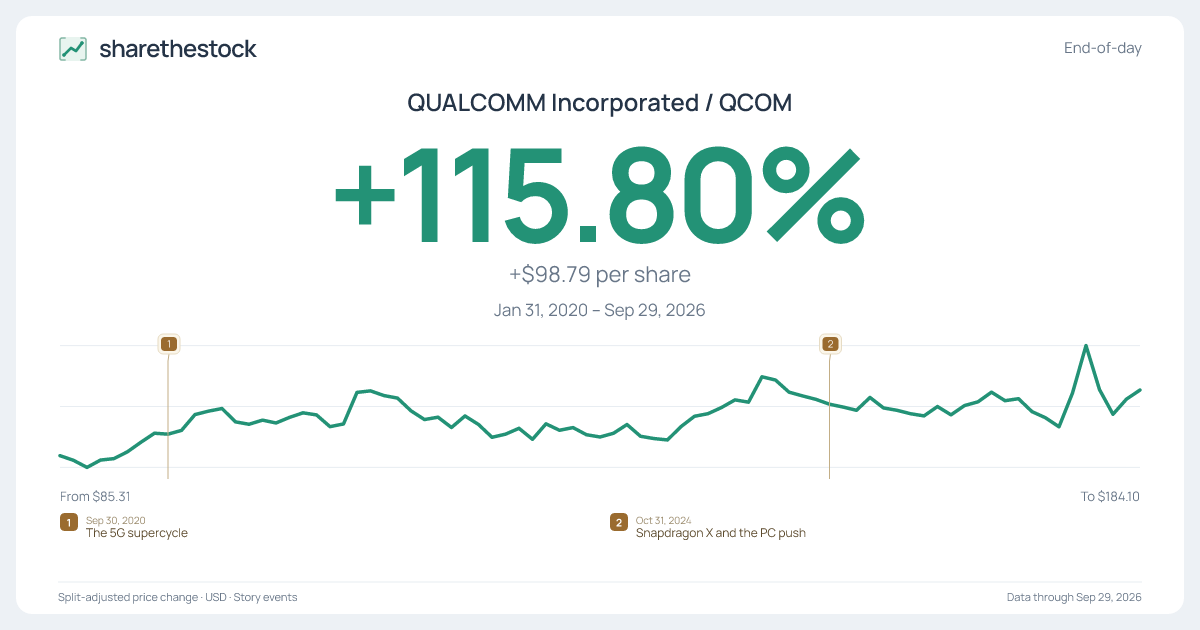
  4. 4Beyond the handsetJan 2020 – Sep 2026+115.80%

A standard the industry said was physically impossible

Irwin Jacobs built a company around a spread-spectrum technique that established carriers dismissed as a violation of the laws of physics. When CDMA became a 3G standard, Qualcomm owned the patents underneath the next twenty years of mobile — and the stock had the single best year of the dot-com era.

  1. Founded by Irwin Jacobs and six colleagues

    A communications-research company named for “quality communications”. Its first business is satellite tracking for trucking fleets; the cellular patents come later.

    Private company — no public price yet
  2. IPO at $16 a share

    A small offering for a company whose central technical claim the incumbent carriers publicly disputed.

    Closed $0.7734 that month
  3. CDMA is adopted as a standard

    The industry accepts the technology it had called impossible. Qualcomm’s patents move from research to the foundation of the digital cellular era.

    Closed $2.10 that month
  4. The best year of the bubble

    The stock rises more than 2,500% in twelve months as 3G expectations and a famous $1,000 price target arrive together. It is among the largest single-year gains ever recorded by a large company.

    Closed $88.06 that month
  5. The telecom bust

    3G deployments slip, handset forecasts collapse, and the stock loses roughly 85% of its value. The royalty base keeps growing through it.

    Closed $35.63 that month
A percentage of the whole handset

Qualcomm charged royalties on the price of the entire phone rather than the chip inside it, and became the most profitable business in mobile without selling anything to consumers. Snapdragon made it the modem and processor of choice at the same time.

  1. The first coordinated antitrust complaints

    Six companies including Nokia and Ericsson complain to Brussels about the licensing model. It is the opening of a legal campaign that lasts fifteen years.

    Closed $39.76 that month
  2. Atheros for $3.1B

    Wi-Fi and connectivity, bundled with the modem. Qualcomm starts selling a platform rather than a component.

    Closed $59.58 that month
  3. Snapdragon in nearly every flagship

    The combination of the best modem and a competitive application processor makes Qualcomm the default silicon for Android at the top of the market.

    Closed $73.58 that month

Everyone sues at once

China fined it, Korea fined it, the FTC sued it, Apple stopped paying, and Broadcom tried to buy it for $117B. The model survived, mostly intact, after the largest concentrated legal assault any technology licensing business has faced.

  1. A $975M fine in China

    The NDRC settlement forces changes to how Qualcomm licenses in its largest market, and establishes that regulators can reprice the royalty.

    Closed $72.51 that month
  2. Apple sues and stops paying

    Two years of litigation over royalties, a parallel FTC case, and Apple shifting modem orders to Intel. Qualcomm loses the revenue and the argument at the same time.

    Closed $53.43 that month
  3. The $117B Broadcom bid is blocked

    CFIUS stops the largest technology acquisition ever attempted on national-security grounds, citing the risk of losing US leadership in 5G standards.

    Closed $55.41 that month
  4. Settlement with Apple in the first hour of trial

    Apple pays, signs a multi-year licence and buys modems again. Qualcomm’s stock rises 23% in a day and the licensing model is validated by the customer that attacked it.

    Closed $86.13 that month

Diversifying away from its biggest customer

With Apple building its own modem, Qualcomm spent the 5G cycle pushing into cars, industrial devices and PCs — trying to convert a mobile royalty into a broader silicon franchise before the handset concentration became a problem.

  1. The 5G supercycle

    Every handset upgrade carries a higher royalty and more Qualcomm silicon. It is the most profitable stretch in the company’s history.

    Closed $117.68 that month
  2. Snapdragon X and the PC push

    Arm-based Windows laptops become the clearest attempt yet to find a second market as large as the phone, with Apple’s in-house modem now a scheduled loss.

    Closed $162.77 that month

The whole arc

+23702.81% in 35 years

One chart, Dec 31, 1991 – Sep 29, 2026. Open it, drag a range, add your own markers — or take this card with you.