sharethestock

The company story

Oracle Corporation

XNYS: ORCL · USD · split-adjusted

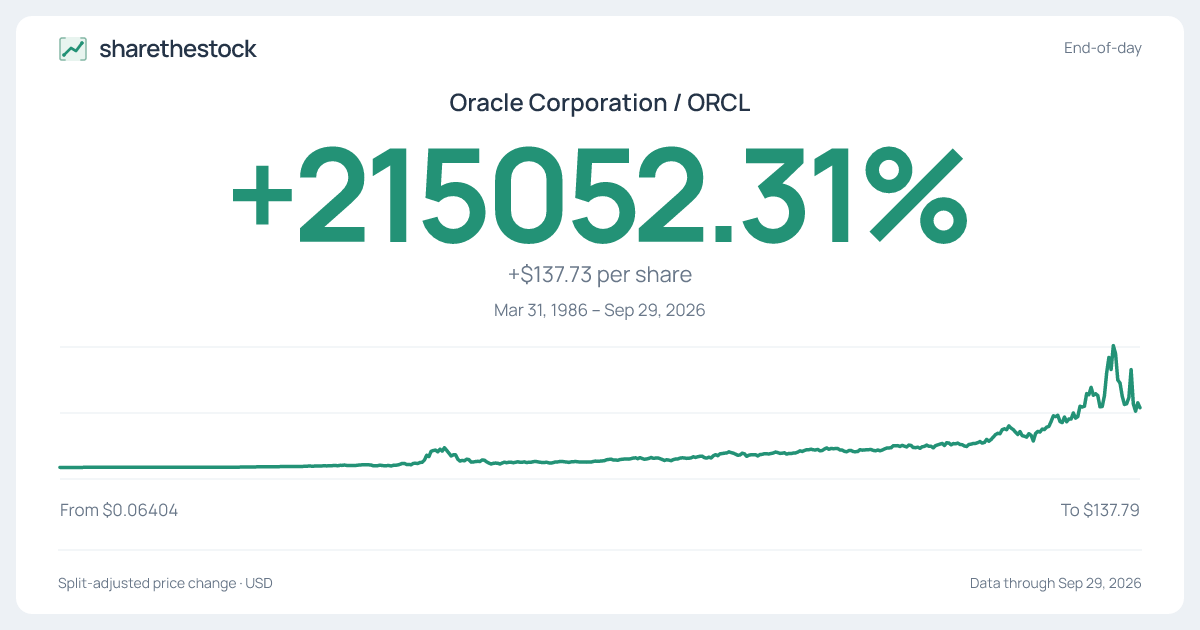
Oracle has been written off as legacy in every decade since the 1990s, and has answered each time by acquiring whatever was declared to be replacing it. The chart is the record of a company that treats software as a consolidation business.

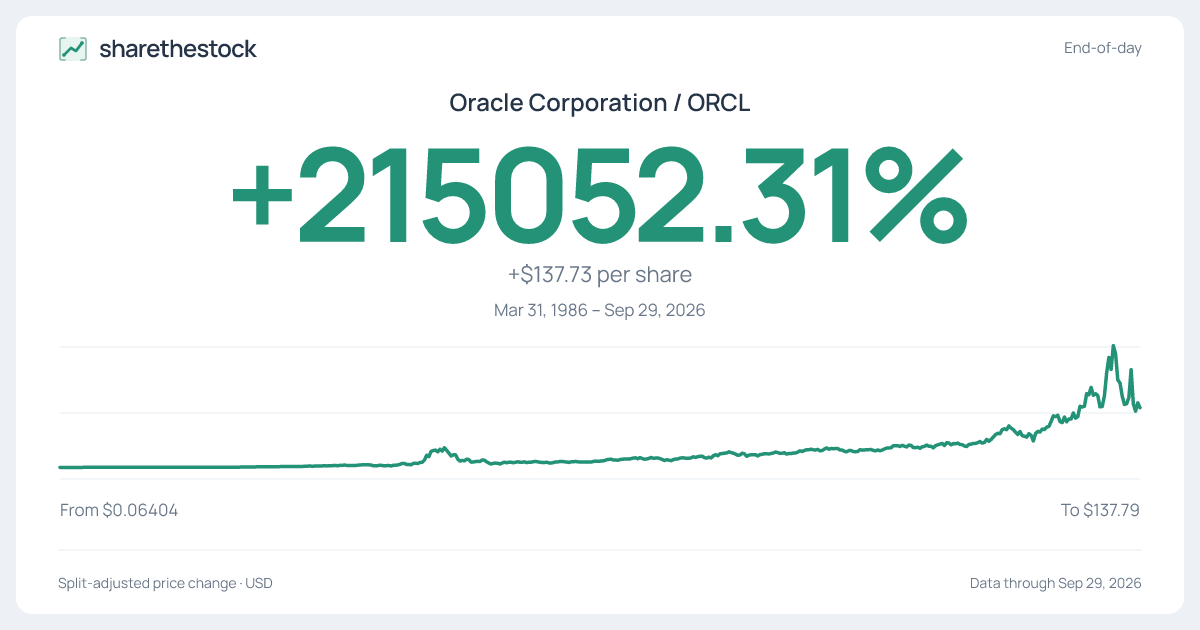
$0.06404first monthly close, Mar 1986 $137.79latest, Sep 29, 2026 +215052.31%since Mar 1986 $1,000 → $2,151,523.09first close to now
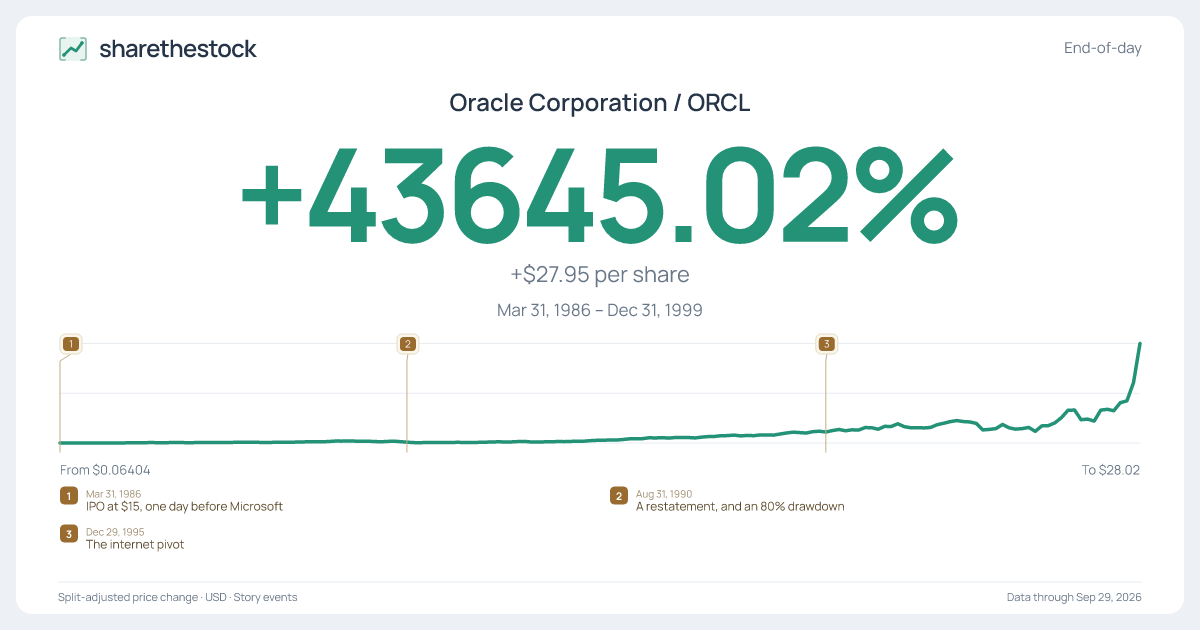
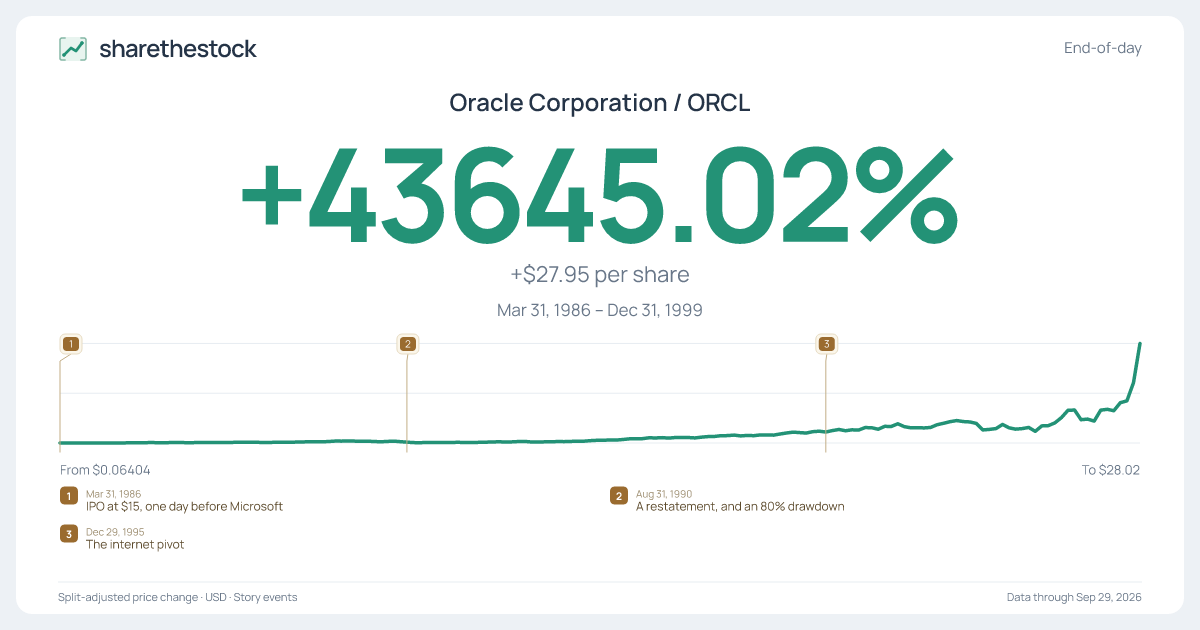
  1. 1The databaseMar 1986 – Dec 1999+43645.02%
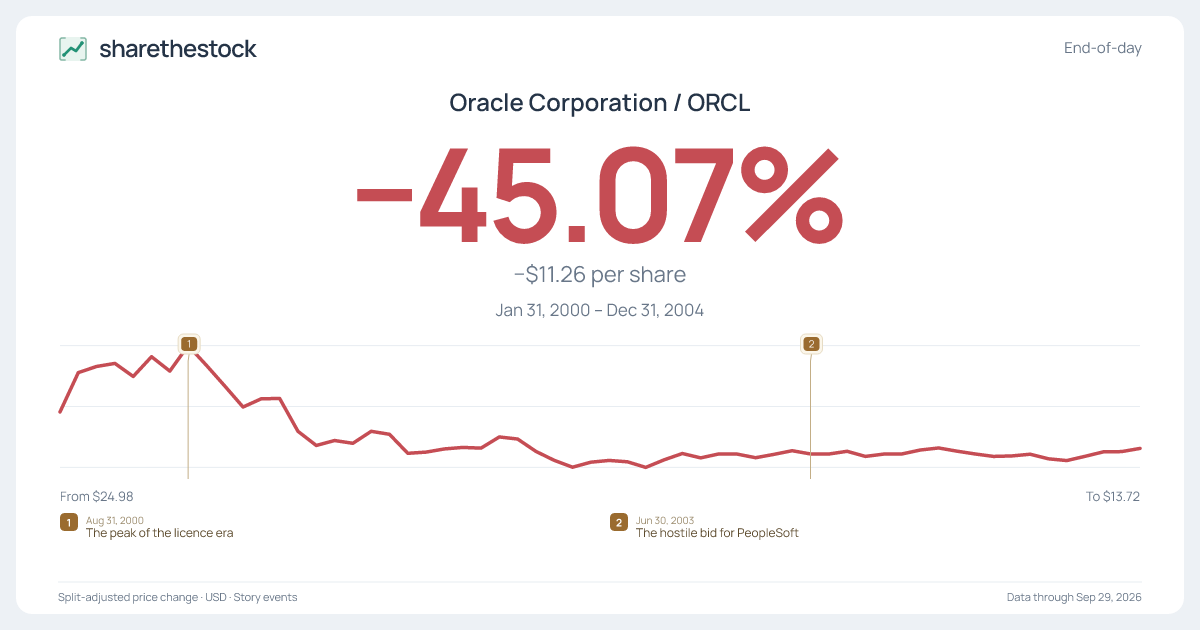
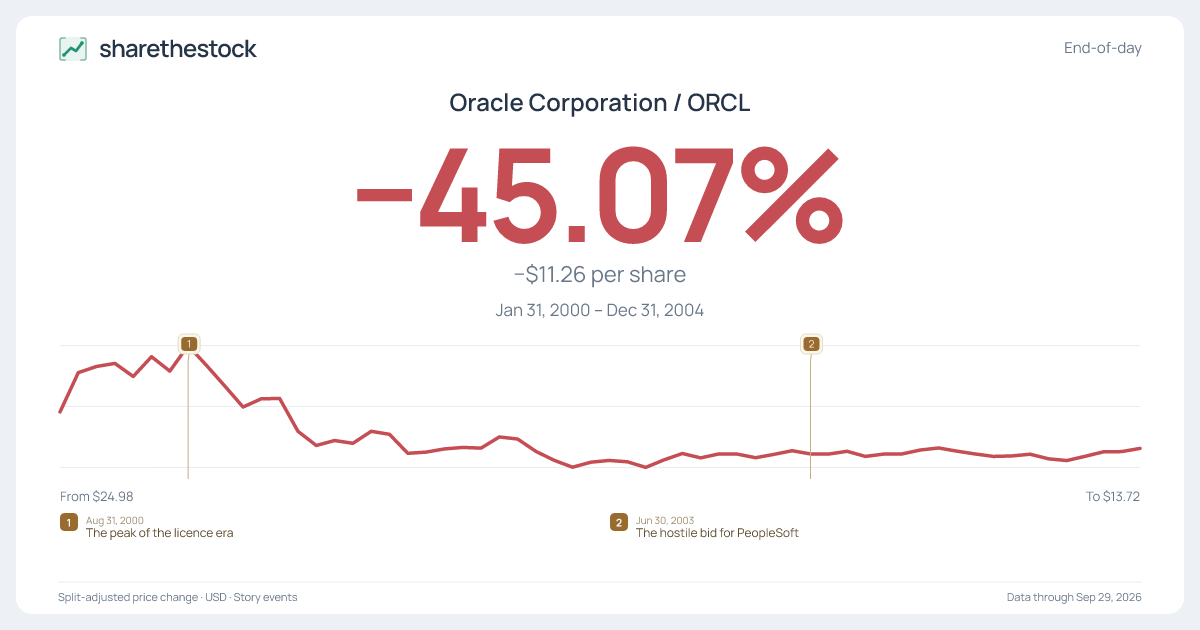
  2. 2The bubble and the bustJan 2000 – Dec 2004−45.07%
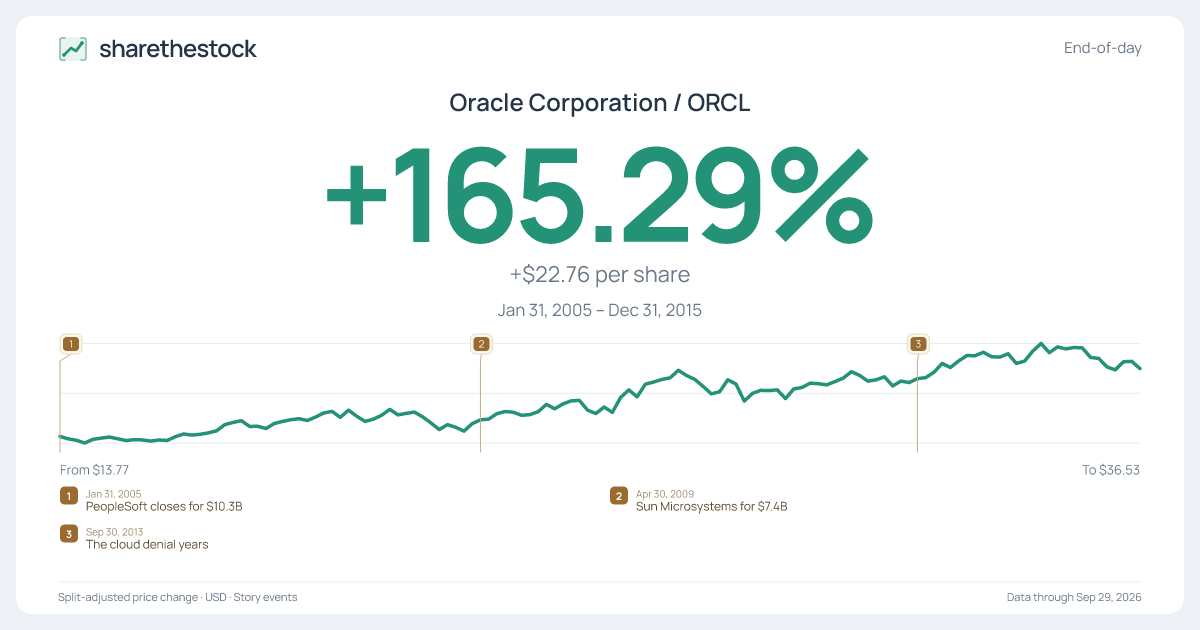
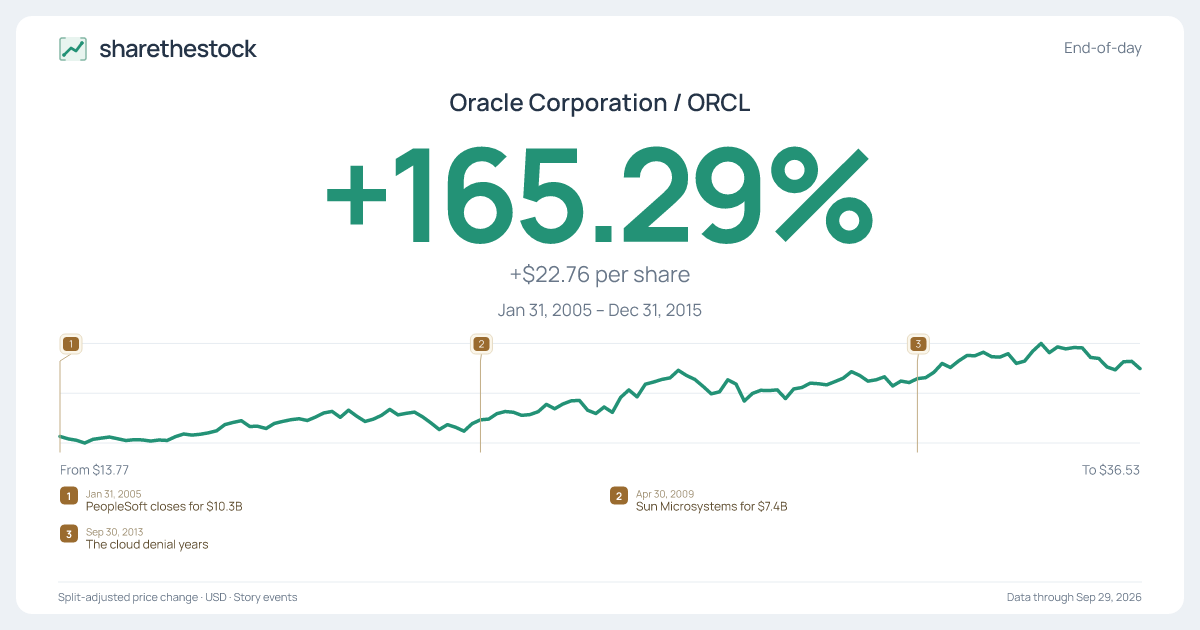
  3. 3Buying the enterpriseJan 2005 – Dec 2015+165.29%
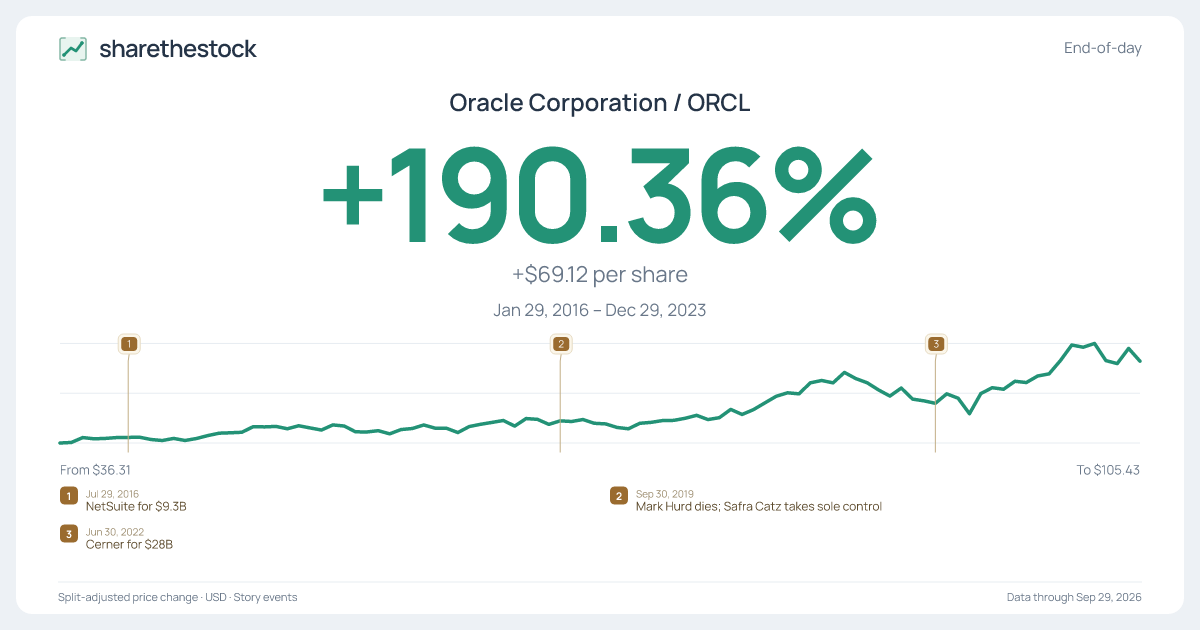
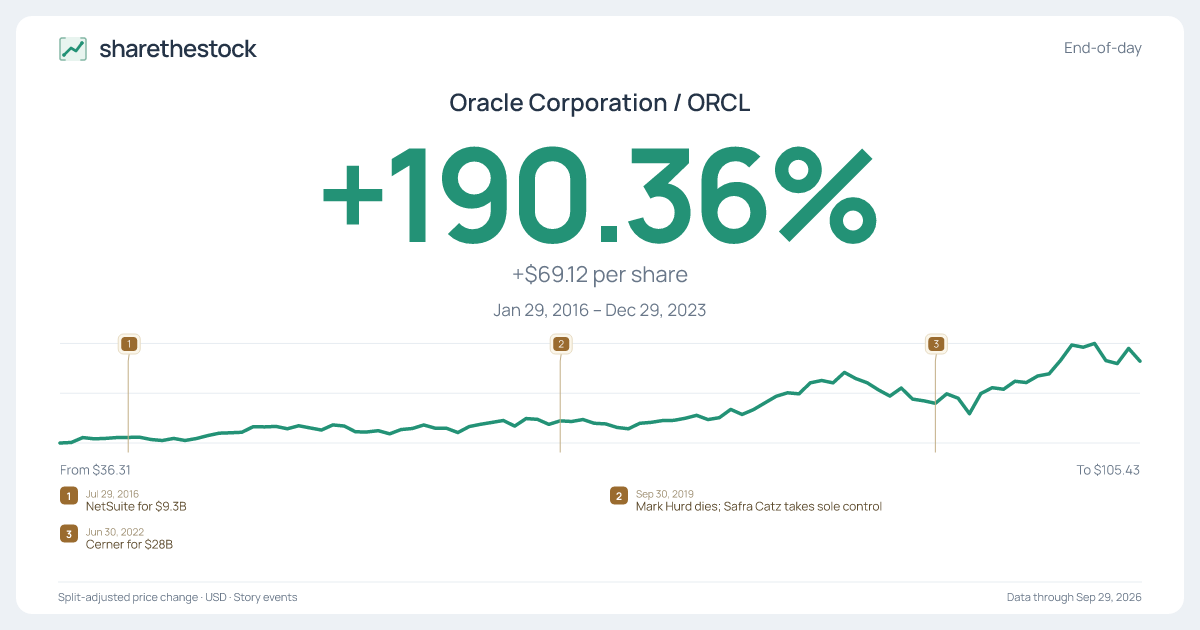
  4. 4The cloud apologyJan 2016 – Dec 2023+190.36%
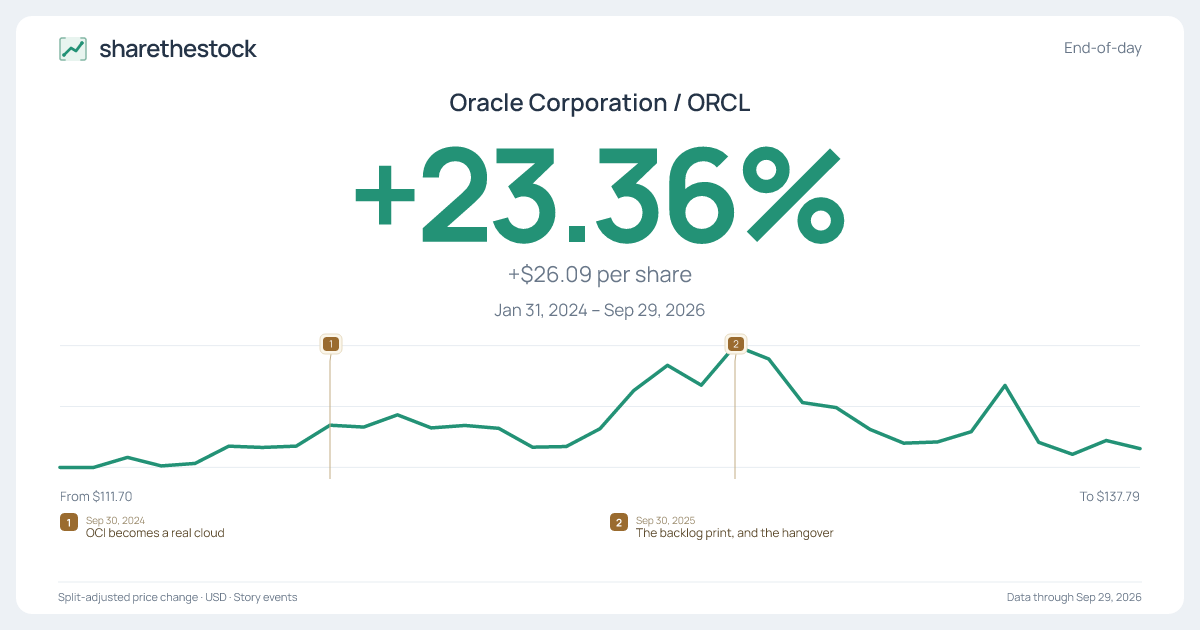
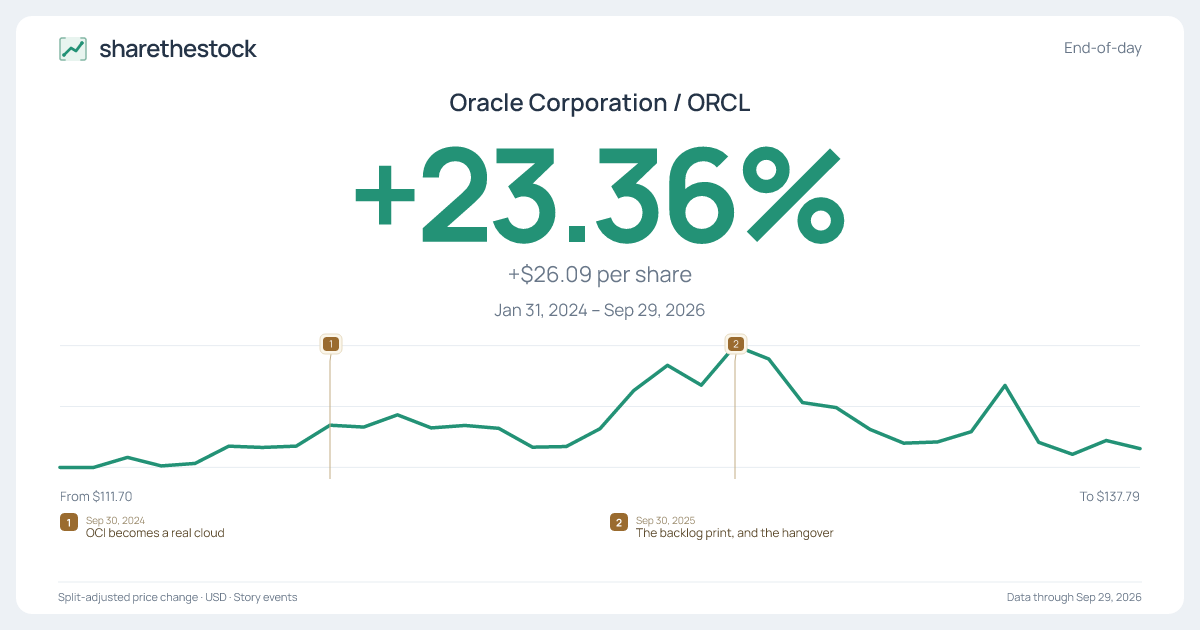
  5. 5The AI landlordJan 2024 – Sep 2026+23.36%

Selling SQL before anyone had asked for it

Larry Ellison read IBM’s own research paper on relational databases and built the commercial product IBM had not bothered to ship. Oracle went public one day before Microsoft and spent the next decade selling the system of record for the corporate world.

  1. Founded as Software Development Laboratories

    Ellison, Bob Miner and Ed Oates start with $2,000 and a CIA contract codenamed Oracle. The product is built from an IBM paper IBM chose not to commercialise.

    Private company — no public price yet
  2. The first commercial SQL database ships

    Version 2 — there was never a version 1, because nobody buys version 1. The naming decision is a fair summary of the company’s attitude to marketing.

    Private company — no public price yet
  3. IPO at $15, one day before Microsoft

    A $31.5M raise. The two offerings that week end up defining enterprise and consumer software for the next forty years.

    Closed $0.06404 that month
  4. A restatement, and an 80% drawdown

    Aggressive revenue recognition catches up with the company, the numbers are restated, and Oracle nearly runs out of cash. It installs real financial controls and never repeats it.

    Closed $0.287 that month
  5. The internet pivot

    Ellison reframes Oracle as the database behind every website, and the network-computer era gives the stock its best run of the decade.

    Closed $3.14 that month
Down 80%, and shopping

The dot-com collapse took most of Oracle’s value with it while licence revenue fell for the first time. Its response was to conclude that enterprise software was a mature industry, and that the correct strategy in a mature industry is to own it.

  1. The peak of the licence era

    Every dot-com is buying a database. When they stop, revenue falls and the stock loses most of its value in two years.

    Closed $45.47 that month
  2. The hostile bid for PeopleSoft

    An eighteen-month fight involving poison pills, a DOJ antitrust trial and a competing customer-refund scheme. Oracle wins and establishes that it will buy competitors over their objections.

    Closed $12.01 that month

A hundred acquisitions, starting with a hostile one

PeopleSoft, Siebel, BEA, Sun. Oracle turned applications into a portfolio, support contracts into an annuity, and the stock into a steady compounder that almost nobody described as exciting.

  1. PeopleSoft closes for $10.3B

    The acquisition machine starts in earnest: Siebel, Hyperion, BEA and dozens more follow, each one folded into the same support annuity.

    Closed $13.77 that month
  2. Sun Microsystems for $7.4B

    Oracle buys hardware, Java and MySQL. The hardware turns out to be a distraction; owning Java turns out to be leverage over the entire enterprise stack.

    Closed $19.34 that month
  3. The cloud denial years

    Oracle insists its on-premise model is superior while Salesforce and AWS take the new workloads. Growth stalls and the stock underperforms software for half a decade.

    Closed $33.17 that month

Late, loud, and eventually competitive

Oracle spent years insisting the cloud was hype, then rebuilt its infrastructure business from scratch, bought NetSuite and Cerner, and discovered that the customers who never left the database were willing to rent compute from it too.

  1. NetSuite for $9.3B

    Buying the cloud ERP company Ellison had personally funded at the start. It is the point where Oracle stops arguing with the cloud and starts paying for a position in it.

    Closed $41.04 that month
  2. Mark Hurd dies; Safra Catz takes sole control

    The co-CEO structure ends and the executive who spent a decade on cost discipline runs the company through the infrastructure build-out.

    Closed $55.03 that month
  3. Cerner for $28B

    The largest deal in Oracle’s history buys the health-records business, and with it a decade of migration work and an enormous integration risk.

    Closed $69.87 that month

Backlog becomes the whole story

Signing multi-year capacity contracts with AI labs turned Oracle into one of the most talked-about stocks in the market, and reintroduced a risk it had not carried in decades: the balance sheet cost of building what it has promised.

  1. OCI becomes a real cloud

    Multi-cloud deals with AWS, Azure and Google put Oracle’s database inside its competitors’ data centers, and the infrastructure backlog starts compounding.

    Closed $170.40 that month
  2. The backlog print, and the hangover

    Oracle discloses a remaining-performance-obligation number that implies hundreds of billions of future AI revenue, and the stock has its best day since 1992 — then spends the following year answering questions about the debt and margins required to deliver it.

    Closed $281.24 that month

The whole arc

+215052.31% in 40 years

One chart, Mar 31, 1986 – Sep 29, 2026. Open it, drag a range, add your own markers — or take this card with you.