How a graphics chip company for video games became the most valuable company on earth.
Three engineers who met at a Denny’s bet that the future of computing was parallel. It took thirty years, two near-death experiences, and one research paper about cats on YouTube for the rest of the world to agree.
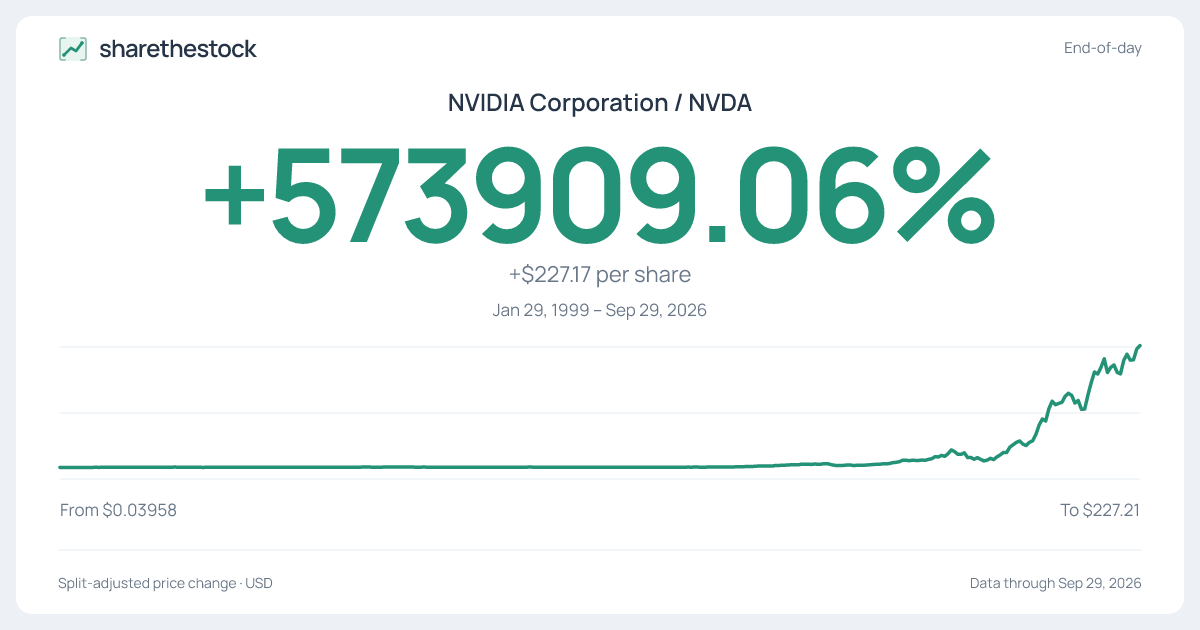
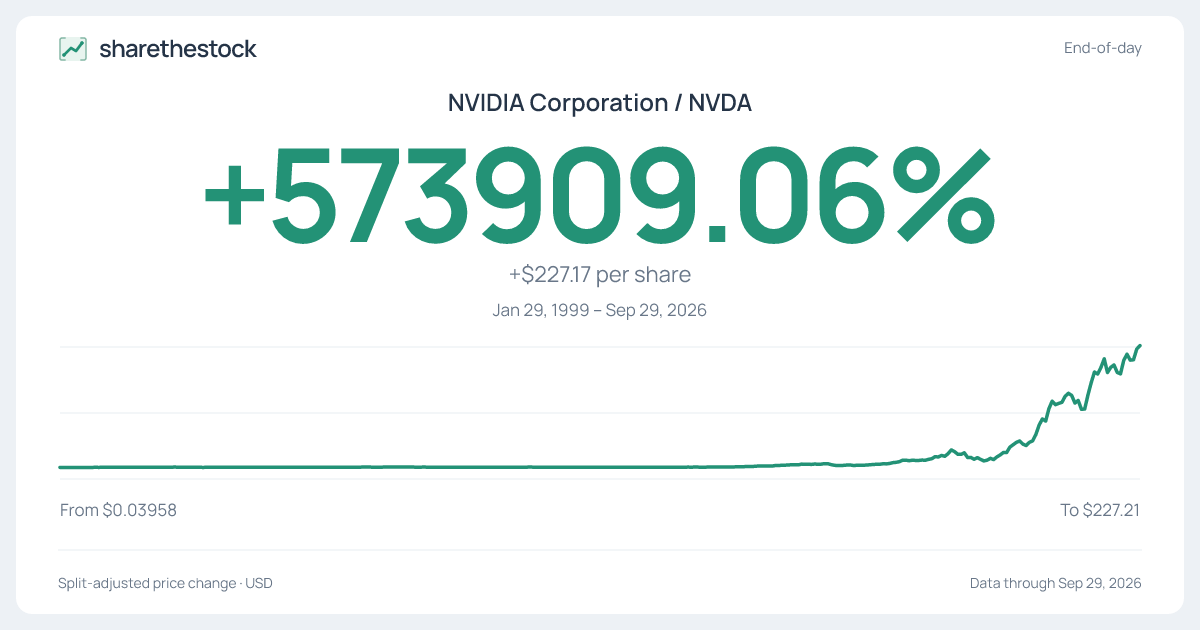
$0.03958first monthly close, Jan 1999$227.21latest, Sep 29, 2026+573909.06%since Jan 1999$1,000 → $5,740,090.62first close to now
A chip company that almost didn’t make it to the IPO
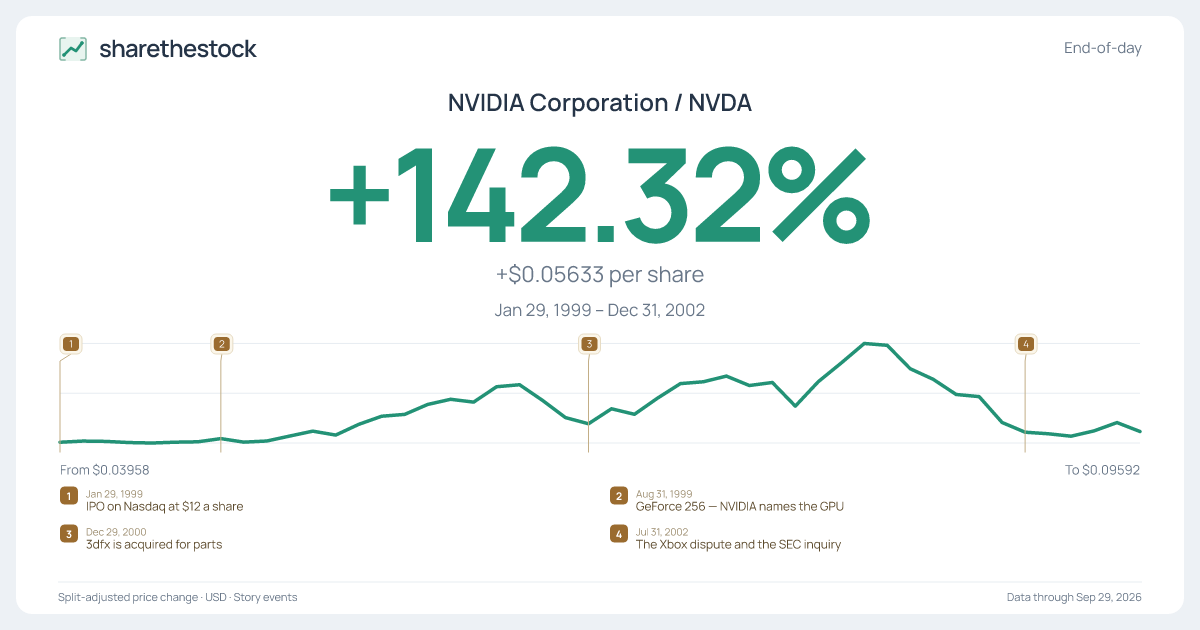
NVIDIA went public in January 1999 as one of dozens of graphics-card makers. Its first real product had already failed. What it had instead was a cadence — a new architecture every six months — that competitors could not match, and a word it invented for what it sold: the GPU.
Founded in a Denny’s on Berryessa RoadFounding
Jensen Huang, Chris Malachowsky and Curtis Priem start a company around one bet: that dedicated, parallel graphics hardware will win over general-purpose CPUs. They pick the name from ‘invidia’ and give themselves about a year of runway.
Private company — no public price yet
The first product failsCrisis
The NV1 uses quadratic surfaces just as Microsoft standardises on triangles in Direct3D. Sales collapse, the company cuts to roughly forty people, and Huang later says NVIDIA was thirty days from insolvency — a state he claims it returned to repeatedly.
Private company — no public price yet
RIVA 128 saves the companyProduct
Built with a simulator instead of physical prototypes because there was no money for a second tape-out, it ships a million units in four months and sets the six-month release cadence that becomes the company’s core weapon.
Private company — no public price yet
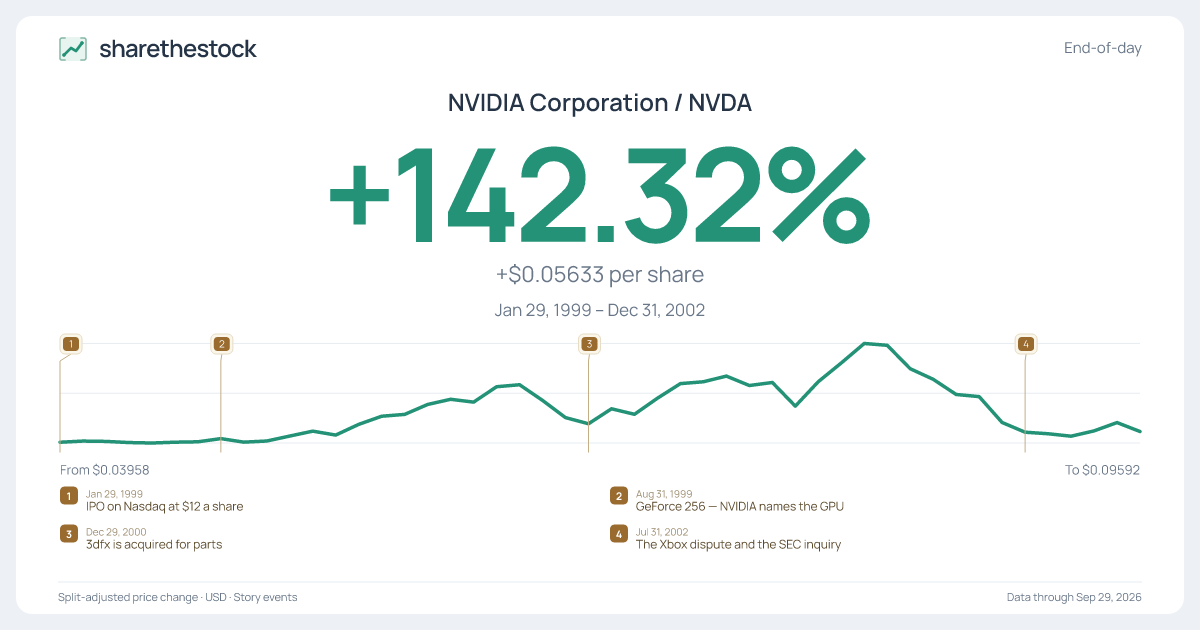
IPO on Nasdaq at $12 a shareMarket
A roughly $626M valuation. Adjusted for the four splits since, the offer price is about a cent and a half per share.
Closed $0.03958 that month
GeForce 256 — NVIDIA names the GPUProduct
Hardware transform and lighting moves work off the CPU and onto the card. The marketing term ‘graphics processing unit’ sticks, and with it the idea that this chip is a processor rather than a peripheral.
Closed $0.05859 that month
3dfx is acquired for partsDeal
The rival that defined 3D gaming sells its assets and patents after losing the cadence war. NVIDIA hires much of the engineering team.
Closed $0.1365 that month
The Xbox dispute and the SEC inquiryCrisis
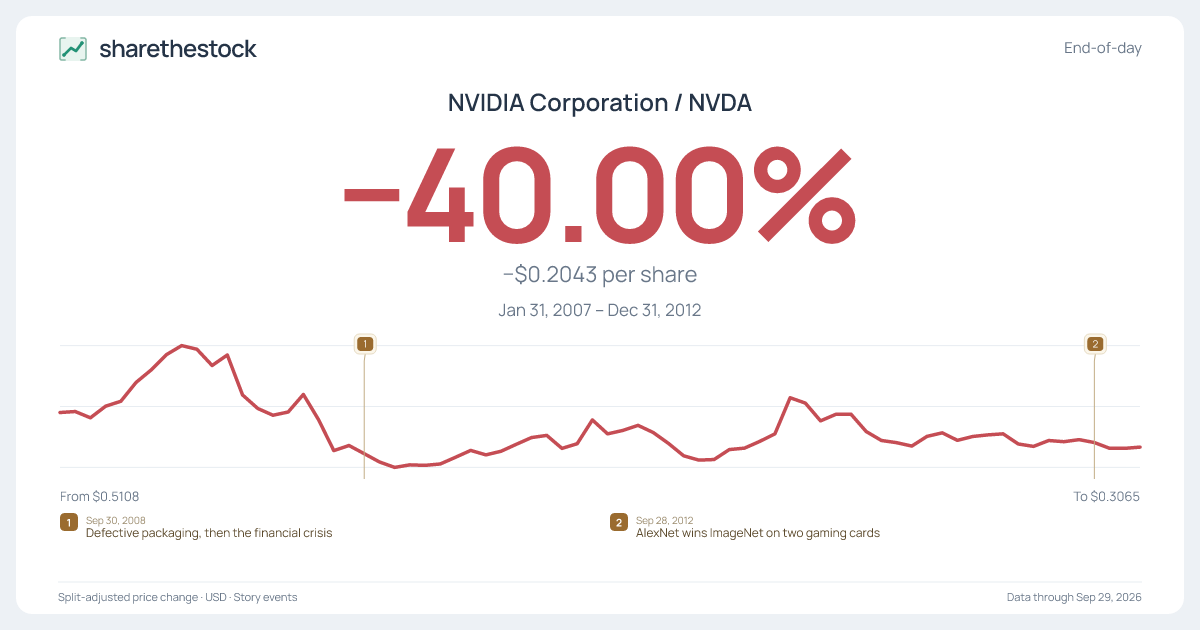
Microsoft disputes chip pricing, the design win becomes an arbitration, and an SEC investigation into reserve accounting follows. The stock falls roughly 90% from its 2002 high; it will take years to recover.
Winning the Xbox, then learning what one customer costs
The Microsoft deal made NVIDIA a household chip and then nearly broke it: a pricing dispute, an SEC inquiry into the accounting, and a stock that gave back most of the bubble. The company emerged with a habit that defined the next decade — build the platform, not the design win.
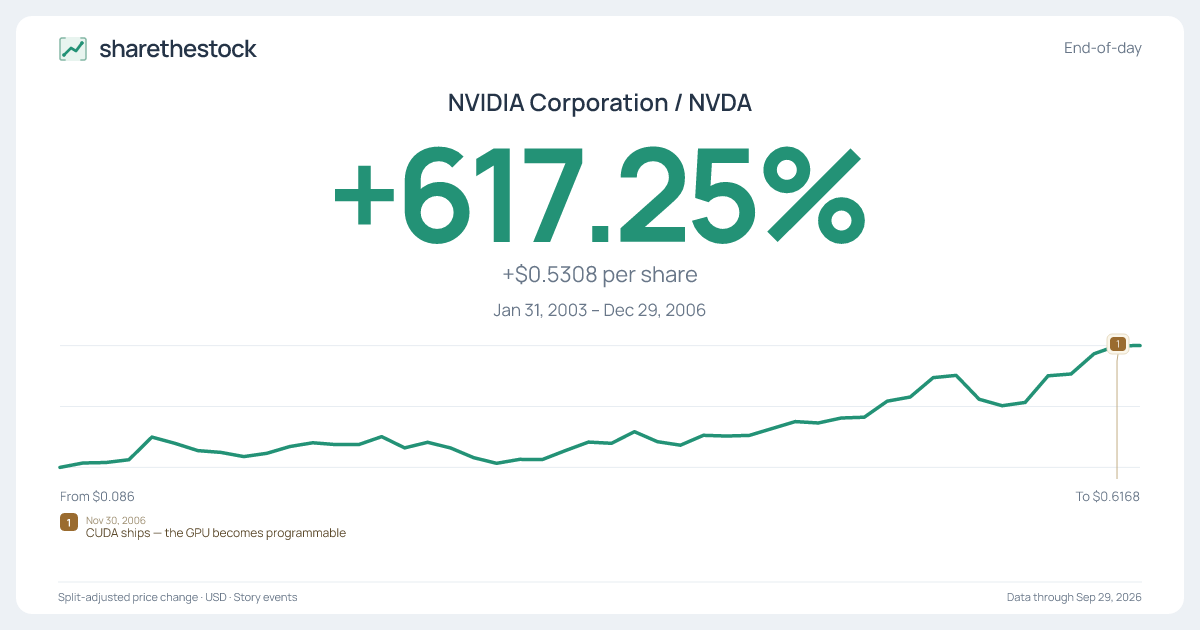
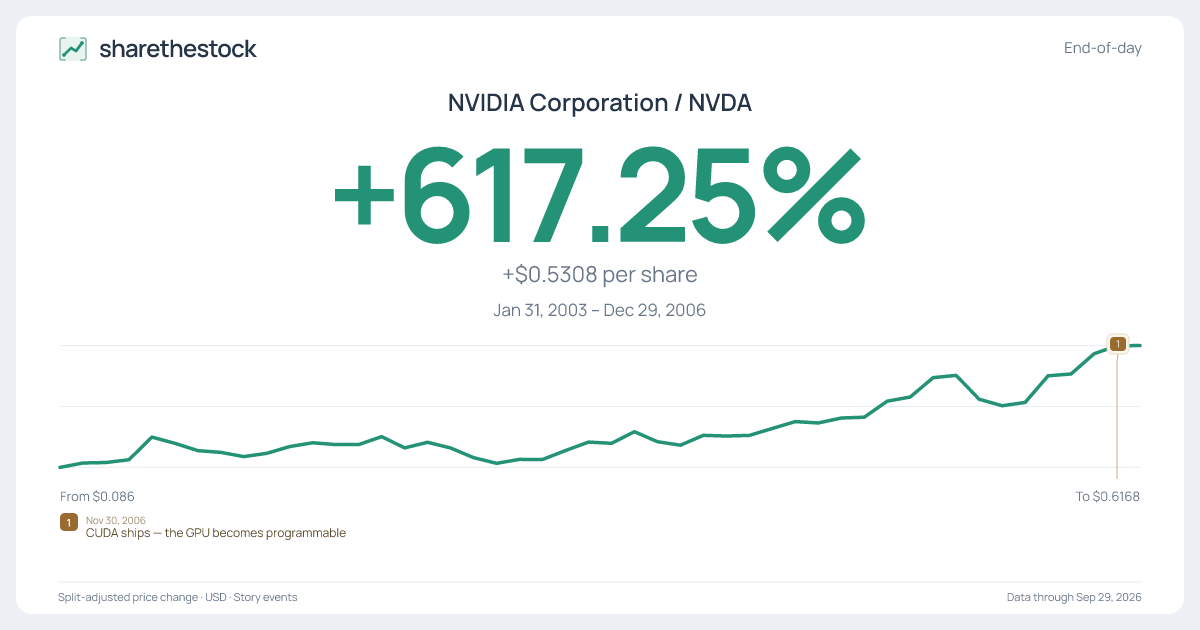
CUDA ships — the GPU becomes programmableProduct
A C-like toolchain lets scientists run general computation on graphics silicon. There is no market for it yet. NVIDIA funds it anyway, including transistors on every consumer die that most buyers will never use.
Six years of spending on software nobody asked for
CUDA turned the GPU into a general-purpose computer, and for years its main effect was to depress gross margins. Wall Street asked, on nearly every call, when the company would stop funding it. Then a neural network called AlexNet trained on two consumer gaming cards won an image-recognition contest by a margin that made the result look like an error.
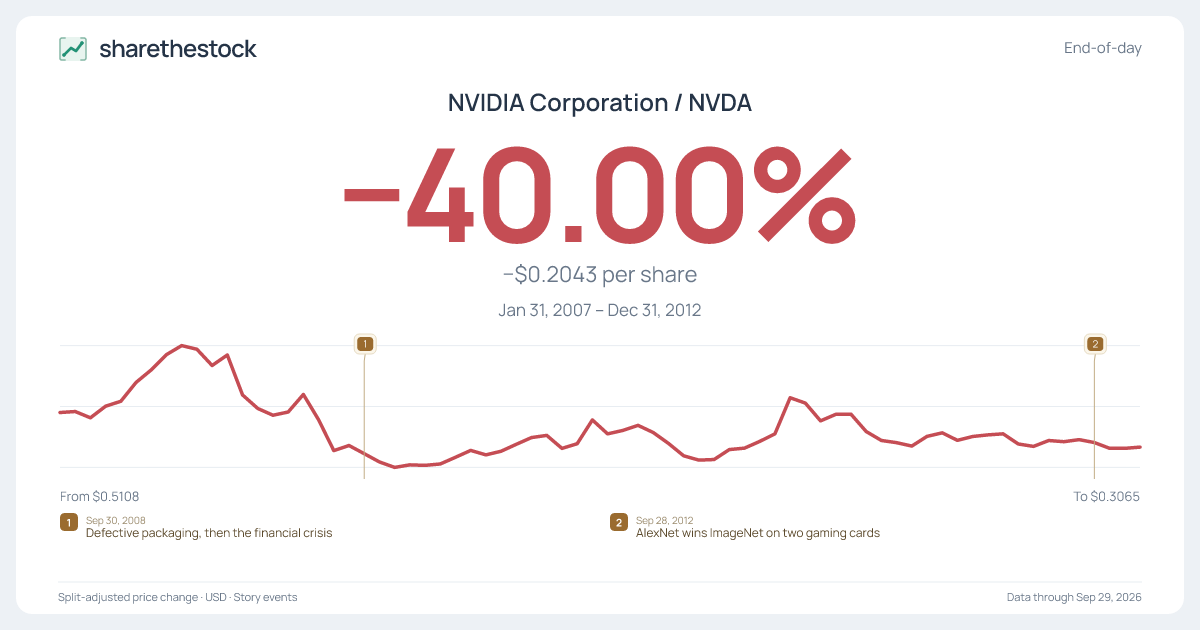
Defective packaging, then the financial crisisCrisis
A $196M charge for failing laptop GPUs lands as the market collapses; the stock falls about 85% peak to trough. CUDA spending continues through it.
Closed $0.2678 that month
AlexNet wins ImageNet on two gaming cardsProduct
Krizhevsky, Sutskever and Hinton train a convolutional network on a pair of GTX 580s and cut the error rate by an unheard-of margin. Deep learning becomes a hardware problem, and NVIDIA is already the hardware.
From gaming quarters to a business measured in racks
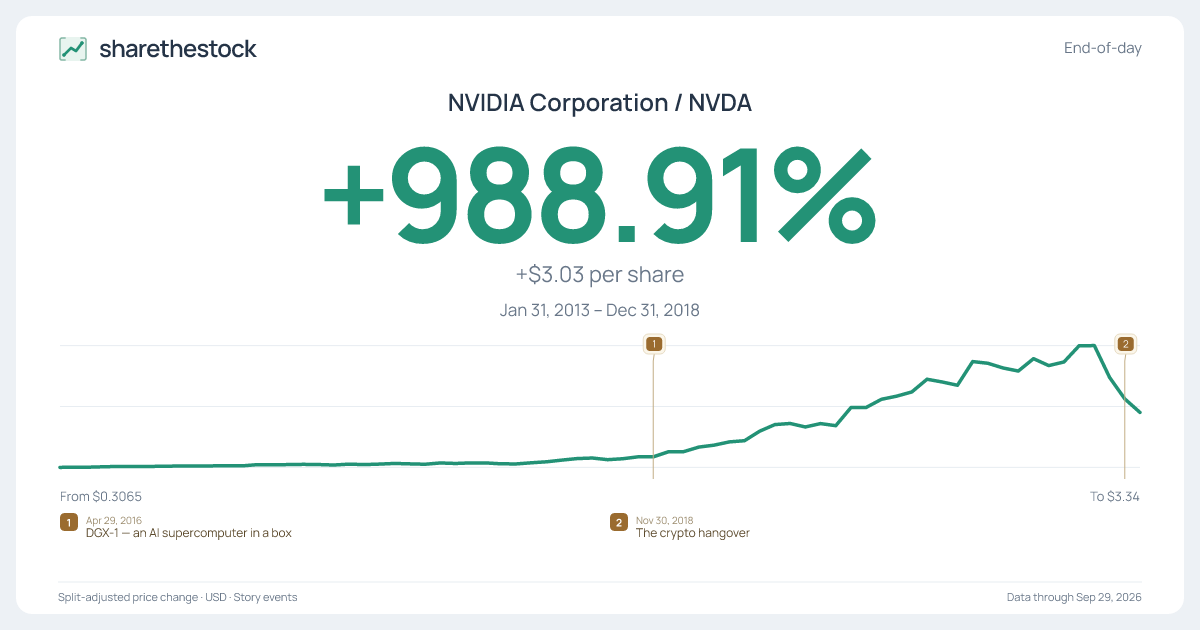
Deep learning moved from a curiosity to the roadmap of every large technology company, and every one of them bought NVIDIA. Crypto mining arrived as an unwelcome accelerant, inflating demand and then evaporating — a lesson the company got to relearn in a single quarter.
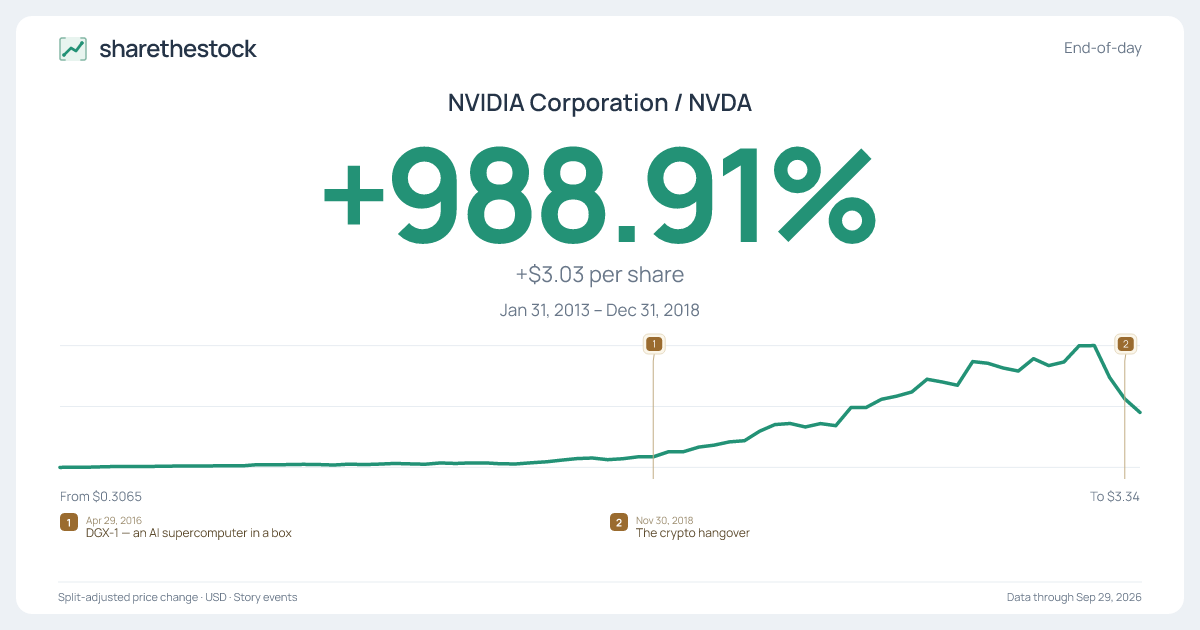
DGX-1 — an AI supercomputer in a boxProduct
Huang hand-delivers the first one to a young nonprofit called OpenAI. Data-center revenue starts compounding.
Closed $0.8883 that month
The crypto hangoverCrisis
Mining demand vanishes, the channel is full of unsold cards, and the stock loses about half its value in a quarter. The data-center story is still intact underneath.
ChatGPT turned a research budget into a capital-expenditure line at every hyperscaler. NVIDIA’s data-center revenue went from a rounding error to the largest such business in the industry, and the stock did something almost no large company has done: it compounded like a startup at trillion-dollar scale.
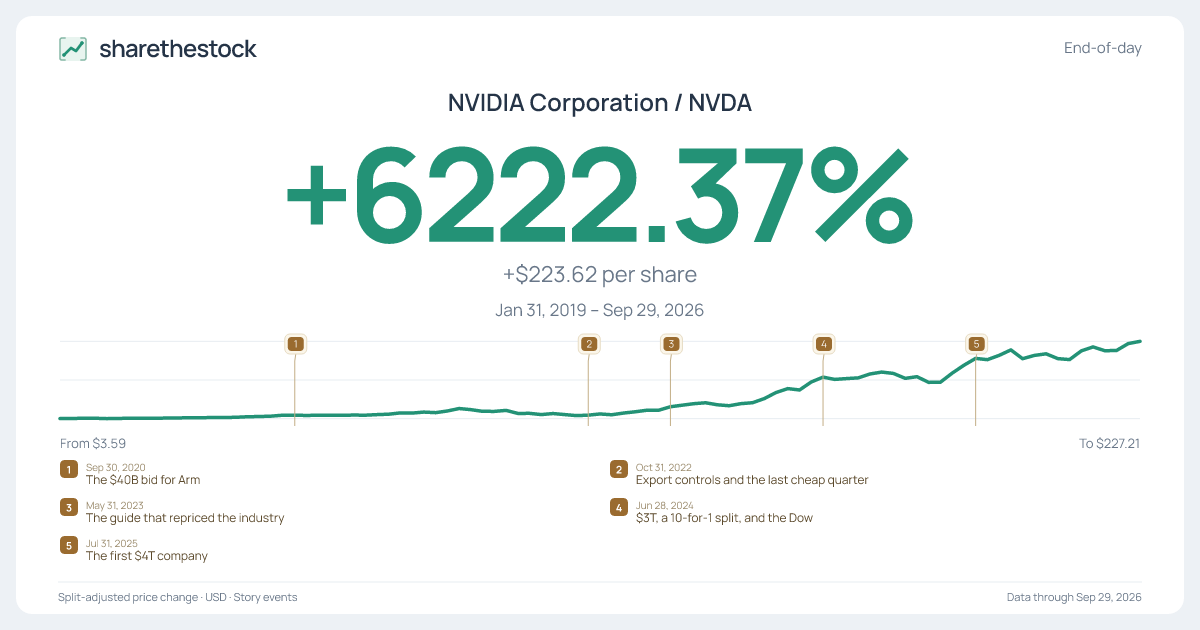
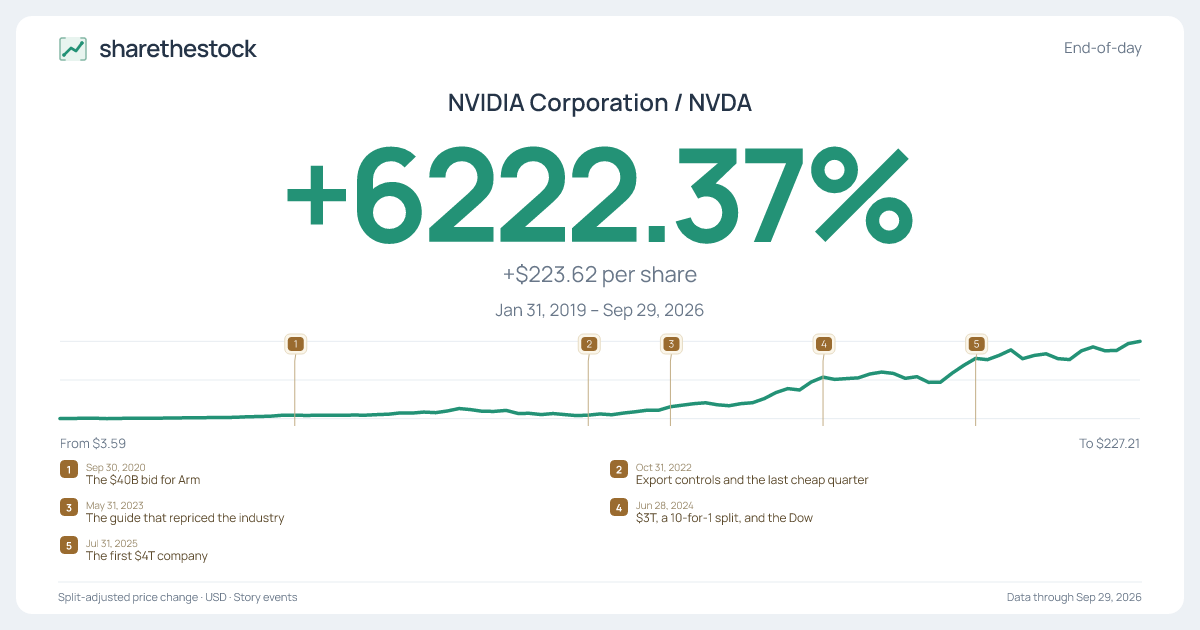
The $40B bid for ArmDeal
An attempt to own the CPU side of the data center. Regulators in three jurisdictions object and the deal is abandoned in February 2022; NVIDIA keeps a $1.25B breakup fee’s worth of scar tissue and builds Grace instead.
Closed $13.53 that month
Export controls and the last cheap quarterCrisis
Washington restricts advanced accelerator sales to China as the post-pandemic technology selloff bottoms. Shares trade in the low teens on a split-adjusted basis — the last time the market prices NVIDIA as a cyclical chip company.
Closed $13.50 that month
The guide that repriced the industryMarket
NVIDIA guides the next quarter roughly 50% above consensus and the stock adds over $180B of market value in a day. Within weeks it crosses $1T.
Closed $37.83 that month
$3T, a 10-for-1 split, and the DowMarket
The company briefly becomes the most valuable in the world, splits its shares to keep them accessible, and in November replaces Intel in the Dow Jones Industrial Average.
Closed $123.54 that month
The first $4T companyMarket
Blackwell ramps into demand that its customers describe as insatiable, and NVIDIA becomes the first company to reach a four-trillion-dollar valuation.