sharethestock

The company story

Intuit Inc.

XNAS: INTU · USD · split-adjusted

Intuit is the rare consumer-software company that beat Microsoft head-on, and then compounded for thirty years by owning the two financial chores nobody wants to do: small-business books and the annual tax return.

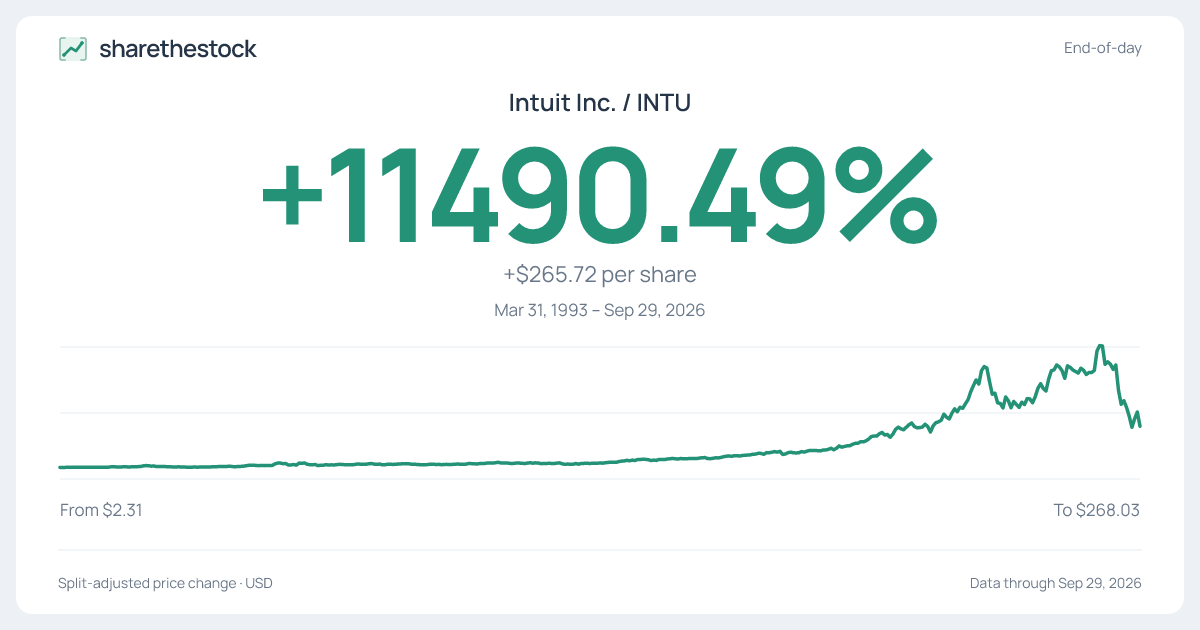
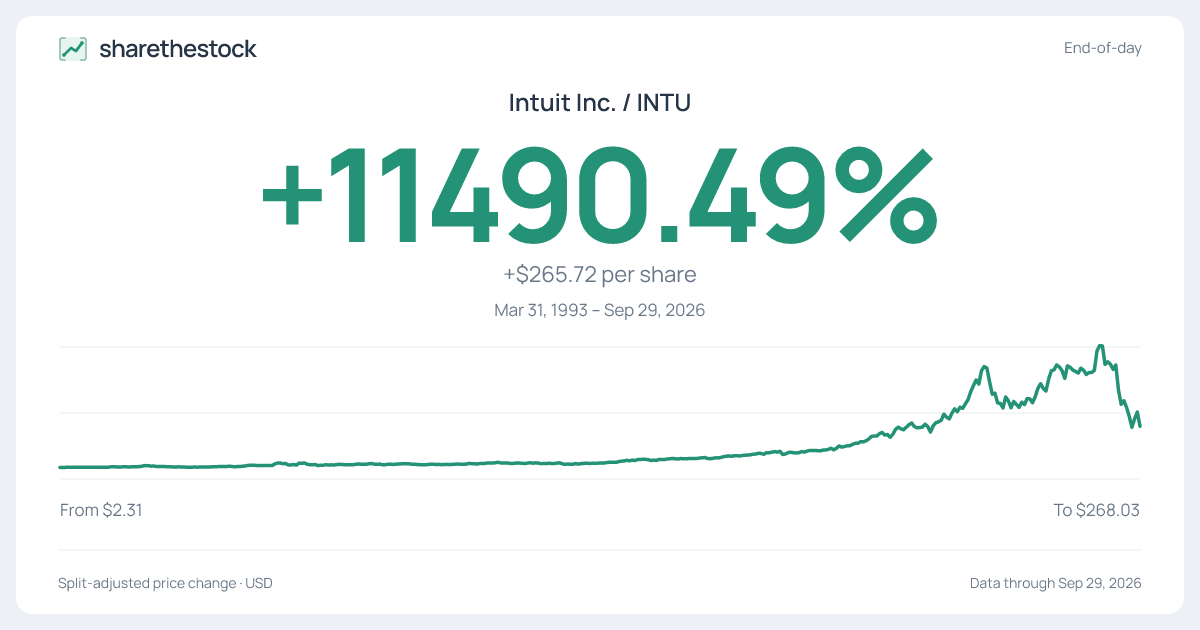
$2.31first monthly close, Mar 1993 $268.03latest, Sep 29, 2026 +11490.49%since Mar 1993 $1,000 → $115,904.86first close to now
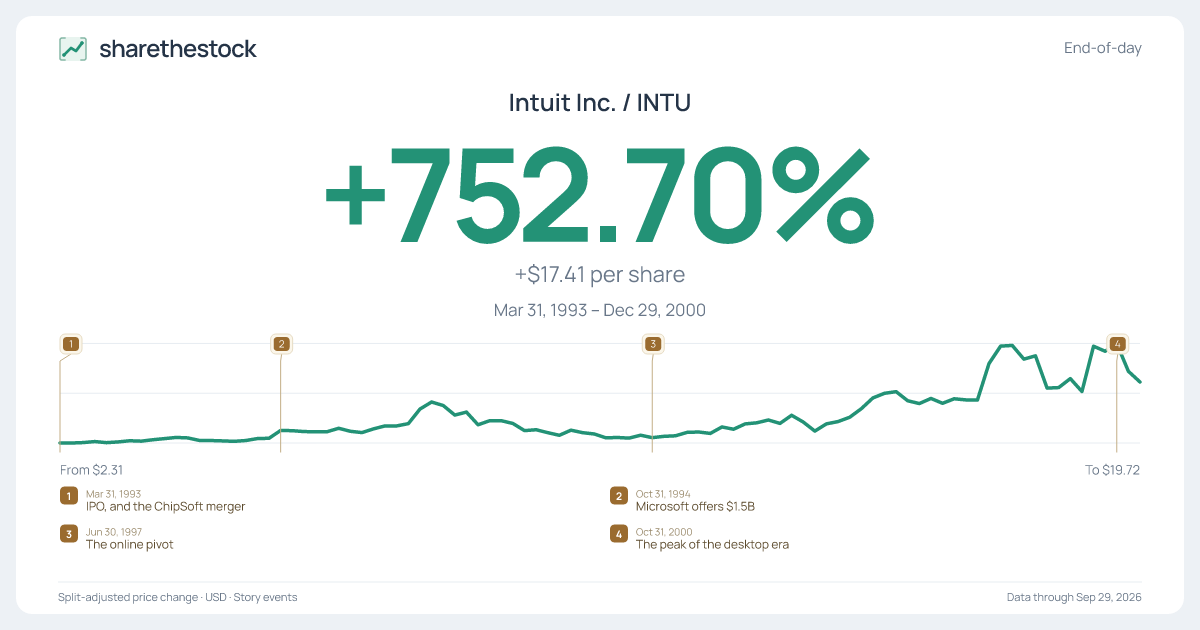
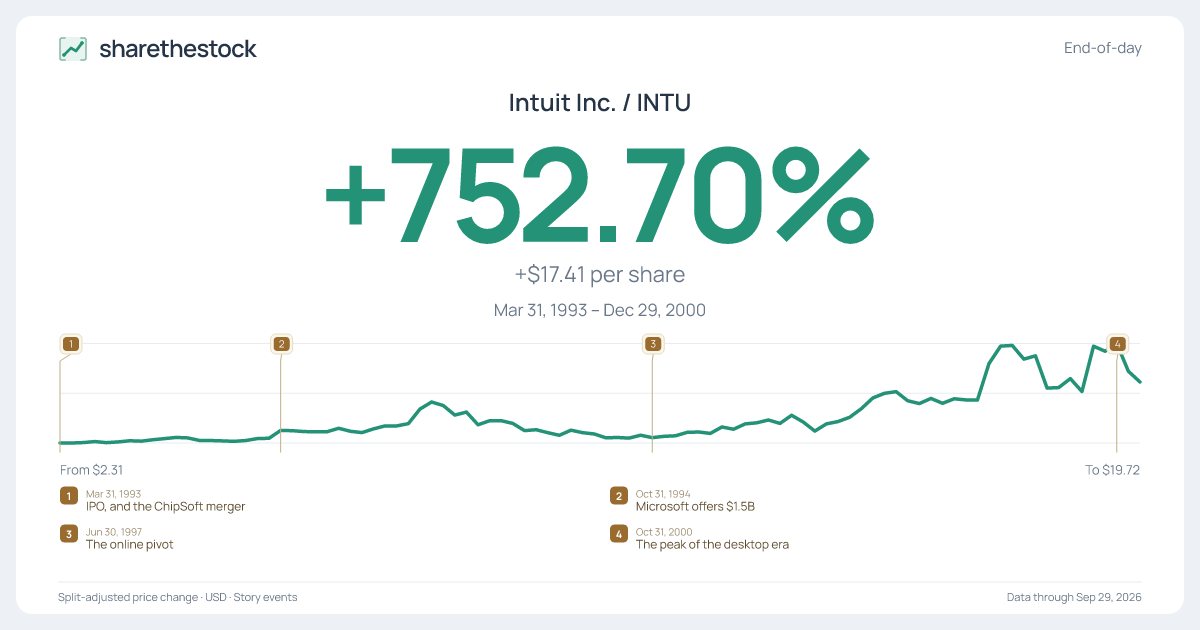
  1. 1QuickenMar 1993 – Dec 2000+752.70%
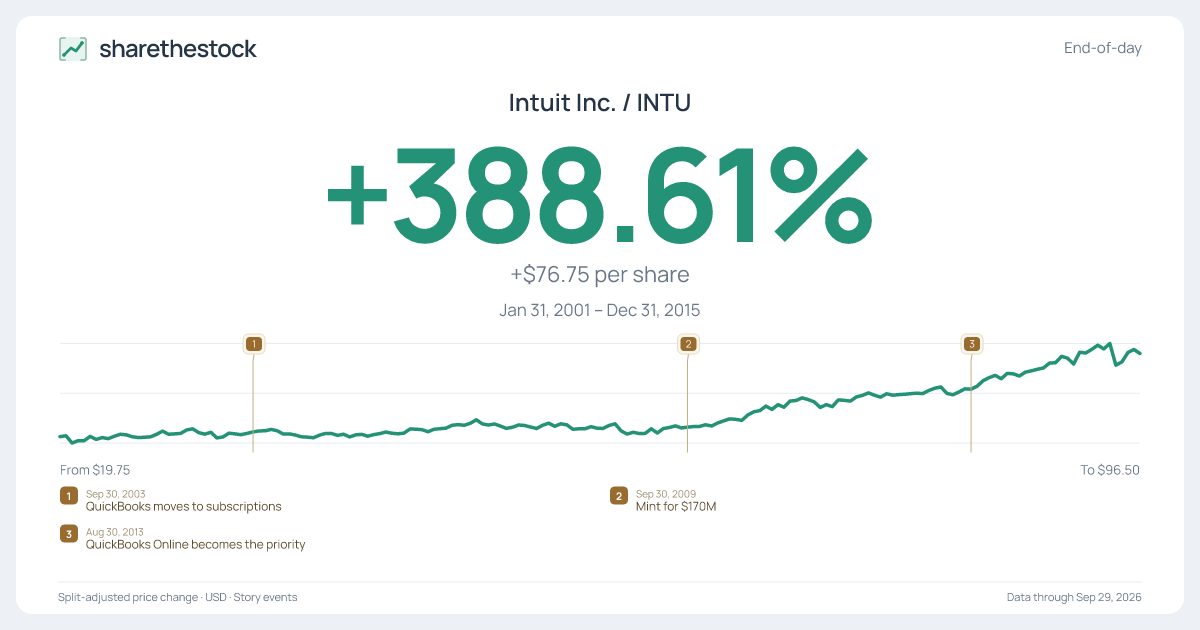
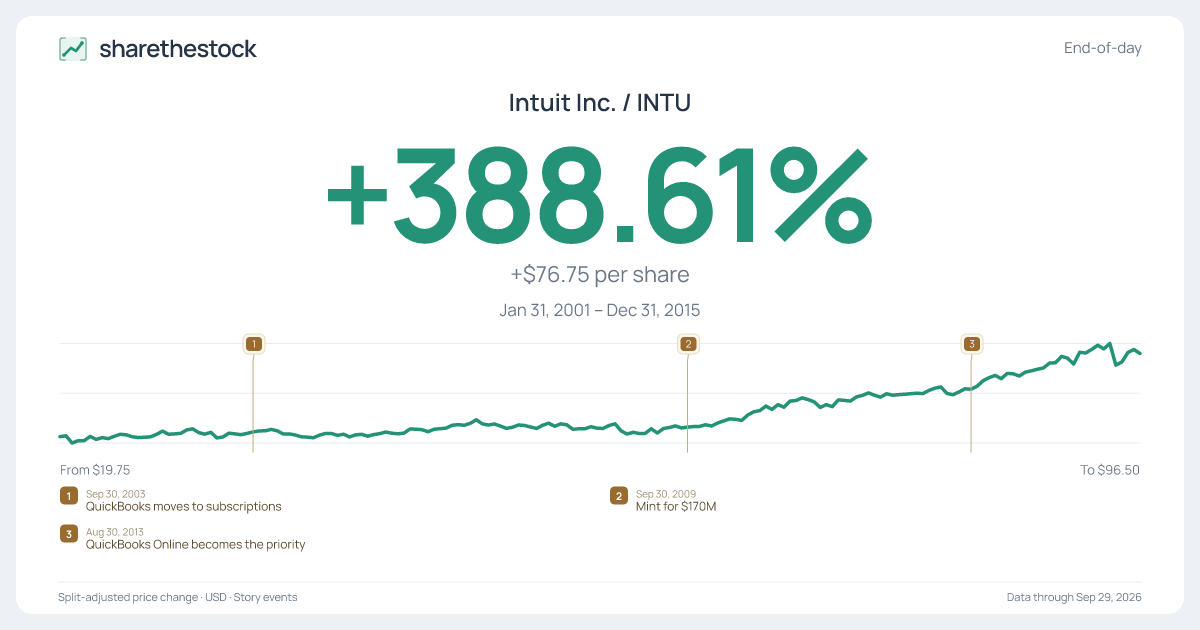
  2. 2The small-business franchiseJan 2001 – Dec 2015+388.61%
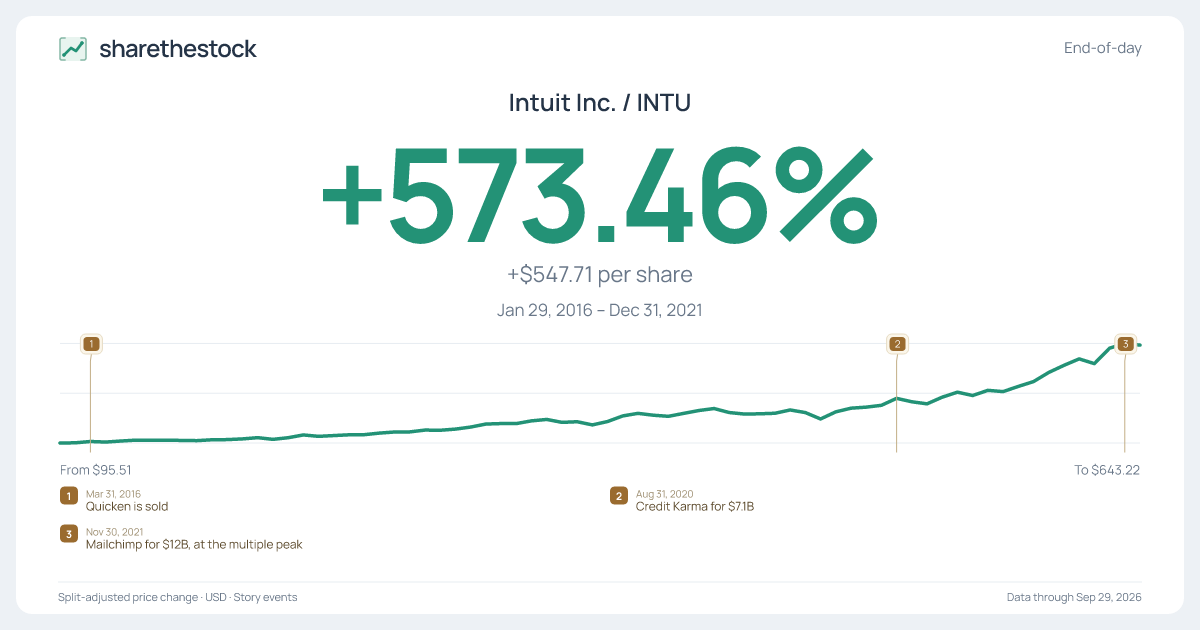
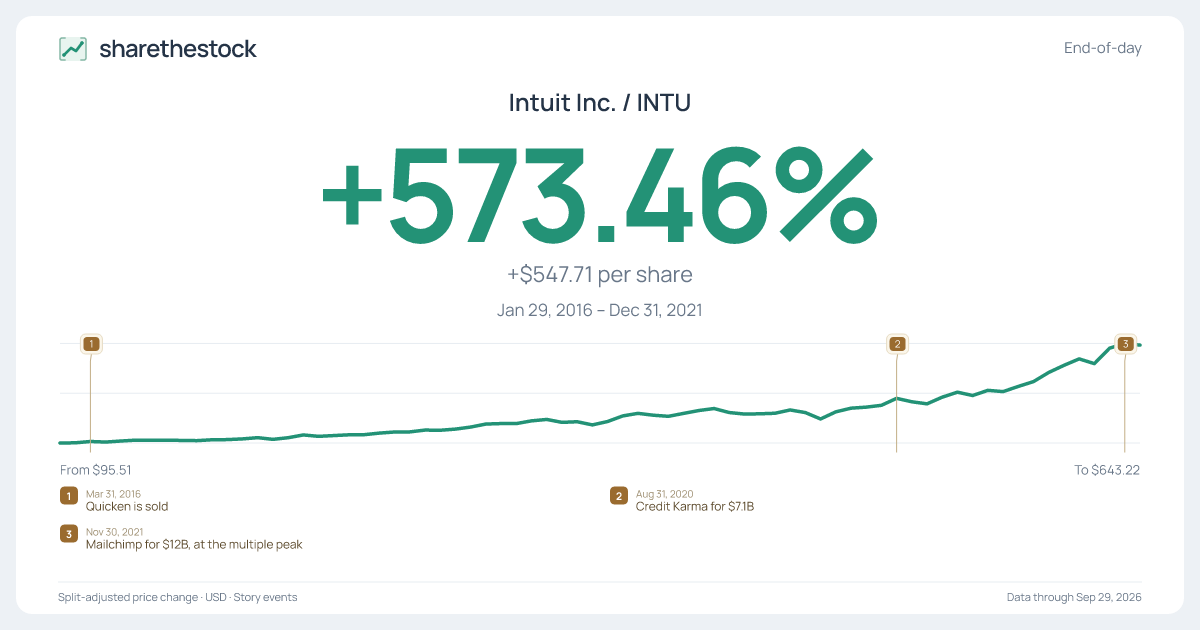
  3. 3Platform and the acquisitionsJan 2016 – Dec 2021+573.46%
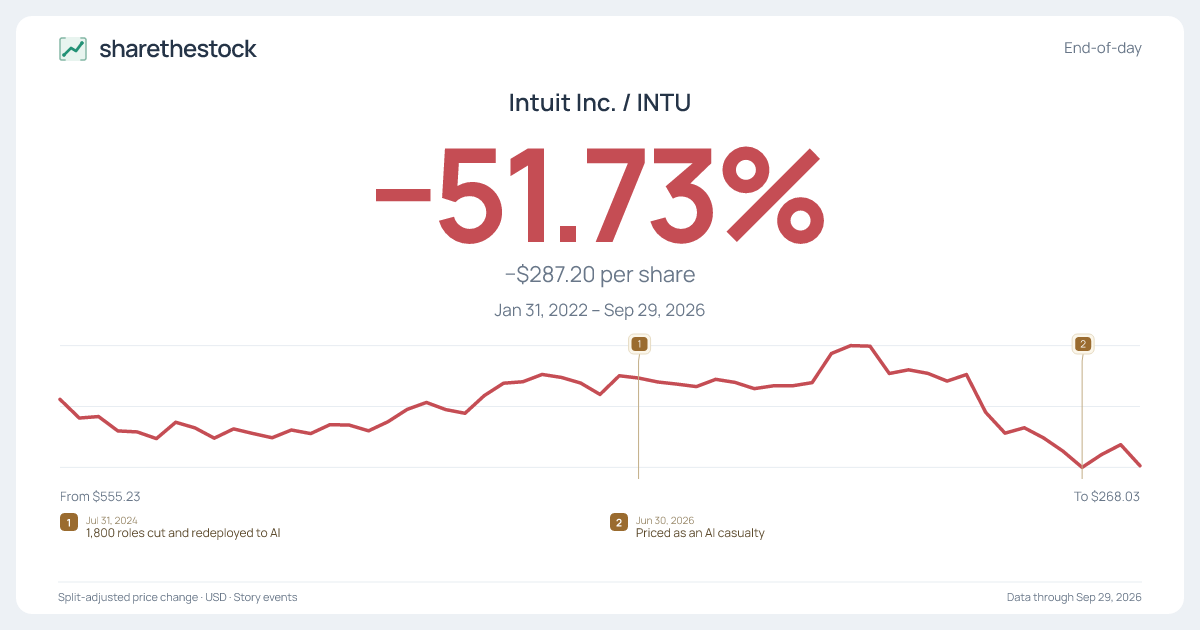
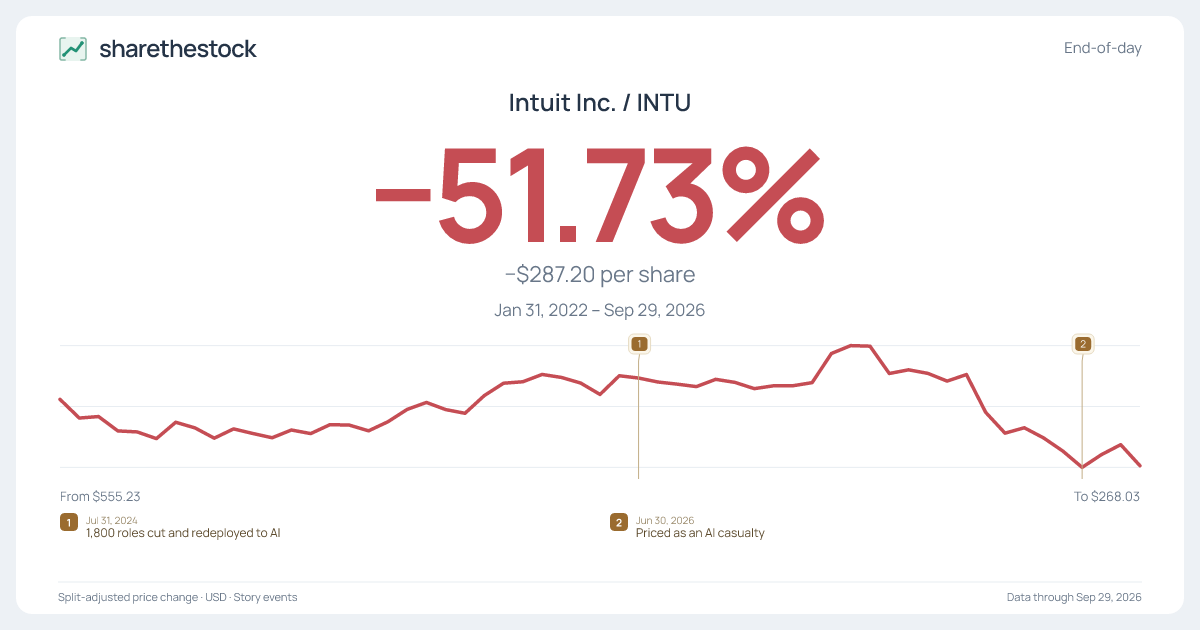
  4. 4AI and the resetJan 2022 – Sep 2026−51.73%

Beating Microsoft at consumer finance

Scott Cook built Quicken after watching his wife struggle with the chequebook. Microsoft shipped a competitor, failed to displace it, and then tried to buy Intuit for $1.5B — a deal the Justice Department blocked. Intuit bought the maker of TurboTax instead.

  1. Founded by Scott Cook and Tom Proulx

    A Procter & Gamble marketer and a Stanford programmer build personal-finance software on the premise that the competition is not other software — it is pen and paper.

    Private company — no public price yet
  2. Microsoft ships Money

    The most dangerous competitor in software enters the category and never takes it. Intuit’s distribution, and its focus on people who hate bookkeeping, hold the market.

    Private company — no public price yet
  3. IPO, and the ChipSoft merger

    Intuit goes public and immediately acquires the maker of TurboTax — the acquisition that turns a personal-finance company into a tax company.

    Closed $2.31 that month
  4. Microsoft offers $1.5B

    Bill Gates agrees to buy Intuit outright. The Justice Department sues to block it in 1995 and the deal is abandoned, leaving Intuit independent and its competitor permanently behind.

    Closed $5.88 that month
  5. The online pivot

    Intuit sells its online banking platform to Checkfree and starts building web-delivered products a decade before the rest of consumer software does.

    Closed $3.82 that month
  6. The peak of the desktop era

    Boxed software at retail, once a year, at high margins. The stock reflects the best economics that model produces, and the next fifteen years are about replacing it.

    Closed $30.72 that month
Two annuities: the books and the return

QuickBooks became the default accounting system for American small businesses and TurboTax the default way to file. Both had high switching costs, annual cadence, and pricing power that Intuit exercised carefully for fifteen years.

  1. QuickBooks moves to subscriptions

    Annual licences and payroll add-ons convert a one-time purchase into recurring revenue, years before the industry adopts the language of SaaS.

    Closed $24.12 that month
  2. Mint for $170M

    Buying the consumer app that was attacking Quicken from the web. It becomes the acquisition template: buy the disruptor early, cheaply.

    Closed $28.50 that month
  3. QuickBooks Online becomes the priority

    Intuit deprioritises the desktop product that generates most of its profit in favour of the cloud version that does not, and takes several years of slower growth to do it.

    Closed $63.53 that month

Selling the namesake product, buying the funnel

Intuit divested Quicken, moved QuickBooks fully online, and then spent $19B on Credit Karma and Mailchimp to own more of the customer relationship — both at the top of the multiple cycle.

  1. Quicken is sold

    The product the company was founded on and named for is divested to private equity. What is left is small business and tax — both larger, both stickier.

    Closed $104.01 that month
  2. Credit Karma for $7.1B

    A hundred million consumers and their credit data, bought to feed the tax funnel and eventually to sell them financial products.

    Closed $345.39 that month
  3. Mailchimp for $12B, at the multiple peak

    Email marketing for small businesses, purchased weeks from the top of the software cycle. It is the most expensive deal Intuit has made on any measure.

    Closed $652.30 that month

The one software category a language model looks built for

Intuit redeployed thousands of roles toward AI and shipped assistants inside every product. The market spent the period arguing about whether guided tax and bookkeeping software is the beneficiary of that technology or its most obvious casualty.

  1. 1,800 roles cut and redeployed to AI

    Intuit lays off 10% of its workforce while saying it will hire a similar number into AI and sales — a public bet that the technology changes what the products are.

    Closed $647.35 that month
  2. Priced as an AI casualty

    The market decides that assistants which can read a shoebox of receipts or a W-2 threaten the value of guided software, and Intuit gives back a large part of a decade’s re-rating while revenue keeps growing.

    Closed $261.00 that month

The whole arc

+11490.49% in 33 years

One chart, Mar 31, 1993 – Sep 29, 2026. Open it, drag a range, add your own markers — or take this card with you.