The company that made Moore’s Law a promise, and then missed a deadline.
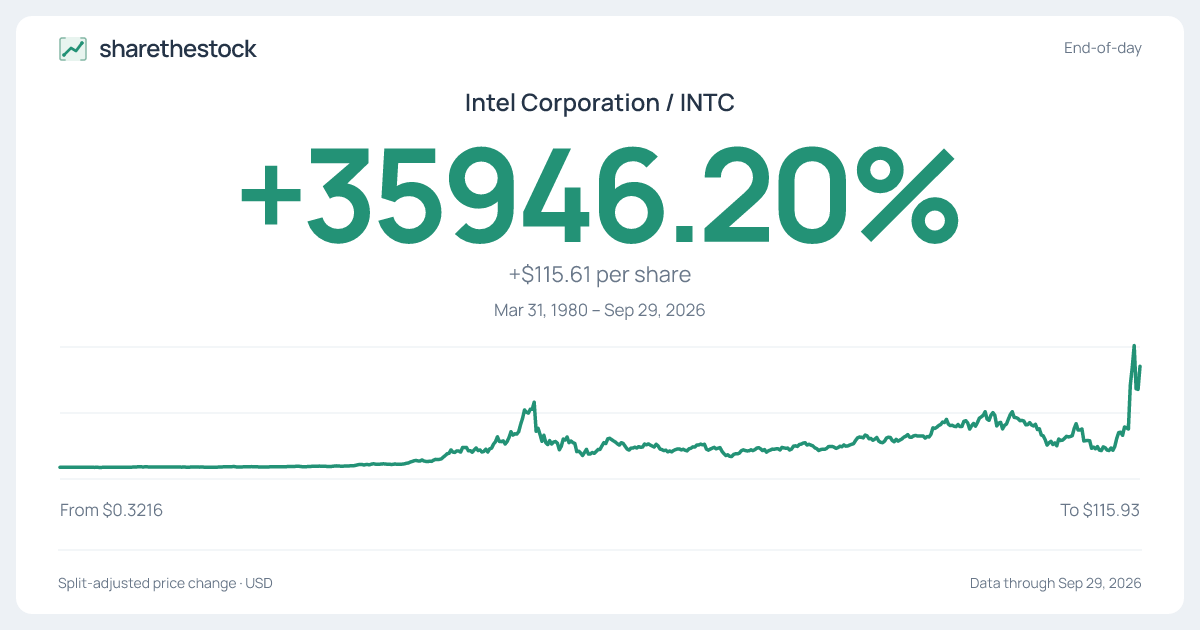
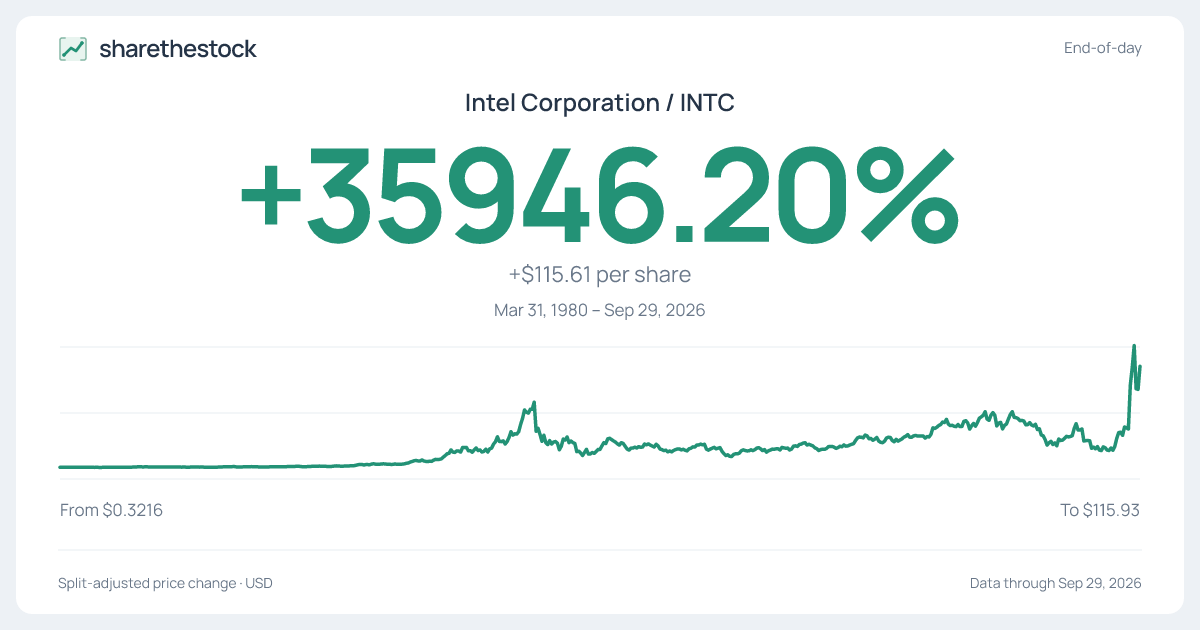
For thirty years Intel’s manufacturing lead was the most reliable advantage in technology. The chart is a record of what happens to a business whose moat was a schedule, when the schedule slips.
$0.3216first monthly close, Mar 1980$115.93latest, Sep 29, 2026+35946.20%since Mar 1980$1,000 → $360,462.04first close to now
Walking away from the business that built the company
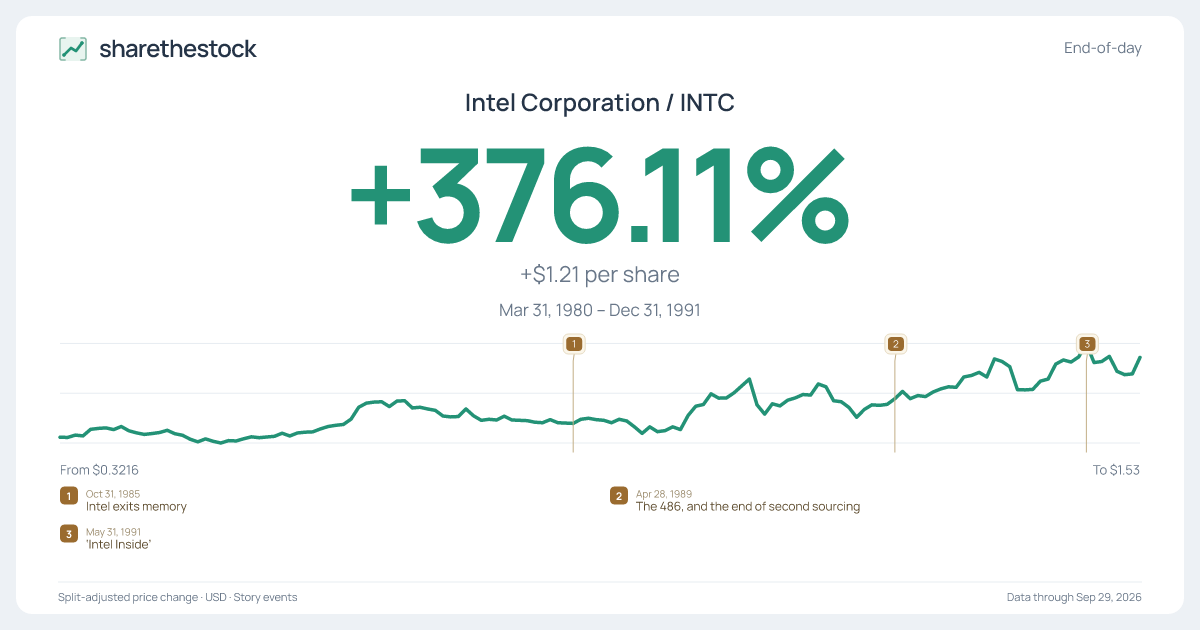
Intel was a memory company that invented the microprocessor almost as a side project. When Japanese DRAM makers destroyed the memory market, Andy Grove made the hardest decision in the company’s history and exited the product Intel was famous for.
Noyce and Moore leave Fairchild to found IntelFounding
Two of the eight who left Shockley leave again, this time with Arthur Rock’s money and a plan to build semiconductor memory. Andy Grove is employee number three.
Private company — no public price yet
IPO at $23.50 a shareMarket
A $6.8M raise for a memory company. The microprocessor that will define it is still a month from launch.
Before monthly price data begins
The 4004 — the first commercial microprocessorProduct
Built for a Japanese calculator company, which Intel then pays to buy the rights back from. An entire industry follows from that repurchase.
Before monthly price data begins
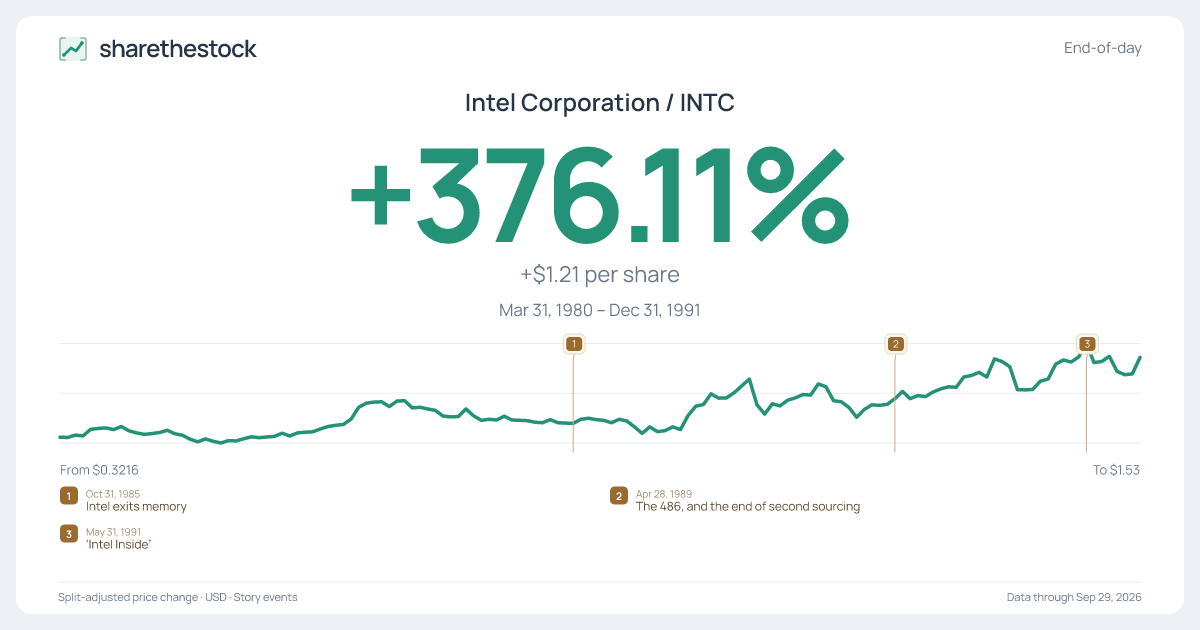
Intel exits memoryCrisis
Grove asks what a new management team would do, then does it: leave DRAM entirely and become a microprocessor company. It costs thousands of jobs and saves the company.
Closed $0.5313 that month
The 486, and the end of second sourcingProduct
Intel stops licensing its designs to competitors and keeps the x86 franchise for itself — the decision that makes the next decade’s margins possible.
Closed $0.9063 that month
‘Intel Inside’Market
A component supplier starts advertising to consumers. Within a few years buyers ask for the chip by name, and PC makers lose their pricing leverage.
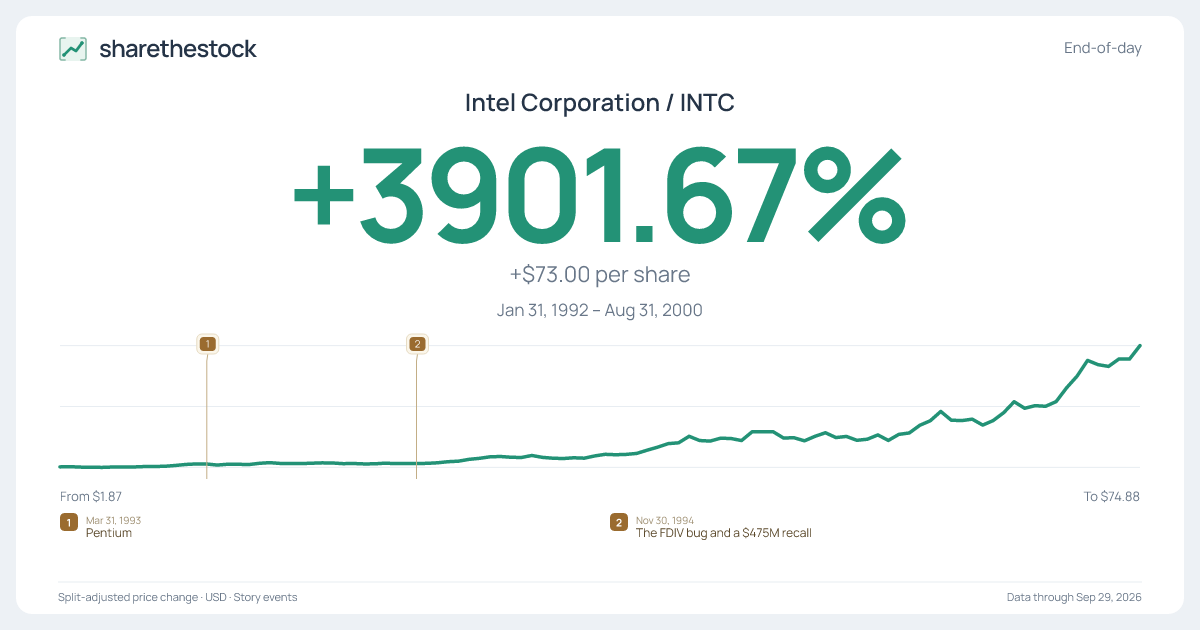
Intel spent co-marketing dollars putting its logo on other companies’ computers and turned a commodity input into a preference. Margins, share and the stock compounded for a decade on the tightest product cadence in industry.
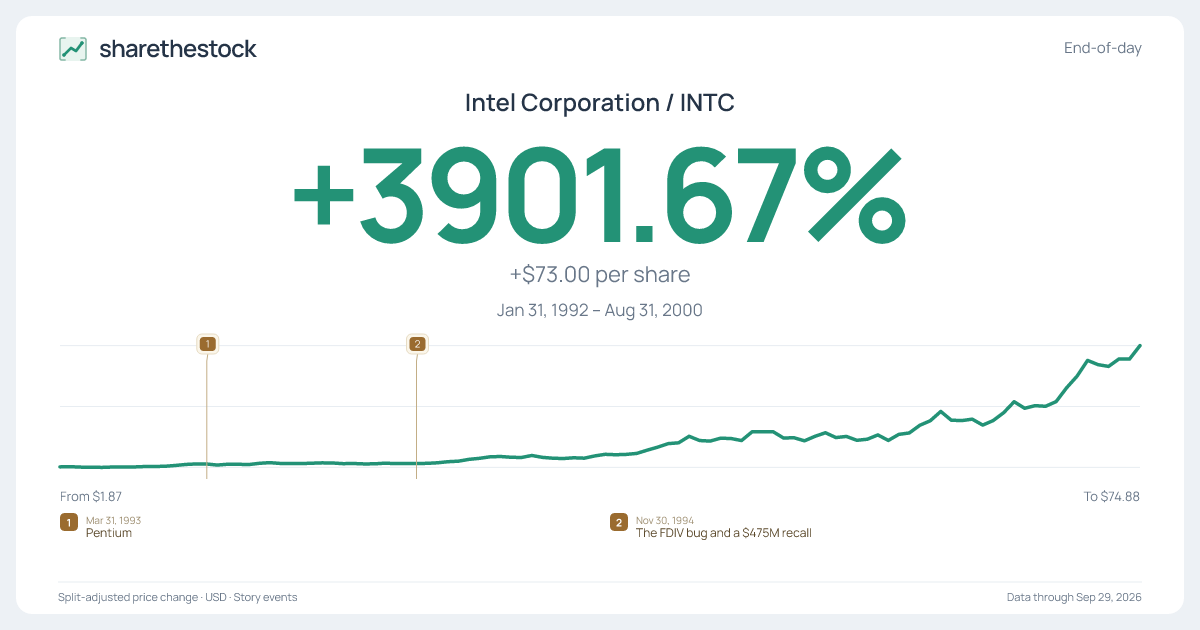
PentiumProduct
A brand instead of a number, because numbers could not be trademarked. It becomes the most recognisable component in consumer electronics.
Closed $3.59 that month
The FDIV bug and a $475M recallCrisis
A rare division error becomes a public-relations crisis. Grove reverses course and offers replacements to anyone who asks — the moment Intel learns it is a consumer brand.
Still enormously profitable, slowly losing relevance
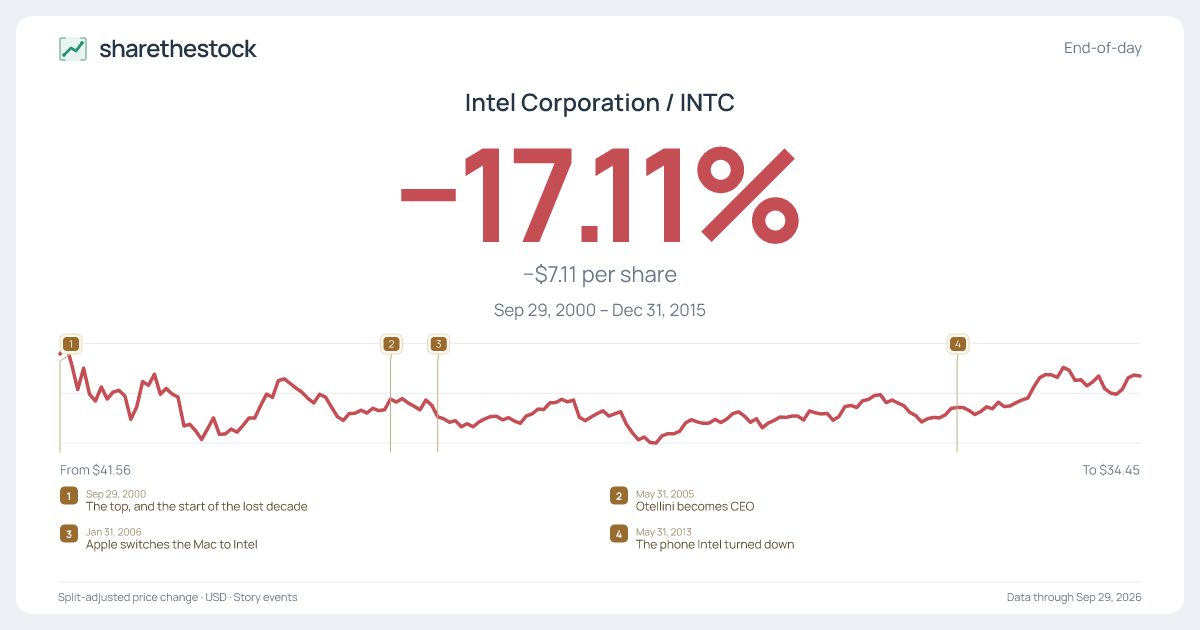
Intel won the notebook era and the data center, and missed the phone entirely — reportedly turning down the first iPhone chip over price. Profits stayed enormous; the multiple never came back.
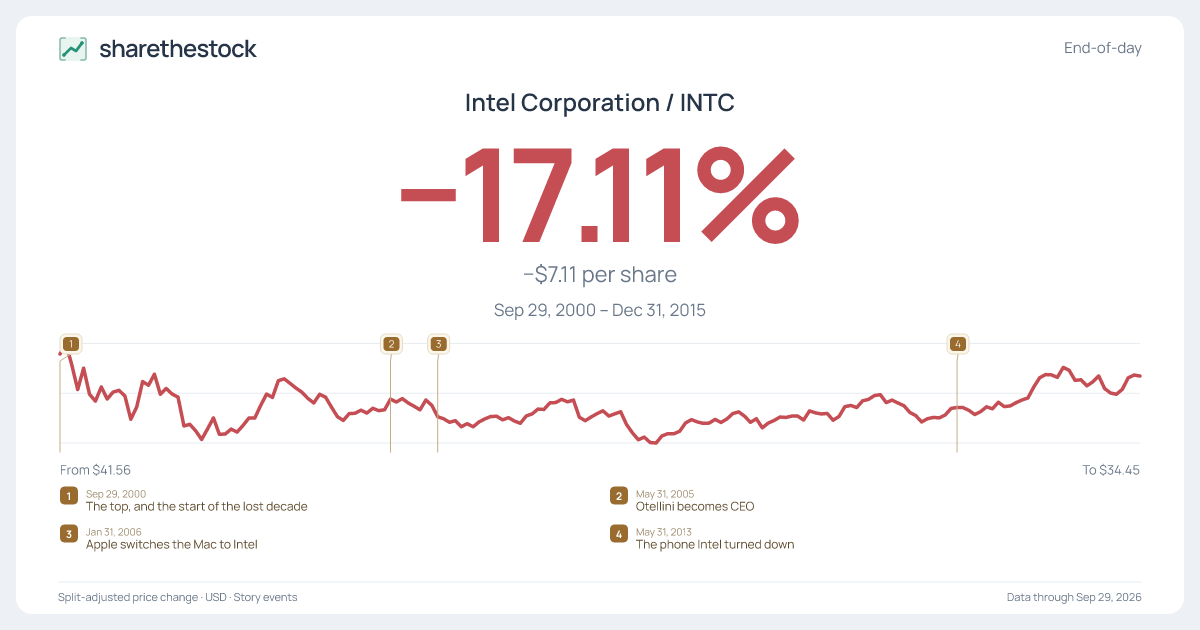
The top, and the start of the lost decadeCrisis
A revenue warning days after the all-time high begins a de-rating that never fully reverses. Intel’s earnings will more than double from here while its share price does not.
Closed $41.56 that month
Otellini becomes CEOLeadership
The first non-engineer to run Intel takes over as the company wins the Mac and the data center, and misses mobile.
Closed $26.96 that month
Apple switches the Mac to IntelDeal
A design win that looks like total victory in the PC era, and turns out to be the last era in which PC leadership was the thing that mattered.
Closed $21.26 that month
The phone Intel turned downCrisis
Otellini concedes Intel passed on the original iPhone processor because the price was below its cost forecast — a forecast that was wrong by an order of magnitude on volume.
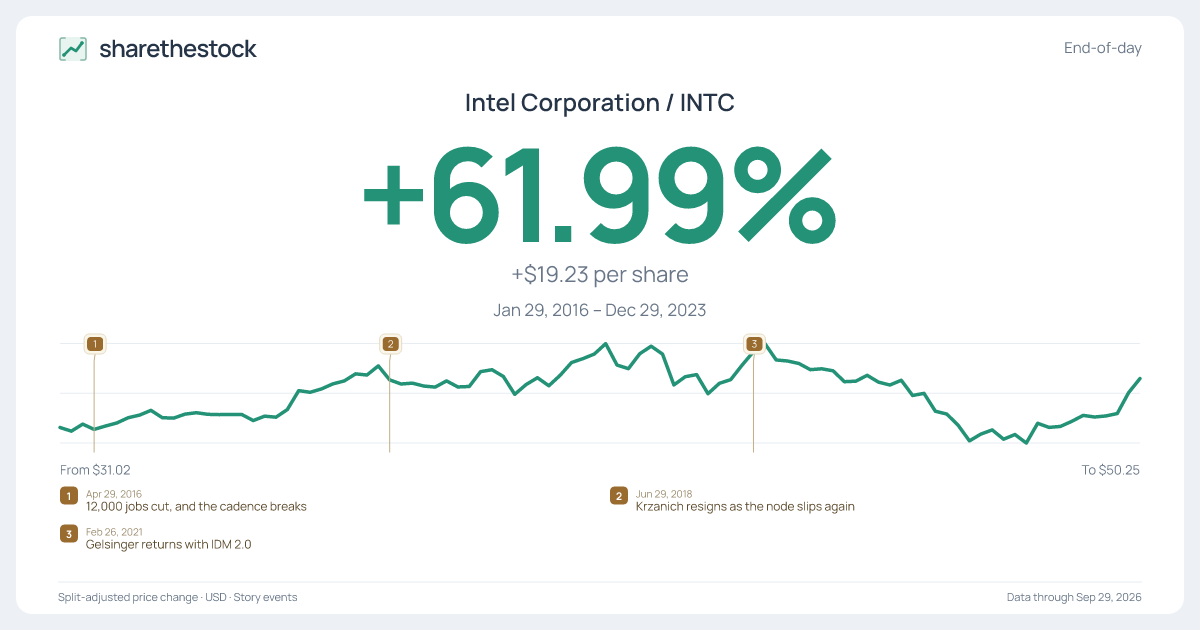
The advantage that justified everything — being one node ahead — went away. TSMC took the lead, AMD rented it, and every part of Intel’s strategy that assumed manufacturing superiority had to be rewritten.
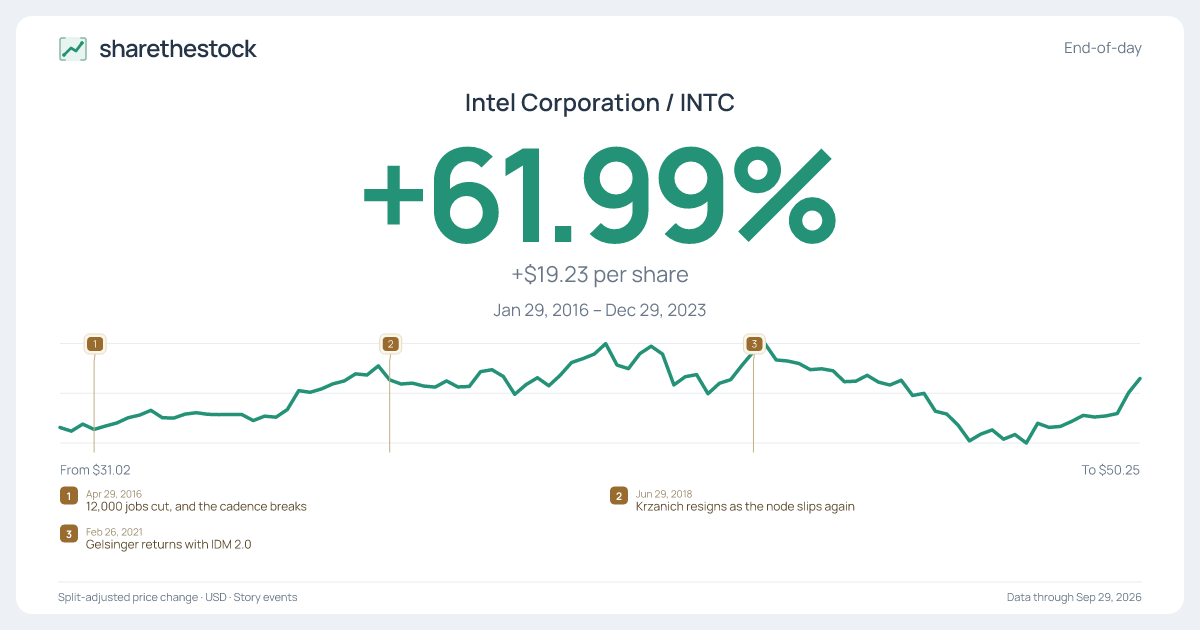
12,000 jobs cut, and the cadence breaksCrisis
Intel drops the tick-tock model as 10nm slips. It is the first public admission that the schedule the whole strategy relied on is no longer reliable.
Closed $30.28 that month
Krzanich resigns as the node slips againLeadership
A CEO departure over a relationship policy lands in the middle of a manufacturing crisis, and the company runs without a permanent chief executive for seven months.
Closed $49.71 that month
Gelsinger returns with IDM 2.0Leadership
A former CTO comes back to rebuild manufacturing and sell capacity to others. It is the right diagnosis and an extraordinarily expensive prescription.
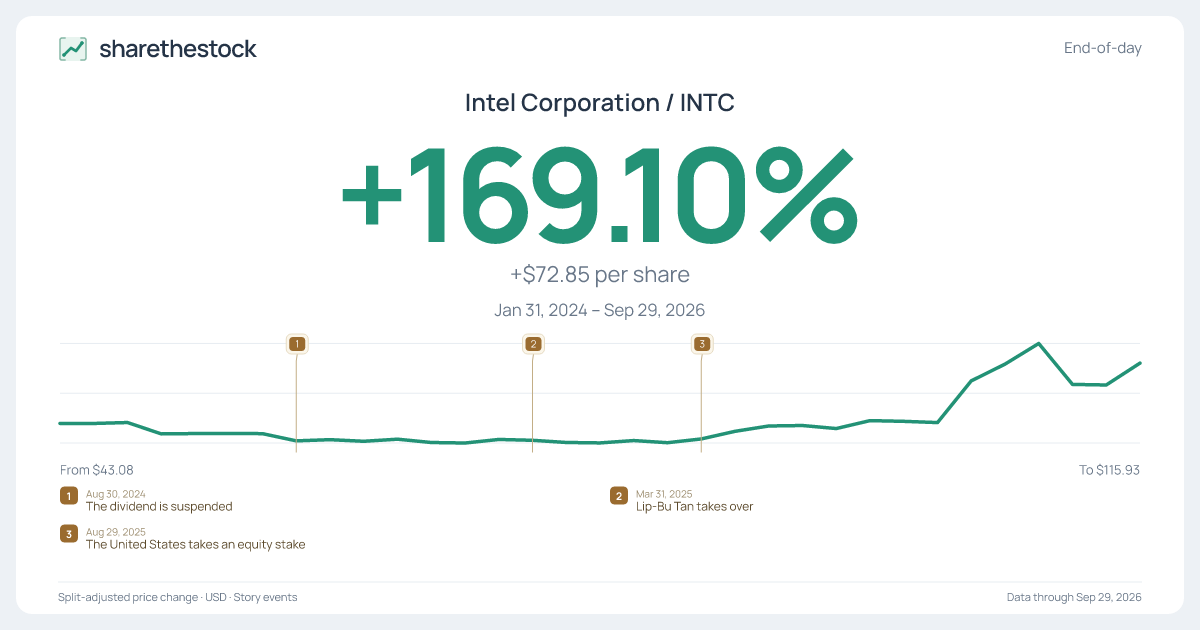
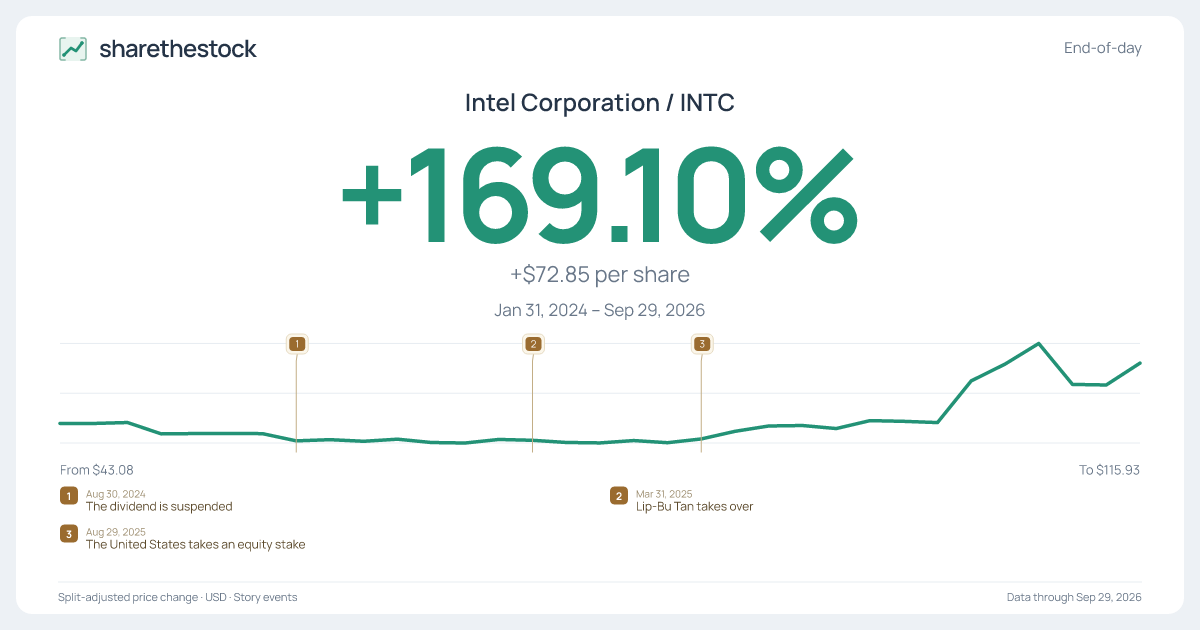
The dividend was cut, the workforce shrank, the foundry ambition consumed capital, and the US government took a stake. The stock became a bet on industrial policy as much as on products.
The dividend is suspendedCrisis
A 15% workforce reduction and the end of a dividend Intel had paid since 1992. The stock has its worst year on record.
Closed $22.04 that month
Lip-Bu Tan takes overLeadership
A semiconductor investor inherits a foundry roadmap, a shrinking product line and a customer list that has to be rebuilt from scratch.
Closed $22.71 that month
The United States takes an equity stakeDeal
Federal support converts into ownership, and Nvidia invests alongside it. Intel becomes a strategic asset whose shareholders are no longer the only constituency.