sharethestock

The company story

International Business Machines Corporation

XNYS: IBM · USD · split-adjusted

IBM invented the idea that a computer company sells a relationship rather than a machine. That idea made it the most powerful company in the industry, then almost destroyed it when the machine stopped mattering.

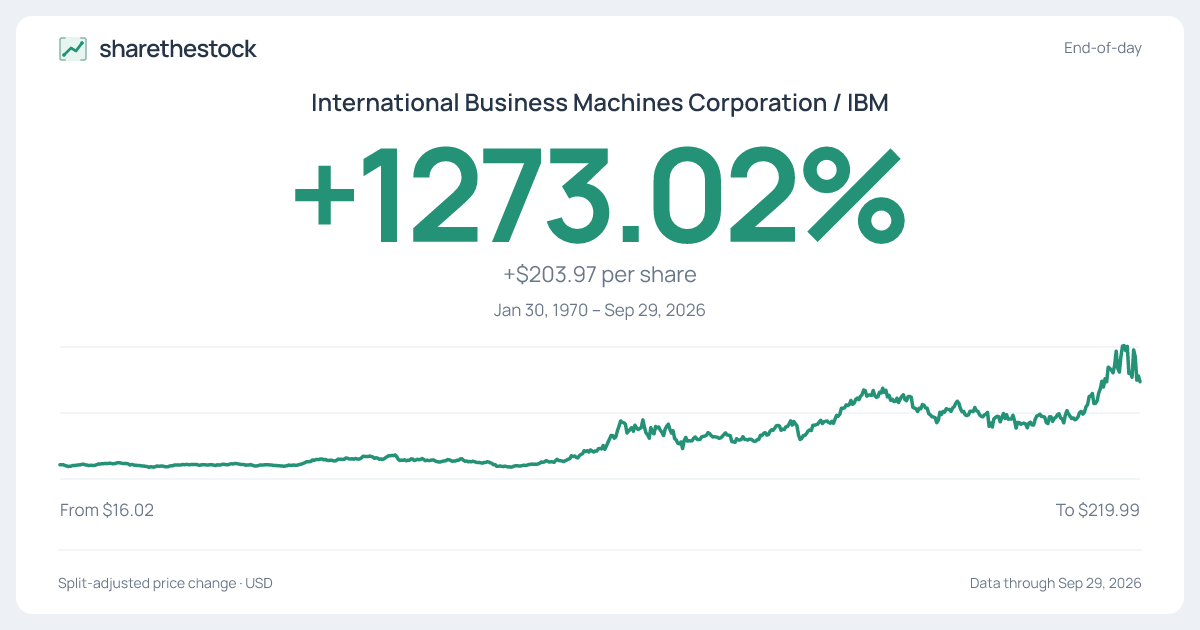
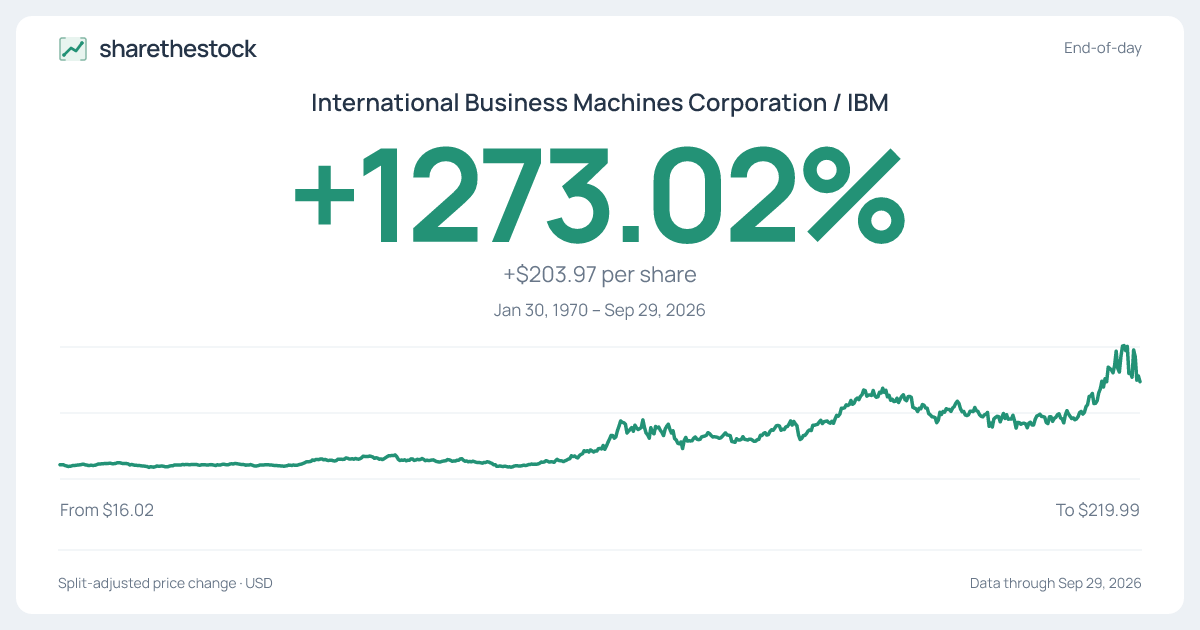
$16.02first monthly close, Jan 1970 $219.99latest, Sep 29, 2026 +1273.02%since Jan 1970 $1,000 → $13,730.20first close to now
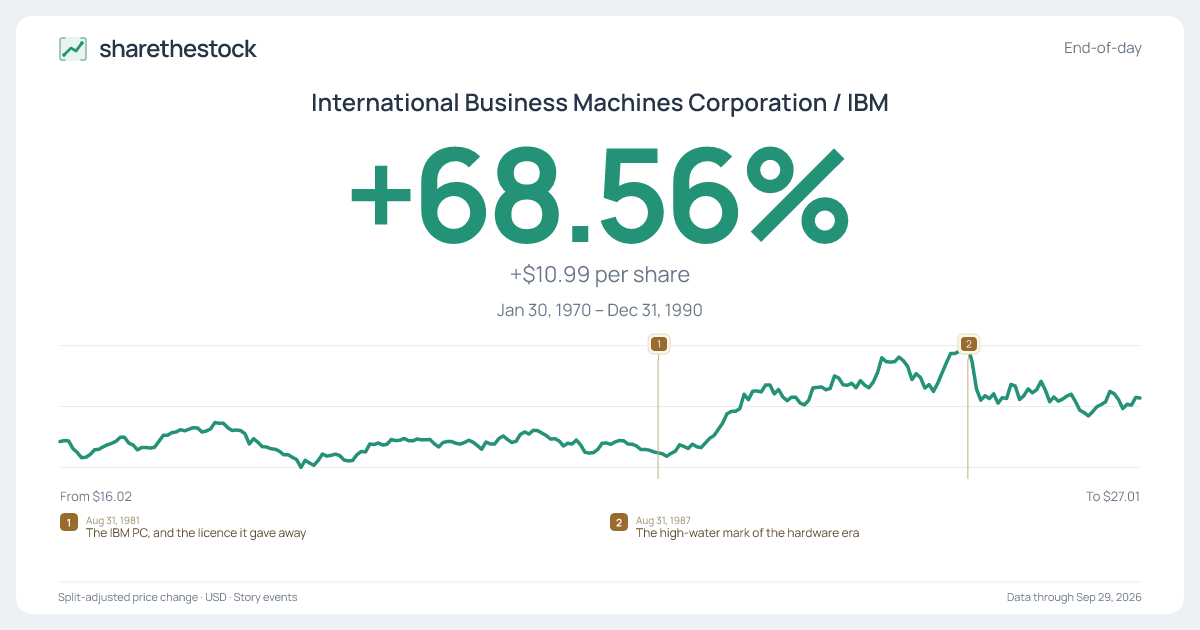
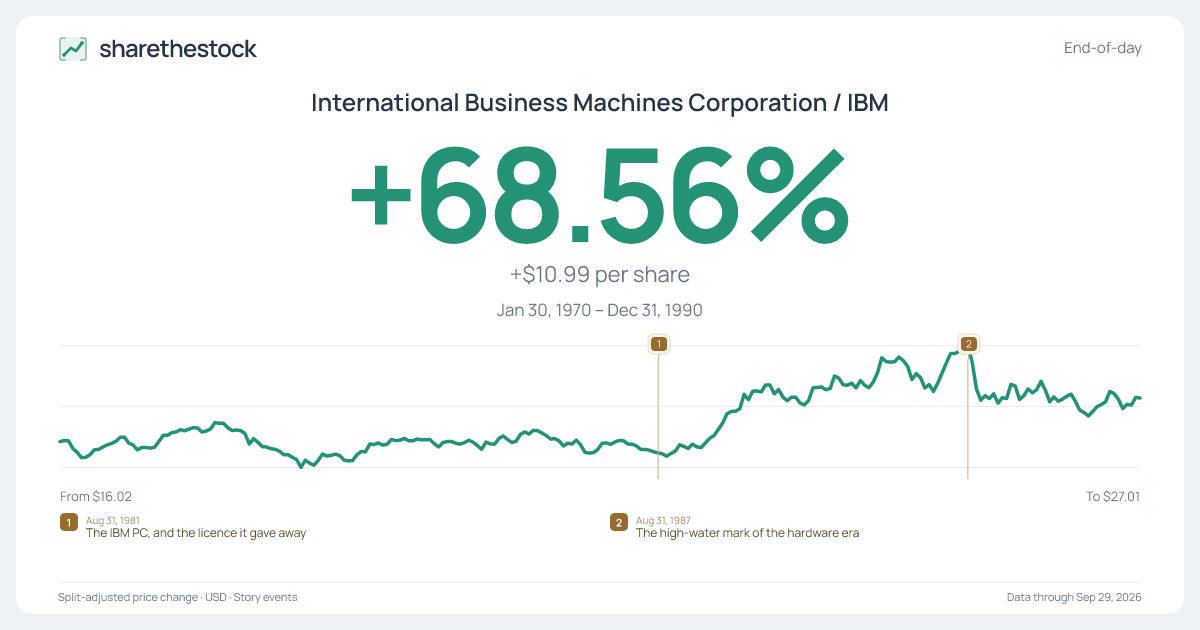
  1. 1The mainframe centuryJan 1970 – Dec 1990+68.56%
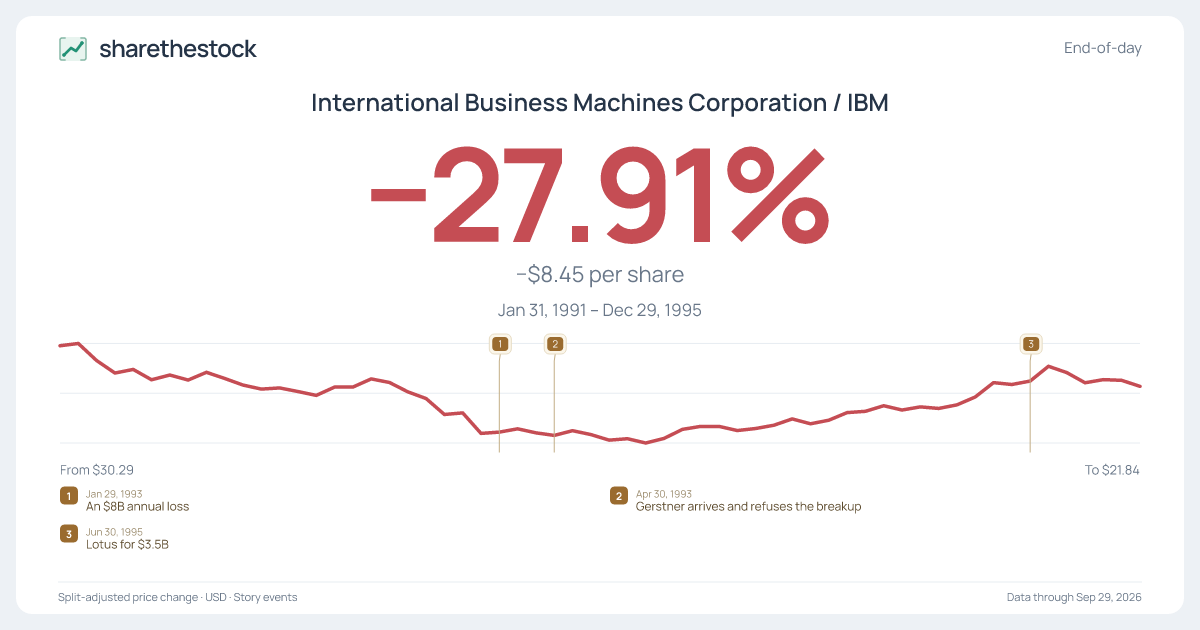
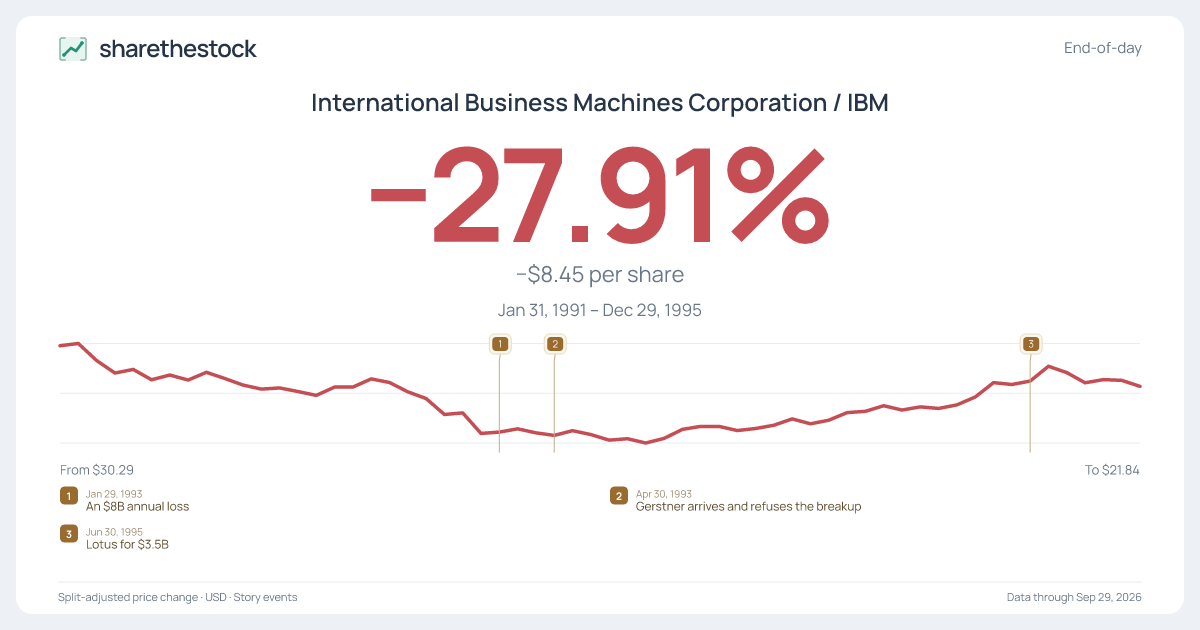
  2. 2The near-deathJan 1991 – Dec 1995−27.91%
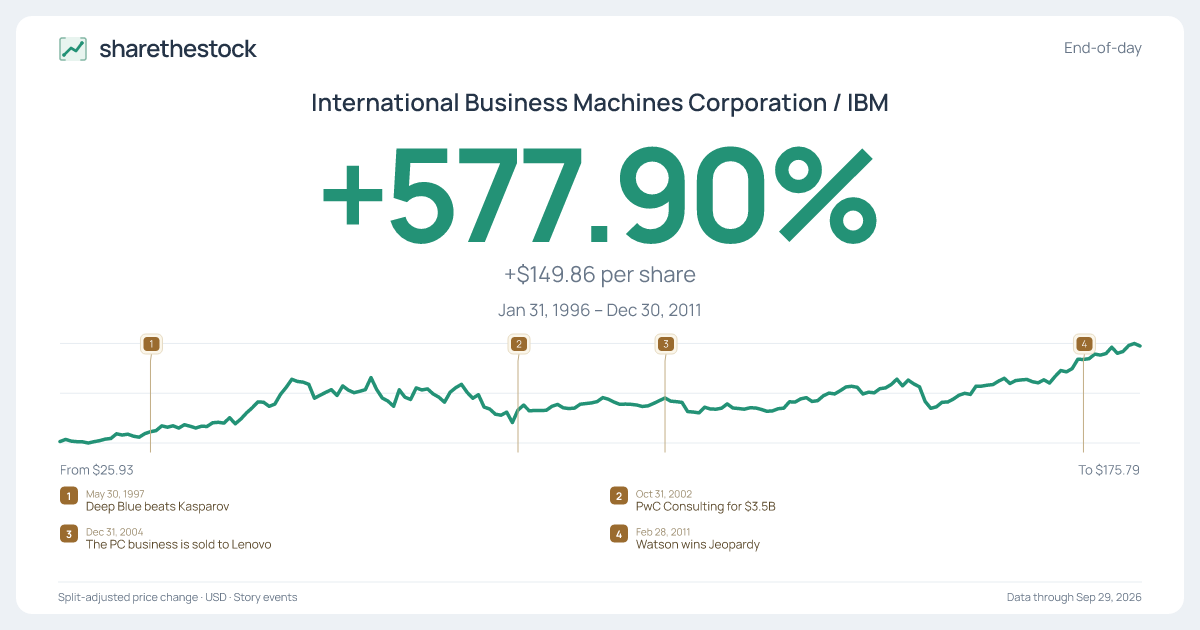
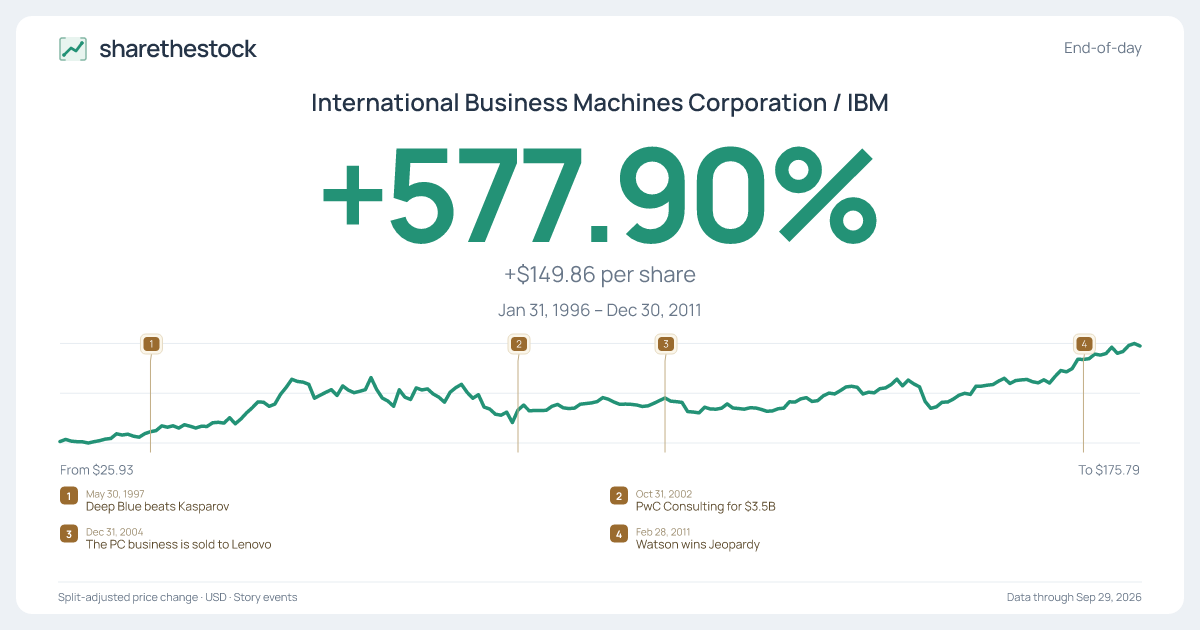
  3. 3Services and softwareJan 1996 – Dec 2011+577.90%
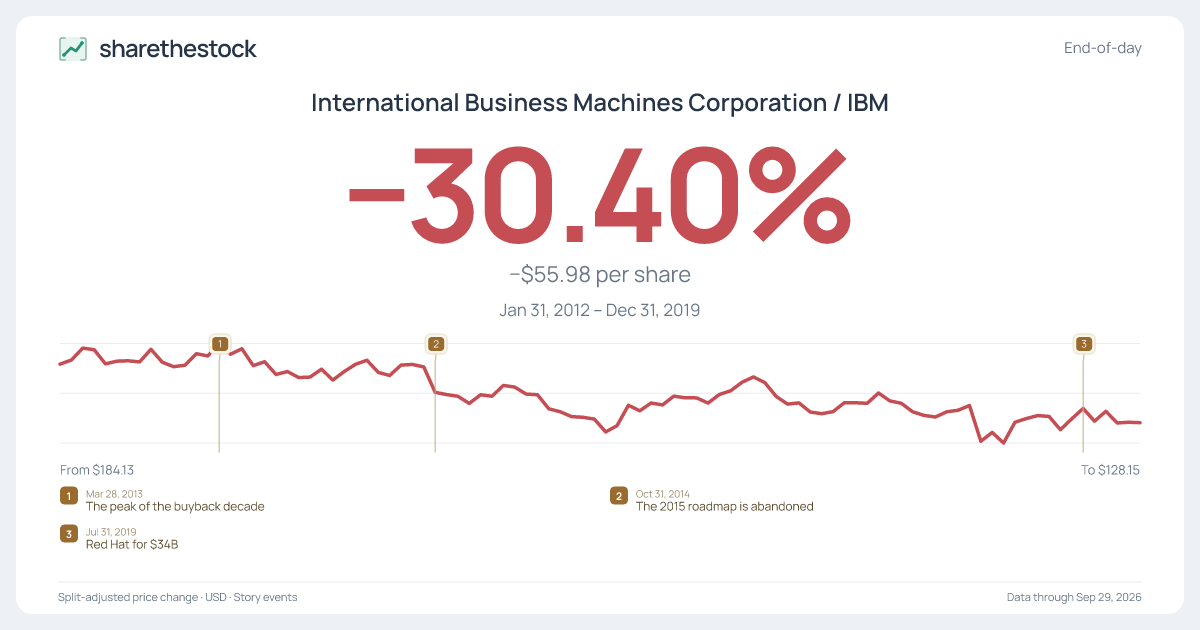
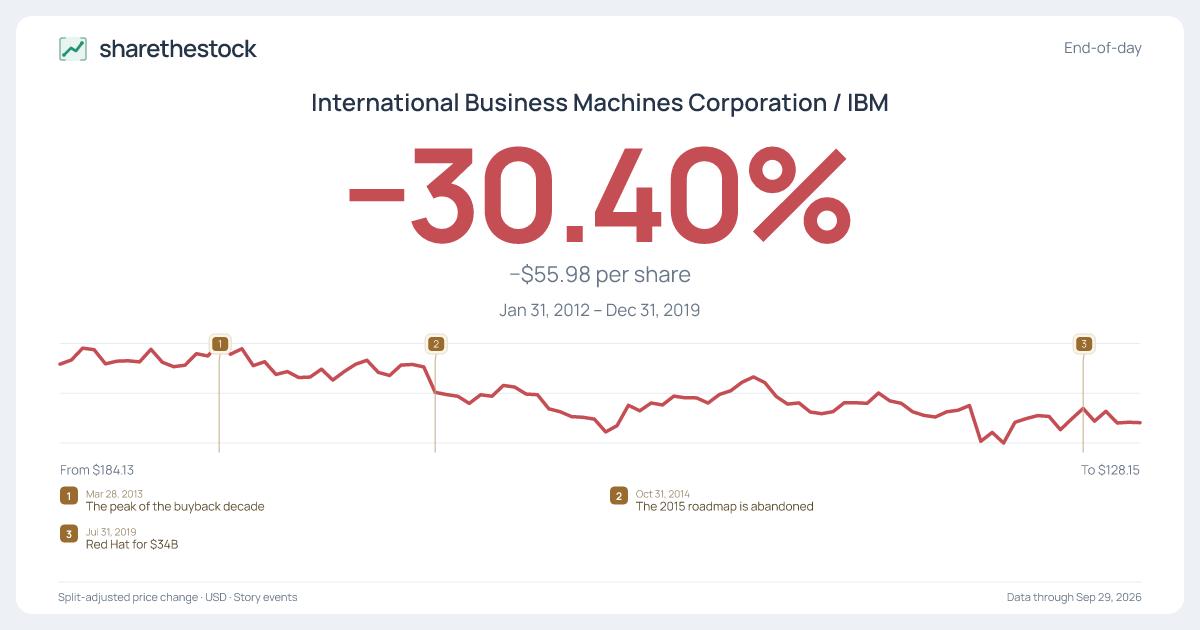
  4. 4Five years of declineJan 2012 – Dec 2019−30.40%
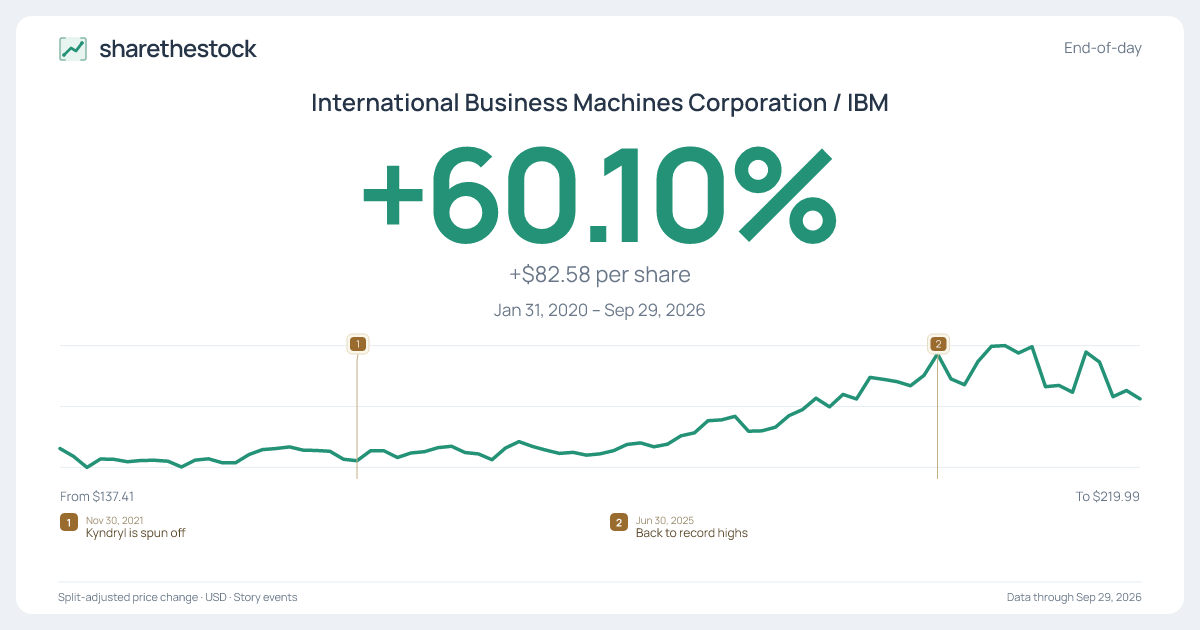
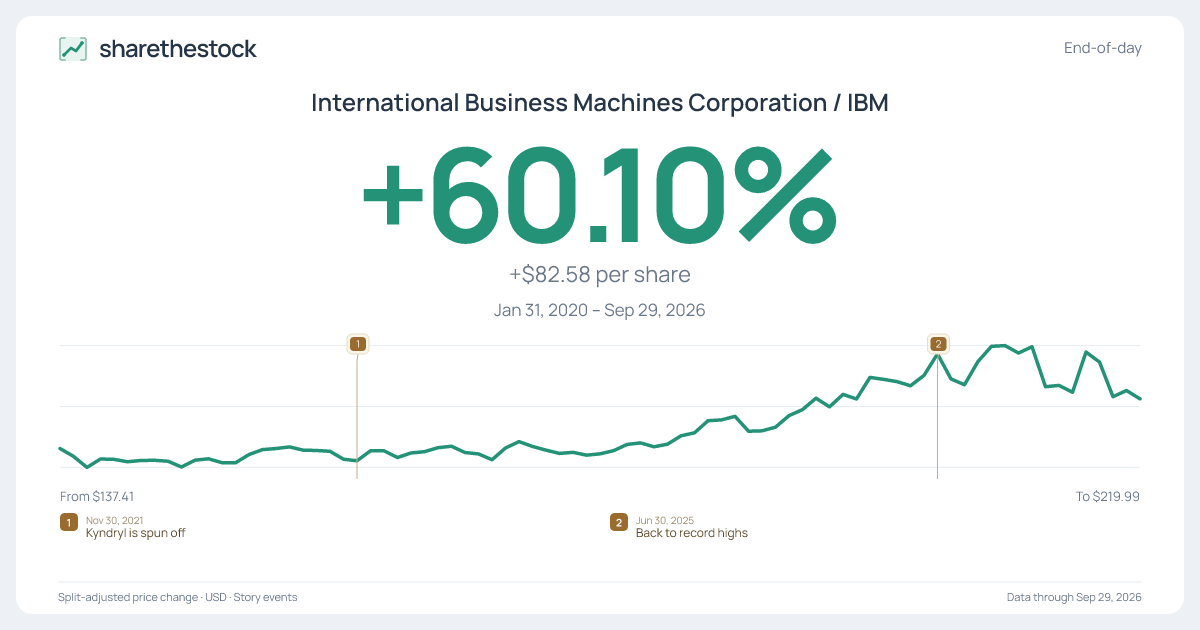
  5. 5Hybrid cloud and AIJan 2020 – Sep 2026+60.10%

The company every other company had to buy from

System/360 made computing a platform and IBM the only credible supplier of it. By the 1980s IBM was so dominant that its decision to outsource the PC’s operating system barely registered as a risk — the single most consequential licensing mistake in business history.

  1. Founded as the Computing-Tabulating-Recording Company

    A merger of four businesses making scales, time clocks and punched-card tabulators. Thomas Watson Sr. arrives in 1914 and renames it International Business Machines a decade later.

    Private company — no public price yet
  2. System/360 — the first computer family

    A $5B bet that customers want compatibility across a product line rather than a single machine. It creates the software industry by making programs portable, and IBM owns the decade.

    Before monthly price data begins
  3. The IBM PC, and the licence it gave away

    Built in a year with off-the-shelf parts and a non-exclusive operating system licence from a small company in Seattle. IBM wins the market and hands the franchise to Microsoft and Intel.

    Closed $13.18 that month
  4. The high-water mark of the hardware era

    IBM is the most profitable company in the world. Within four years it will be posting historic losses on the same business.

    Closed $40.24 that month
The largest corporate loss in American history

Cheap servers and PCs commoditised the hardware, the mainframe business collapsed, and IBM lost money on a scale nobody had seen. The board hired an outsider who refused the obvious remedy of breaking the company into pieces.

  1. An $8B annual loss

    The largest loss any American company had reported. The dividend is cut for the first time, 100,000 jobs go, and the board starts looking outside the company for a chief executive.

    Closed $12.31 that month
  2. Gerstner arrives and refuses the breakup

    A former RJR Nabisco executive rejects the plan to split IBM into thirteen pieces, on the grounds that the one thing customers cannot buy anywhere else is integration.

    Closed $11.62 that month
  3. Lotus for $3.5B

    A hostile takeover of a desktop-software company for one asset: Notes, and the idea that IBM should sell software as a business rather than a bundled extra.

    Closed $22.94 that month

Selling integration instead of iron

Gerstner and then Palmisano rebuilt IBM around consulting, middleware and outsourcing, exited commodity hardware, and produced fifteen years of rising earnings per share — a lot of it engineered rather than grown.

  1. Deep Blue beats Kasparov

    A marketing triumph that reintroduces IBM as a research company, twenty-four years before the AI cycle it was rehearsing for.

    Closed $41.35 that month
  2. PwC Consulting for $3.5B

    IBM buys 30,000 consultants and completes the transformation into a services company where more than half of revenue is people.

    Closed $75.47 that month
  3. The PC business is sold to Lenovo

    IBM exits the category it created, for $1.75B. It is the right call on margins and the end of IBM as a consumer name.

    Closed $94.24 that month
  4. Watson wins Jeopardy

    A genuine research achievement that gets sold as a commercial AI platform for the next decade, mostly unsuccessfully. The healthcare unit is eventually divested.

    Closed $154.76 that month

When financial engineering ran out

The roadmap promised earnings, not revenue, and revenue fell for twenty-two straight quarters. Watson was marketed as artificial intelligence years before the technology could deliver it, and the cloud transition started late.

  1. The peak of the buyback decade

    Earnings per share hit the roadmap target while revenue is already shrinking. It is the last time IBM trades at these levels for eight years.

    Closed $203.92 that month
  2. The 2015 roadmap is abandoned

    IBM drops its own earnings target, pays GlobalFoundries $1.5B to take its chip fabs, and admits the transition is not working.

    Closed $157.17 that month
  3. Red Hat for $34B

    The largest software acquisition IBM has made, and the one that gives it a defensible position: the layer enterprises use to run workloads across every cloud.

    Closed $141.72 that month

Narrower, and finally growing again

Red Hat gave IBM a real position in how enterprises run software, the low-margin infrastructure business was spun off, and the AI cycle arrived at a company that sells exactly the kind of integration work it creates.

  1. Kyndryl is spun off

    Two-thirds of the managed-infrastructure business leaves as a separate company. What remains is smaller, higher-margin, and able to report growth.

    Closed $117.10 that month
  2. Back to record highs

    Software and consulting bookings tied to AI deployment return IBM to all-time highs for the first time since 2013 — a twelve-year round trip.

    Closed $294.78 that month

The whole arc

+1273.02% in 57 years

One chart, Jan 30, 1970 – Sep 29, 2026. Open it, drag a range, add your own markers — or take this card with you.