sharethestock

The company story

Cisco Systems, Inc.

XNAS: CSCO · USD · split-adjusted

Cisco built the plumbing of the internet and was, for one month in 2000, the most valuable company on earth. Its chart is the best lesson available on the difference between a great business and a good price.

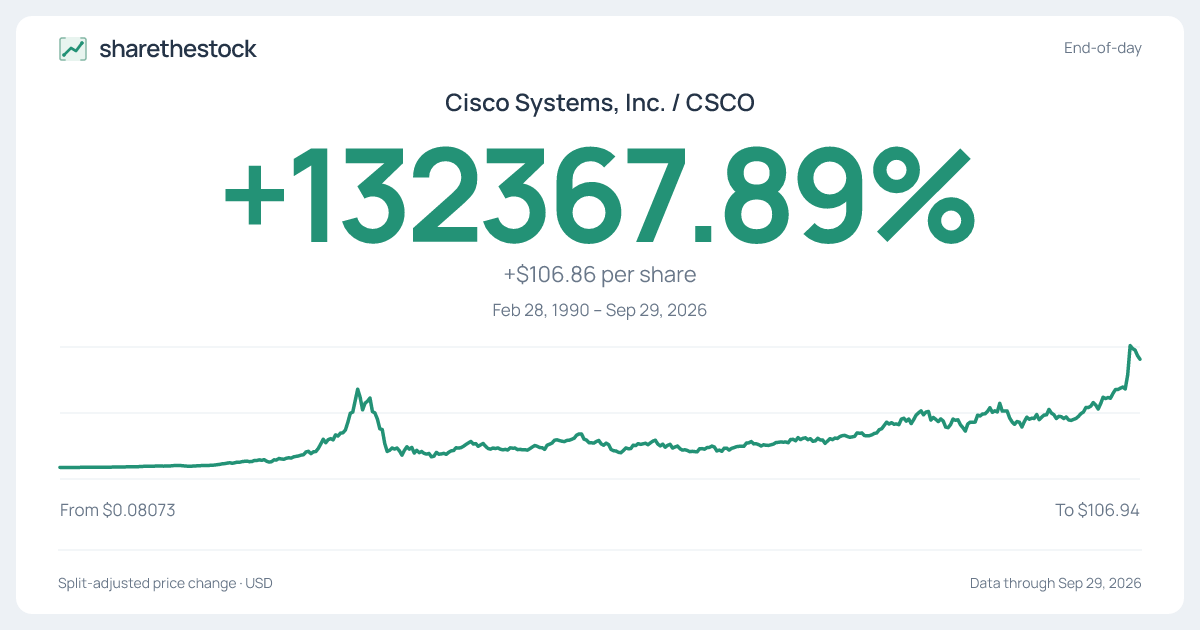
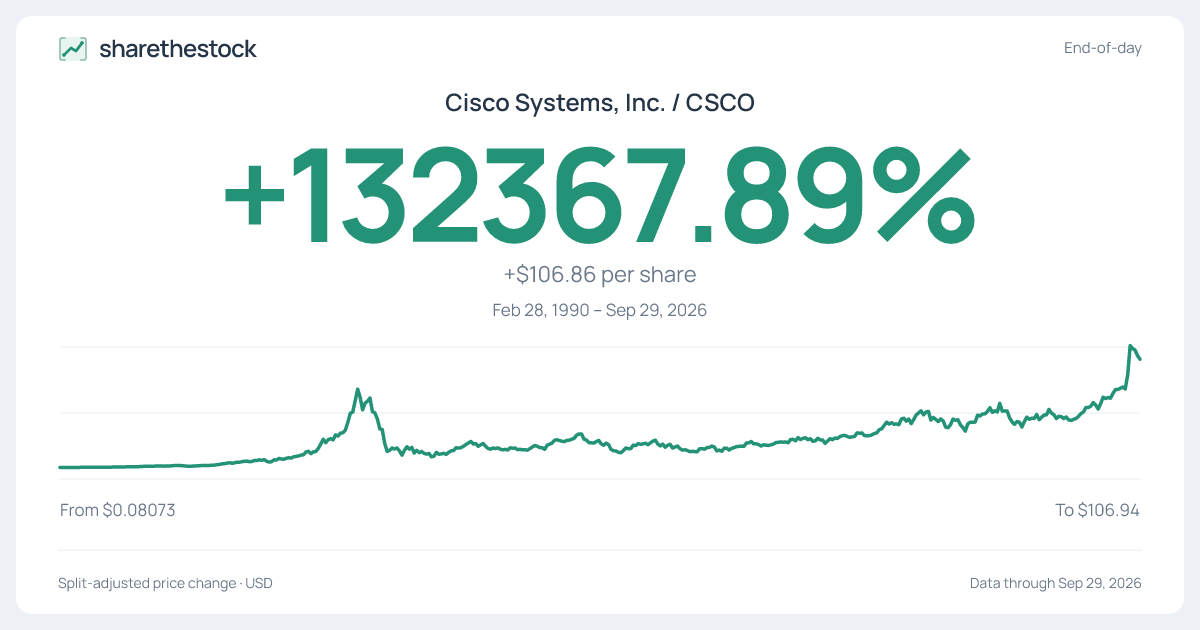
$0.08073first monthly close, Feb 1990 $106.94latest, Sep 29, 2026 +132367.89%since Feb 1990 $1,000 → $1,324,678.89first close to now
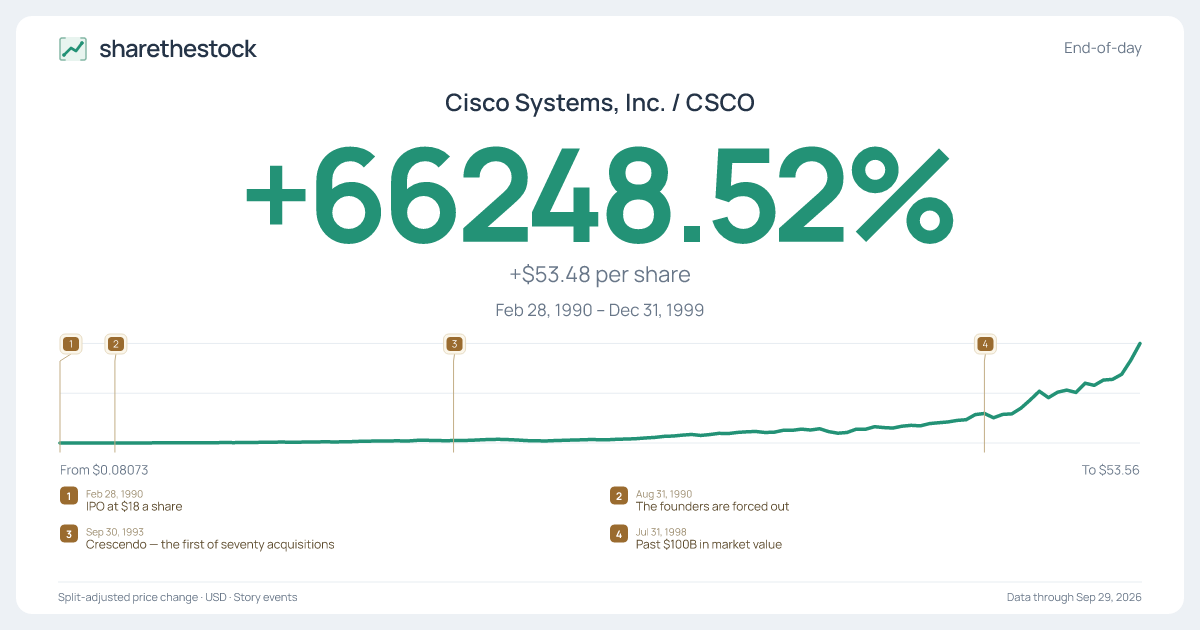
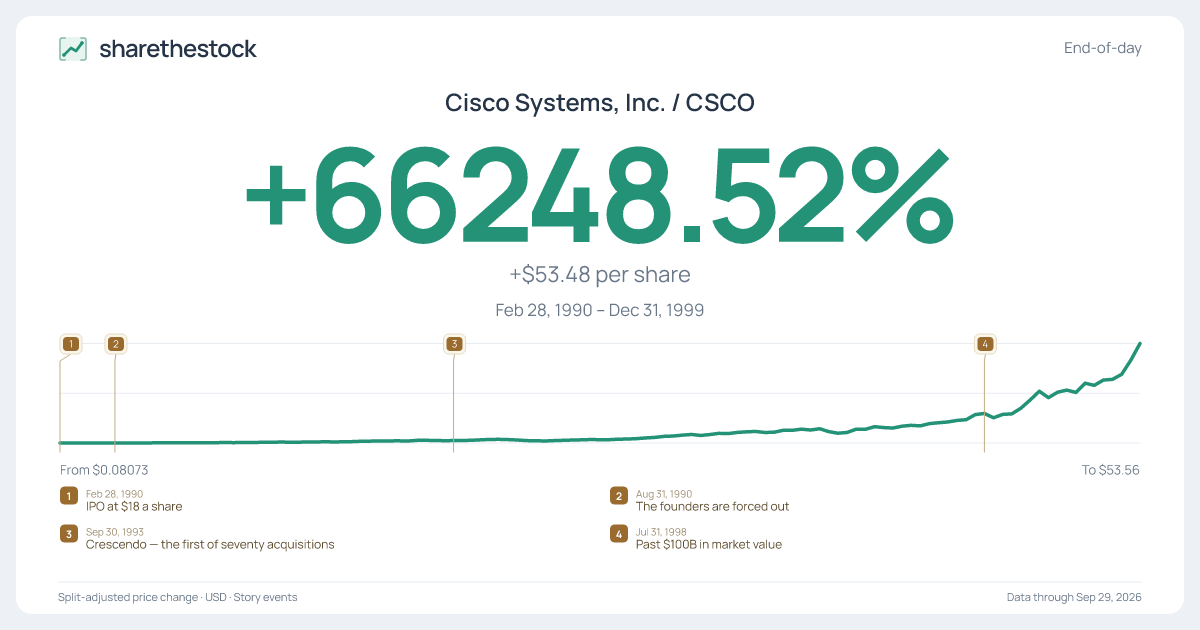
  1. 1The routerFeb 1990 – Dec 1999+66248.52%
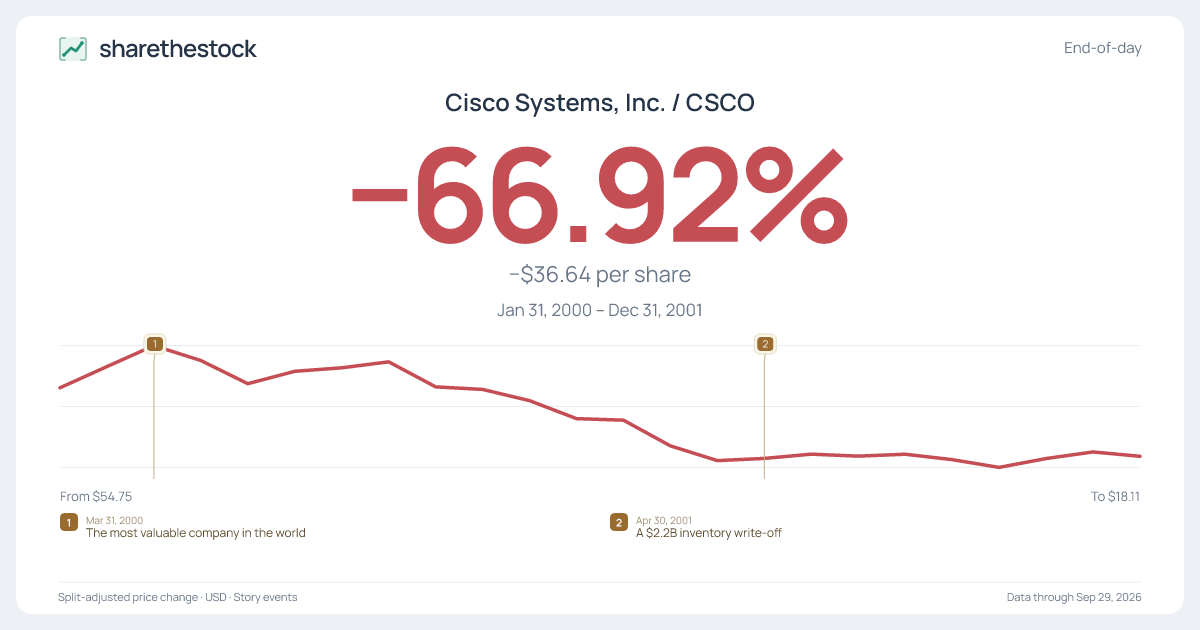
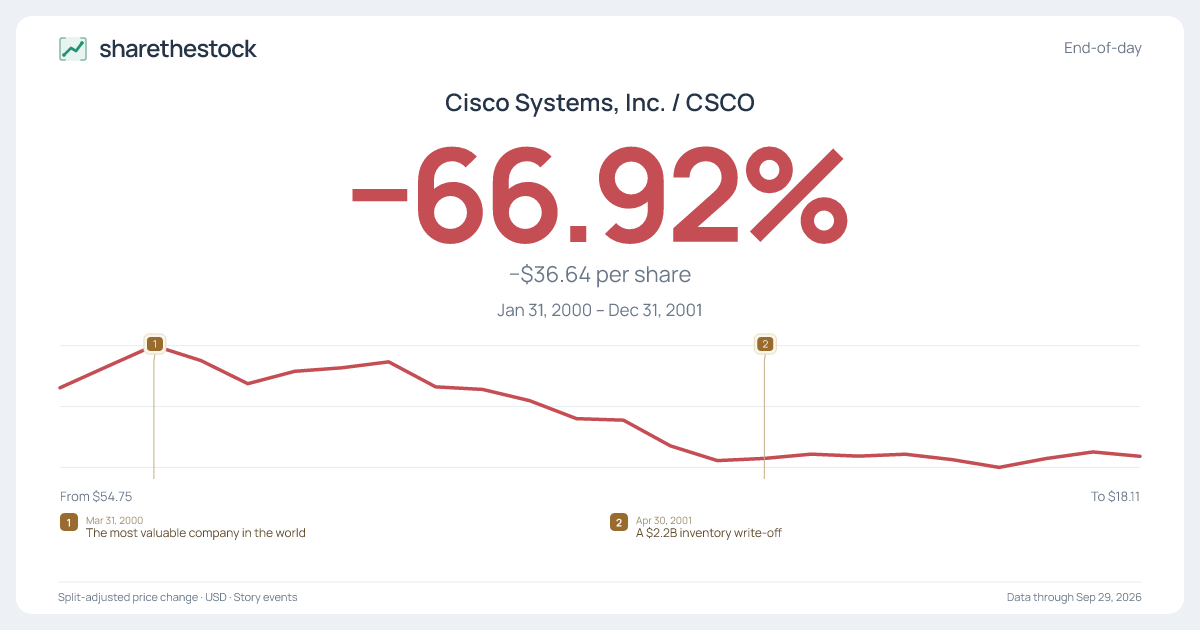
  2. 2The most valuable company in the worldJan 2000 – Dec 2001−66.92%
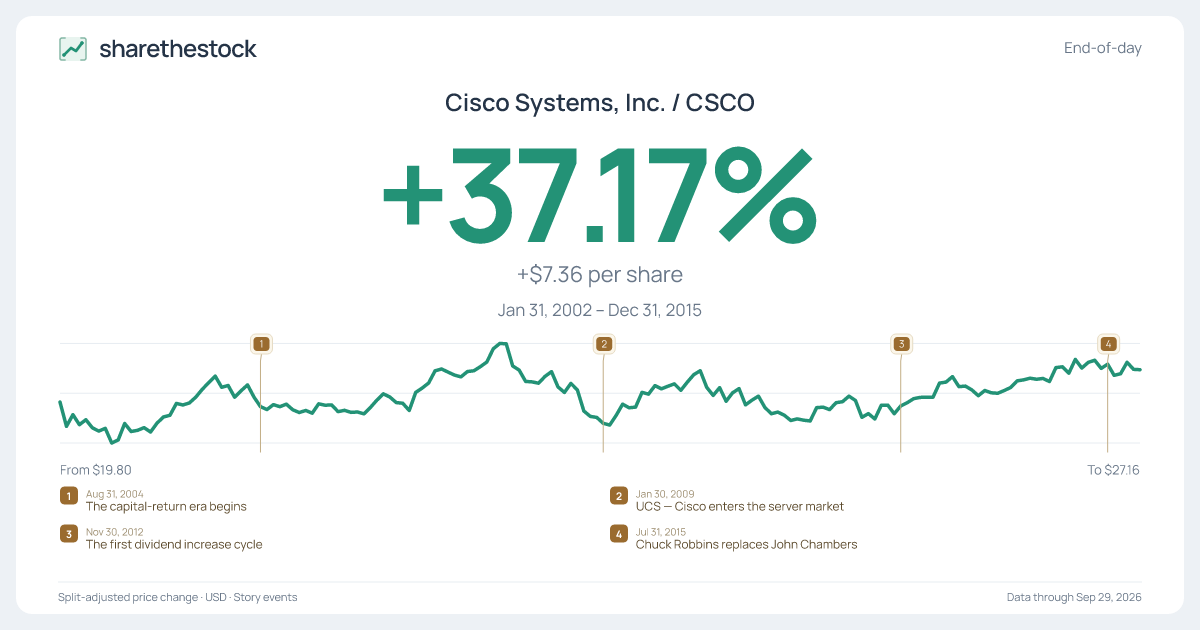
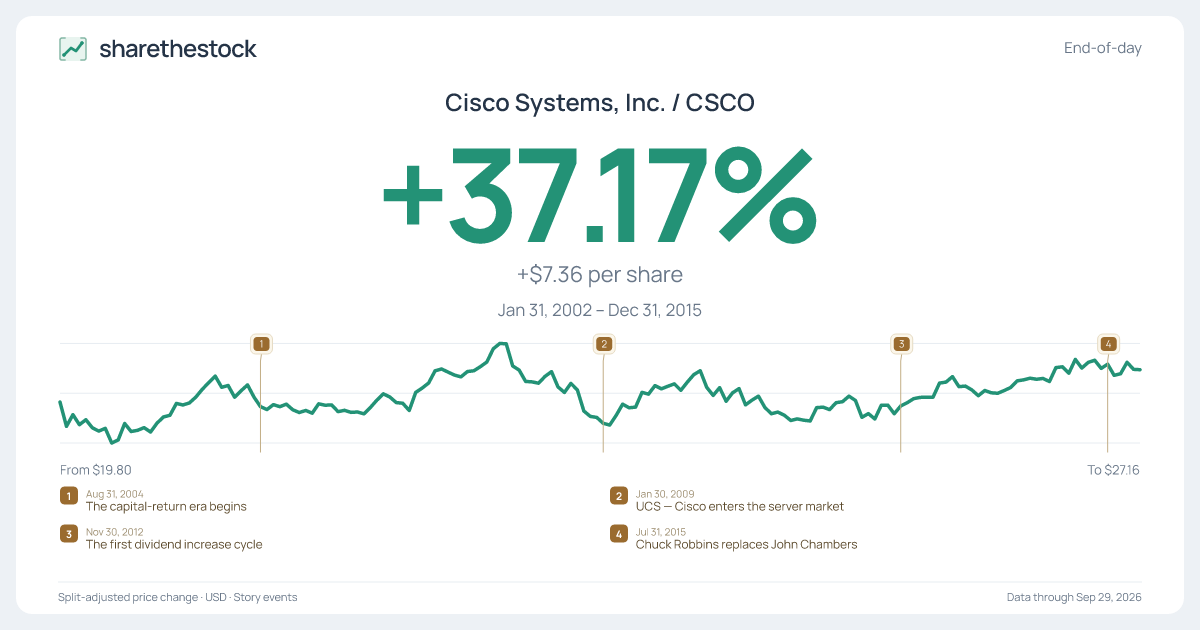
  3. 3Two decades under the peakJan 2002 – Dec 2015+37.17%
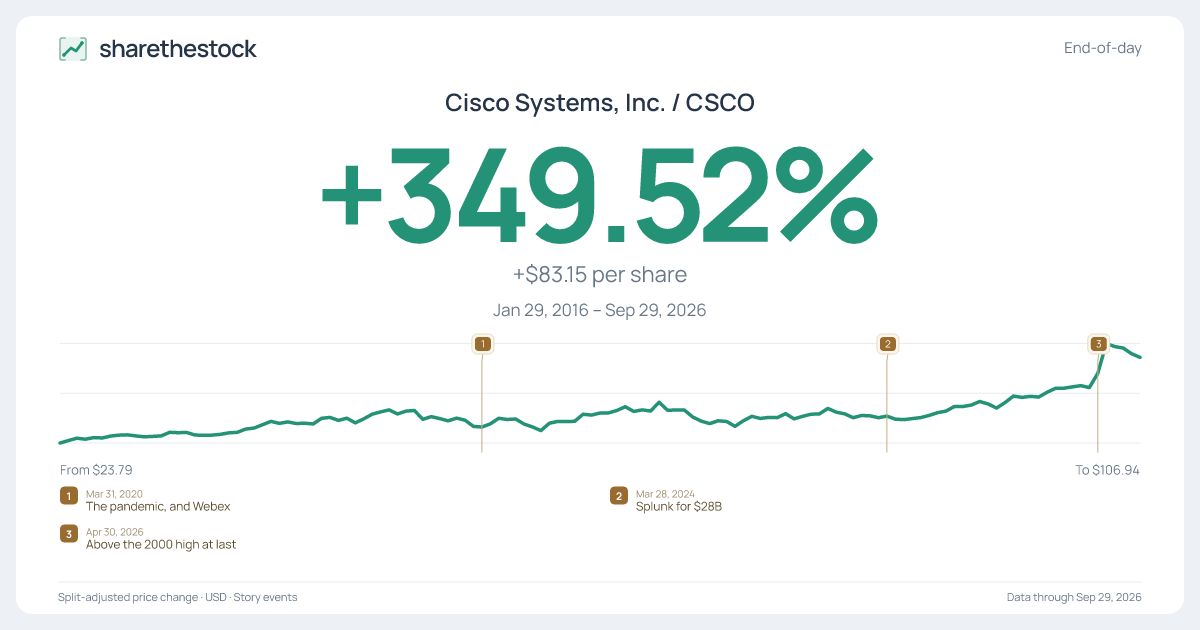
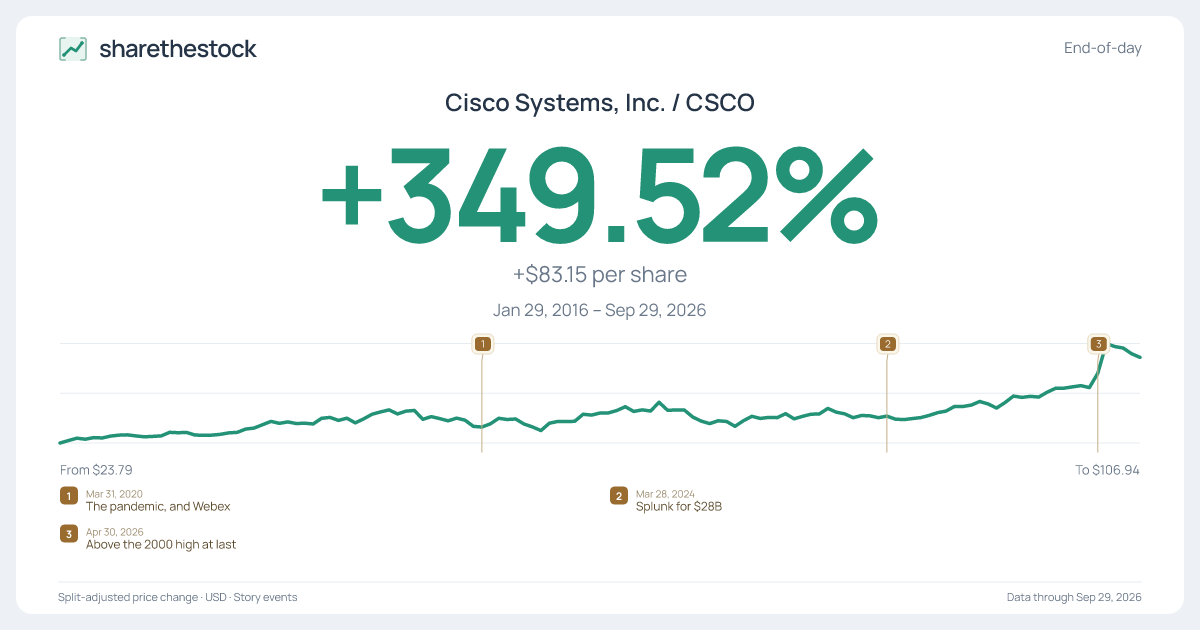
  4. 4Subscriptions and siliconJan 2016 – Sep 2026+349.52%

Selling the picks and shovels of the internet

A Stanford couple commercialised the multi-protocol router, venture capital replaced them with professional management, and John Chambers turned acquisitions into a manufacturing process — seventy companies bought in a decade, each one bolted onto the same sales force.

  1. Founded by Leonard Bosack and Sandy Lerner

    Two Stanford staff who built a router to connect incompatible campus networks mortgage their house to start the company. Both are gone within six years.

    Private company — no public price yet
  2. IPO at $18 a share

    A $224M valuation for a company selling the boxes that make networks interoperate. It is the single best IPO of the decade to have bought and held.

    Closed $0.08073 that month
  3. The founders are forced out

    Sequoia’s Don Valentine installs professional management and Lerner is fired; Bosack resigns the same day. They sell their stake and give most of it away.

    Closed $0.08594 that month
  4. Crescendo — the first of seventy acquisitions

    A $95M purchase of a switching company becomes the template: buy the technology, keep the engineers, sell it through Cisco’s channel. Nobody in the industry does it faster.

    Closed $1.39 that month
  5. Past $100B in market value

    Cisco becomes the purest way to own internet infrastructure growth, and index funds, retail investors and momentum all arrive at once.

    Closed $15.96 that month
A $555B peak, then an $2.2B write-off

At the top Cisco traded near a hundred times earnings on the assumption that network spending would compound forever. When the telecoms stopped buying, the inventory turned out to be worth a fraction of its cost.

  1. The most valuable company in the world

    A market capitalisation of roughly $555B at more than a hundred times earnings. Analysts publish price targets implying a trillion dollars.

    Closed $77.31 that month
  2. A $2.2B inventory write-off

    Orders evaporate as the telecom build-out stops. Cisco writes off equipment it can no longer sell, takes its first loss, and the stock ends the slide roughly 85% below the peak.

    Closed $16.98 that month

A very good business the market had finished paying up for

Cisco kept its share, generated enormous cash, started paying a dividend, and bought back shares relentlessly. Shareholders who bought in 2000 spent the whole period waiting; shareholders who bought in 2002 did fine.

  1. The capital-return era begins

    With growth back to the low teens, Cisco starts returning cash on a scale that eventually retires a large share of the float.

    Closed $18.76 that month
  2. UCS — Cisco enters the server market

    A move into its partners’ business that works commercially and ends the alliances that defined the previous decade.

    Closed $14.97 that month
  3. The first dividend increase cycle

    Cisco is formally a value stock: a dividend, a buyback, single-digit growth, and a valuation that reflects all three.

    Closed $18.91 that month
  4. Chuck Robbins replaces John Chambers

    After twenty years, the acquirer-in-chief hands over a company that has to convert hardware refresh cycles into software subscriptions.

    Closed $28.42 that month

Software, security, and finally a new high

A new CEO shifted the model toward recurring revenue, Splunk added a real security franchise, and AI data-center orders gave the networking business a growth story again — which is when the 2000 high finally fell.

  1. The pandemic, and Webex

    Enterprise hardware spending stops while the collaboration product it had under-invested in becomes essential — and then loses the category to Zoom and Teams anyway.

    Closed $39.31 that month
  2. Splunk for $28B

    The largest acquisition in Cisco’s history buys observability and security data, and turns a networking vendor into a company with a serious recurring-revenue base.

    Closed $49.91 that month
  3. Above the 2000 high at last

    Twenty-six years after the peak, AI data-center orders and the subscription mix carry Cisco past the level it reached at the top of the bubble.

    Closed $91.50 that month

The whole arc

+132367.89% in 37 years

One chart, Feb 28, 1990 – Sep 29, 2026. Open it, drag a range, add your own markers — or take this card with you.