sharethestock

The company story

Salesforce, Inc.

XNYS: CRM · USD · split-adjusted

Salesforce did not invent better CRM software. It invented the idea that you should not install any software at all — and then spent twenty years buying everything adjacent to the customer record.

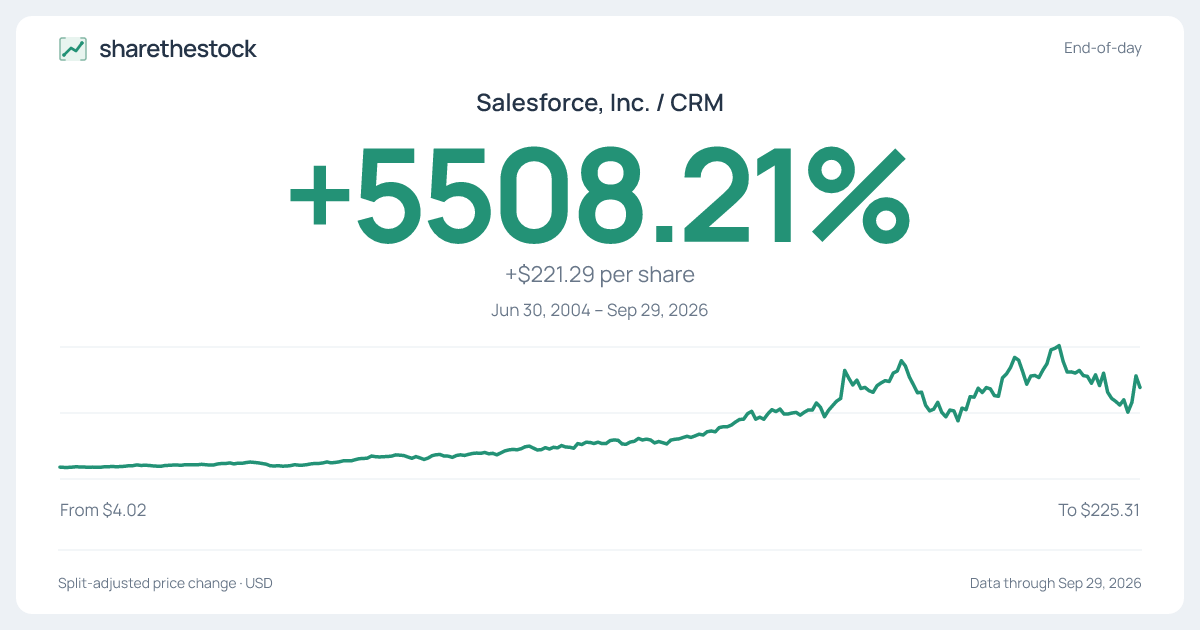
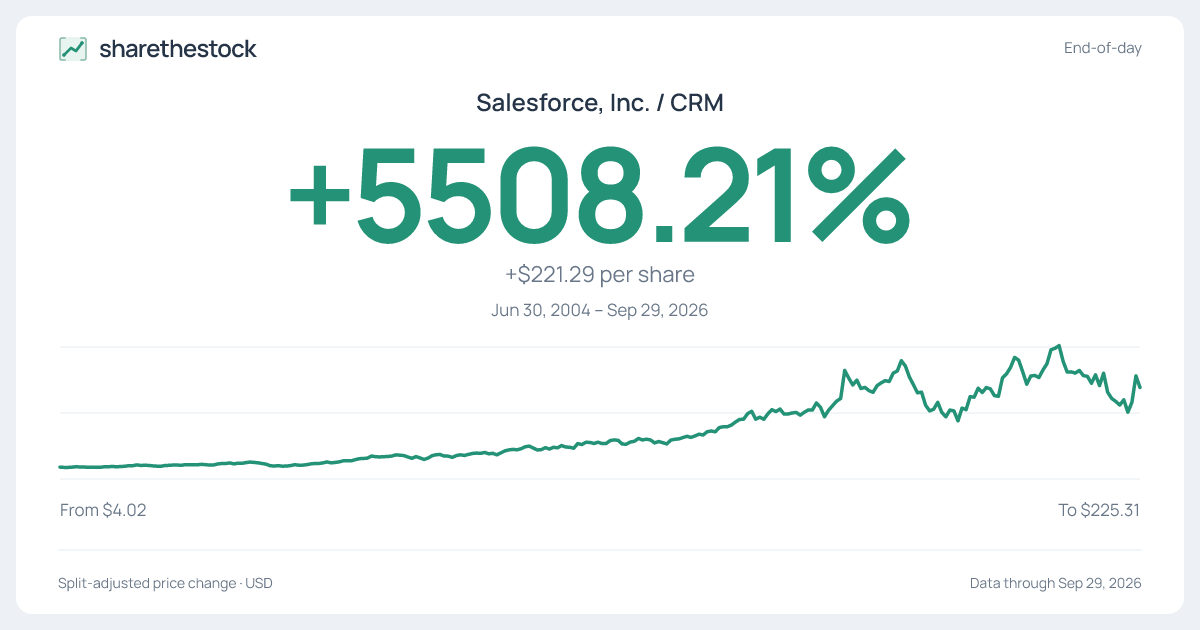
$4.02first monthly close, Jun 2004 $225.31latest, Sep 29, 2026 +5508.21%since Jun 2004 $1,000 → $56,082.14first close to now
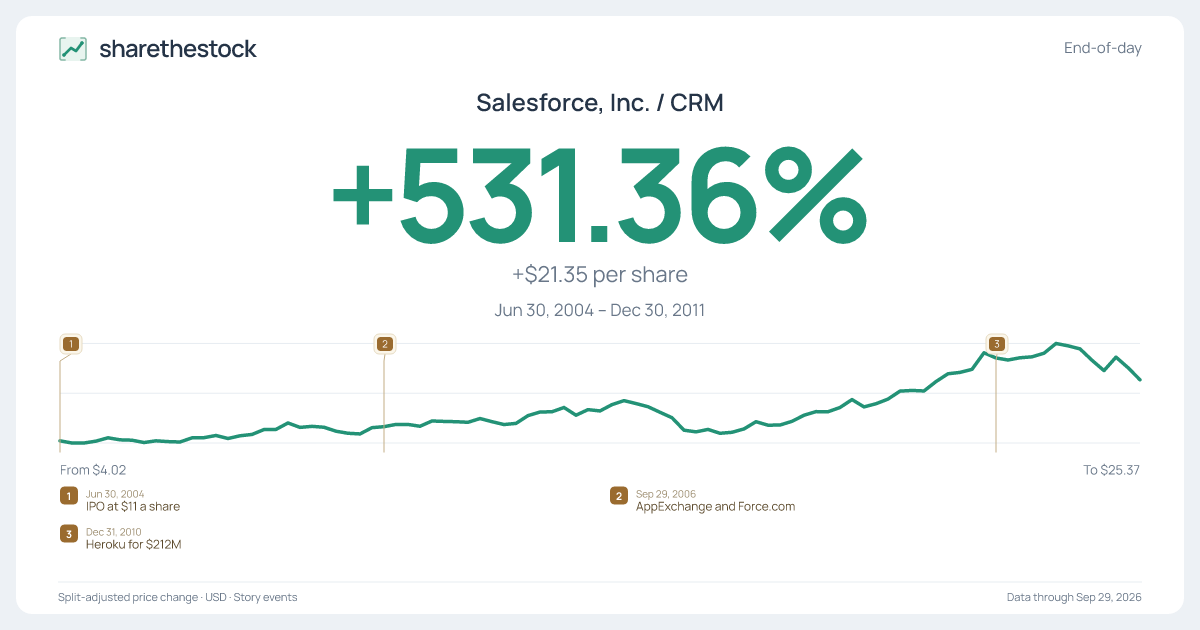
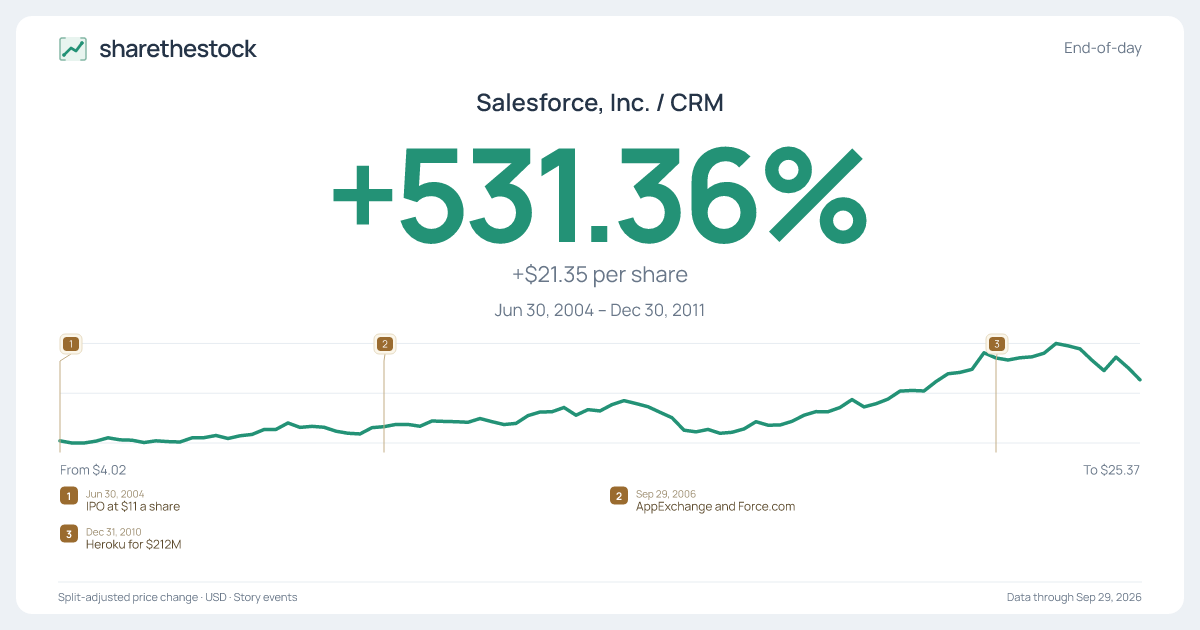
  1. 1No softwareJun 2004 – Dec 2011+531.36%
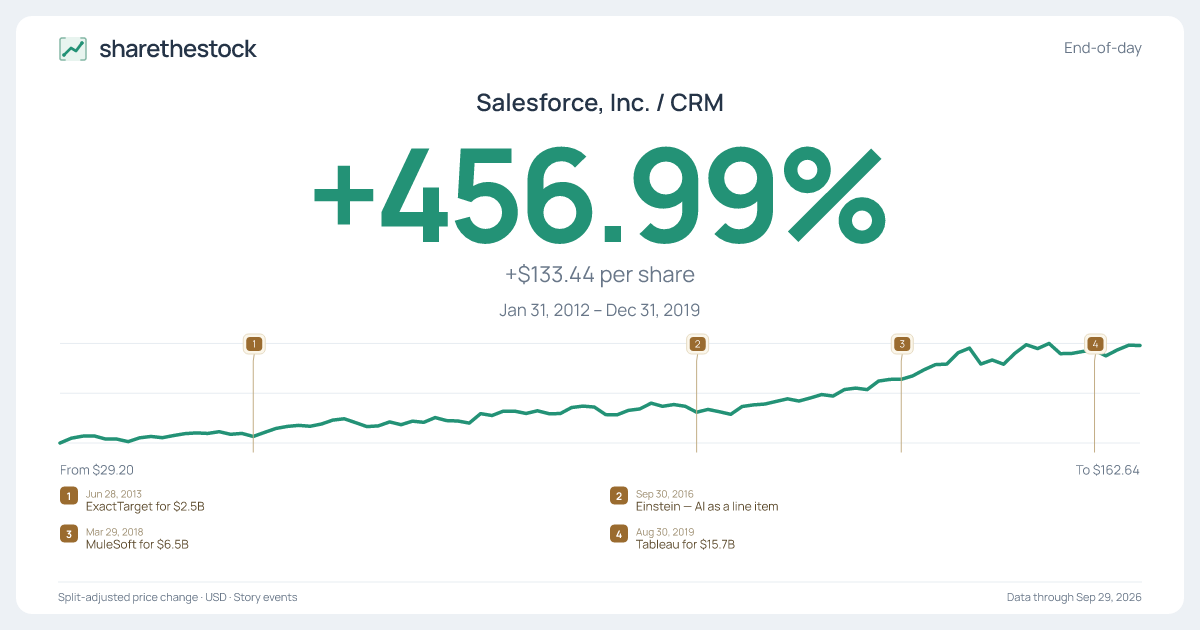
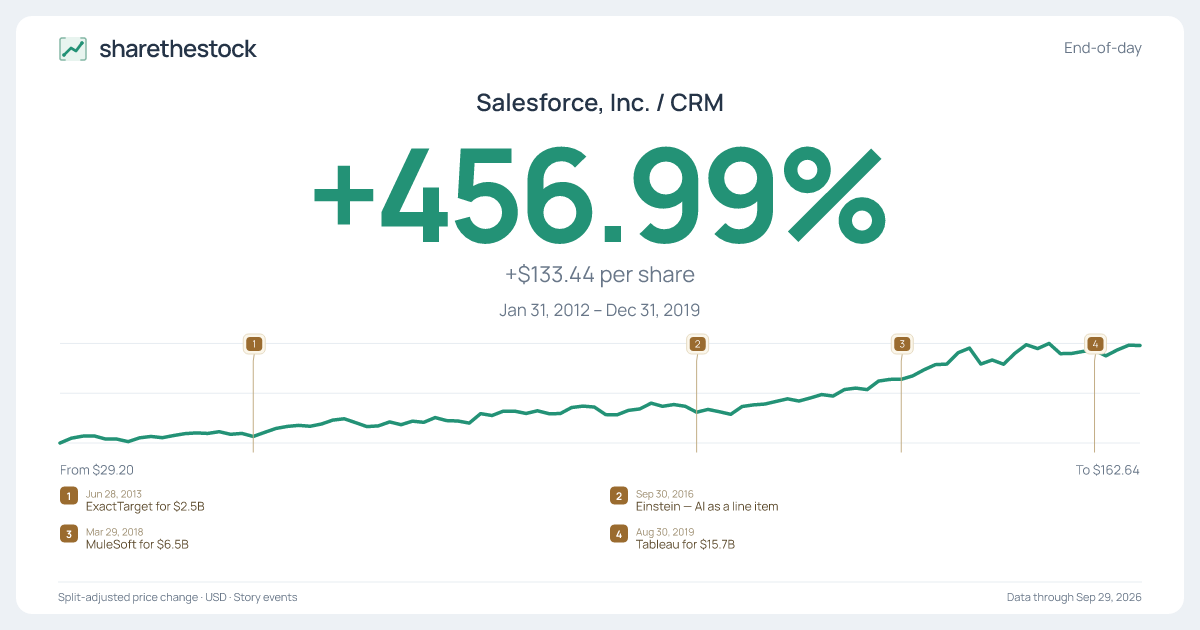
  2. 2The platform decadeJan 2012 – Dec 2019+456.99%
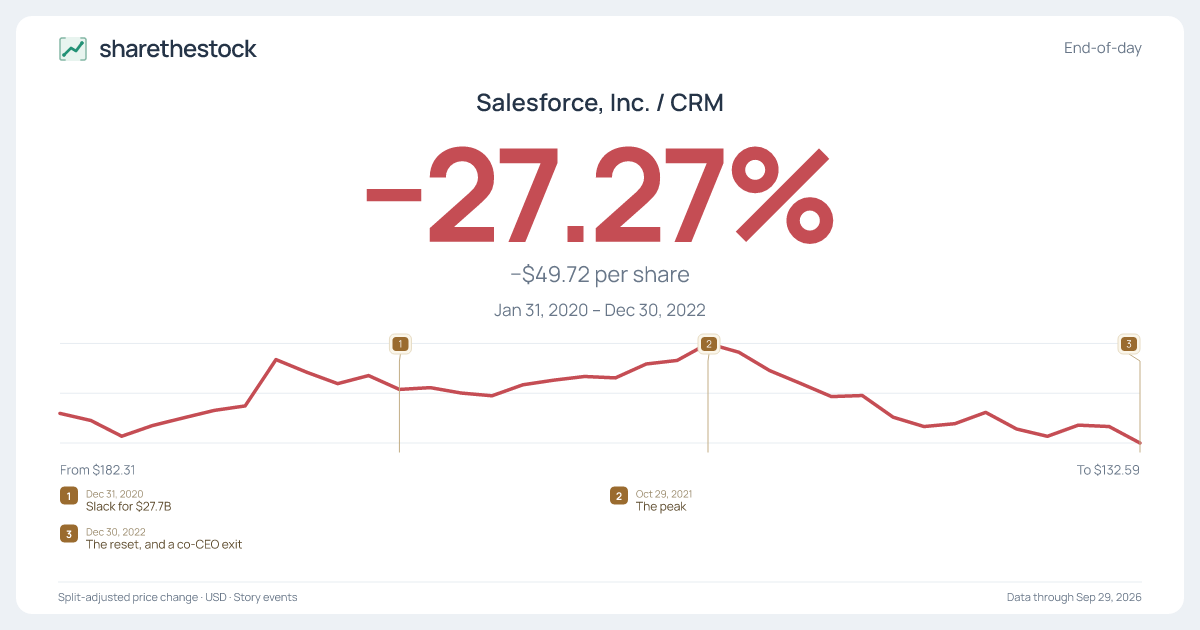
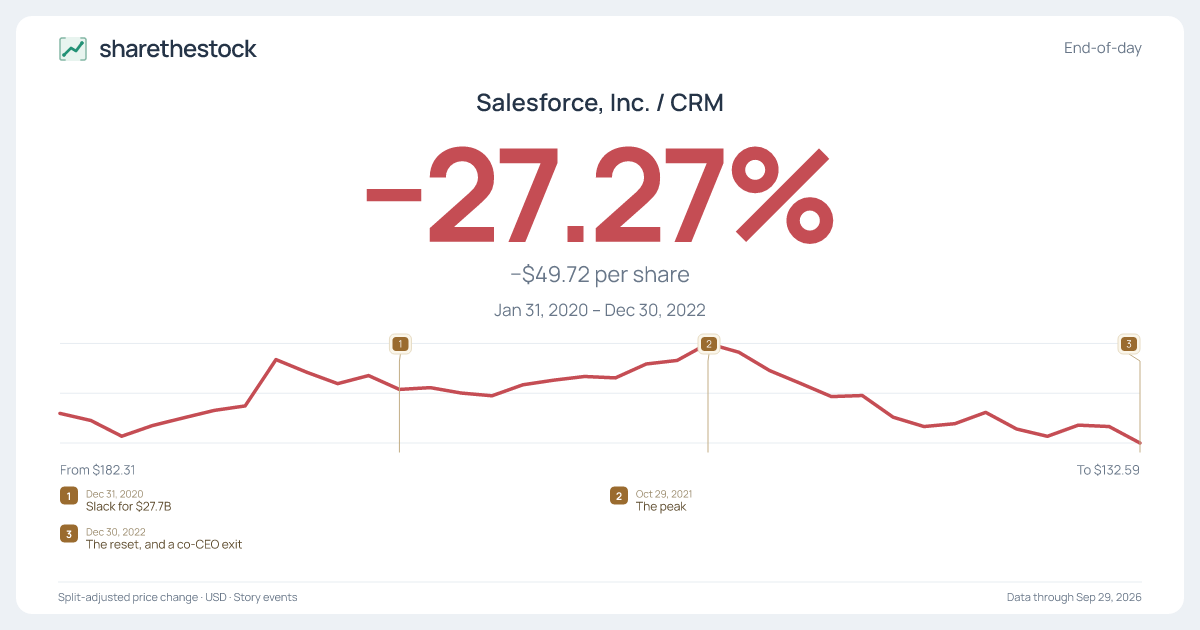
  3. 3Slack and the overbuildJan 2020 – Dec 2022−27.27%
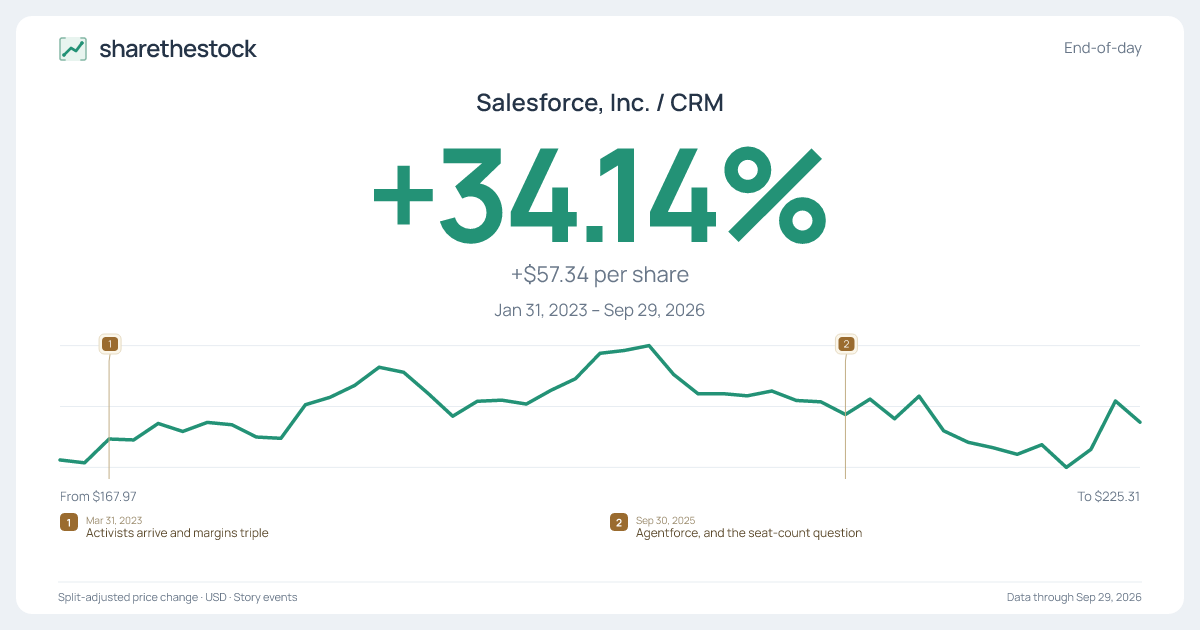
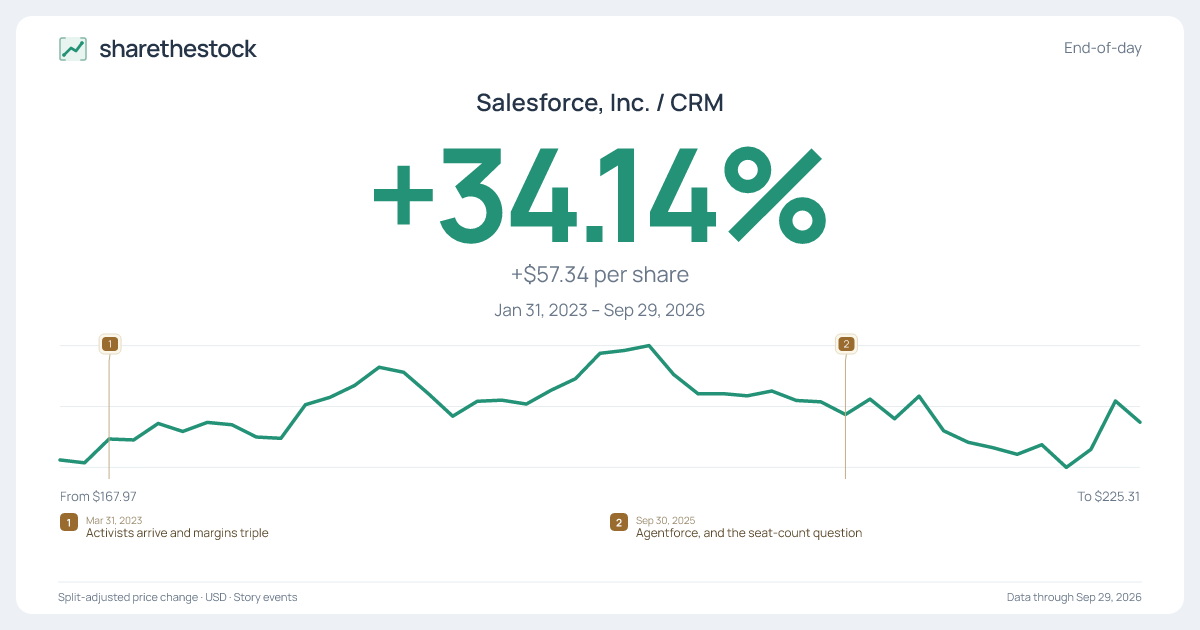
  4. 4Margins and agentsJan 2023 – Sep 2026+34.14%

A rented application, sold against an industry

Marc Benioff left Oracle, started a company in an apartment, and marketed it with a logo of the word “software” inside a red circle with a line through it. The IPO in 2004 was the first real public test of whether subscription software could be a business.

  1. Founded in a rented San Francisco apartment

    Benioff takes a sabbatical from Oracle and starts a company around one idea: business software delivered through a browser, billed monthly, with no installation.

    Private company — no public price yet
  2. IPO at $11 a share

    The first significant subscription-software listing. Sceptics point out that the company has never earned a meaningful profit, which remains true for most of the next twenty years.

    Closed $4.02 that month
  3. AppExchange and Force.com

    Customers can extend Salesforce and sell their extensions. The CRM product becomes a platform, and the switching costs stop being about data and start being about everything built on top of it.

    Closed $8.97 that month
  4. Heroku for $212M

    A developer-platform bet that signals the ambition: not an application vendor but the place enterprise software gets written.

    Closed $33.00 that month
Own the record, then sell everything around it

Salesforce turned the CRM database into a development platform and then bought its way across the marketing, integration and analytics stack. Growth stayed above 20% for years and profitability stayed just out of reach, by design.

  1. ExactTarget for $2.5B

    Marketing automation, and the start of a decade in which Salesforce buys a category leader roughly every eighteen months.

    Closed $38.18 that month
  2. Einstein — AI as a line item

    Predictive scoring and recommendations across the product, six years before the language-model cycle makes the branding look prescient.

    Closed $71.33 that month
  3. MuleSoft for $6.5B

    Integration software, because the customer record is only useful if it connects to the systems that already exist.

    Closed $116.30 that month
  4. Tableau for $15.7B

    An all-stock deal for analytics that doubles the size of Salesforce’s largest-ever acquisition — until the next one.

    Closed $156.07 that month

The most expensive acquisition, at the top

Pandemic demand pulled software spending forward, Salesforce paid $27.7B for Slack, and hiring ran well ahead of the revenue. The reckoning came within a year: growth decelerated, activists arrived, and the stock more than halved.

  1. Slack for $27.7B

    Announced into the strongest software tape in history. It gives Salesforce a communications layer and gives investors their first real doubts about capital discipline.

    Closed $222.53 that month
  2. The peak

    Revenue growth above 25% and a multiple to match. From here the stock spends three years going nowhere while the business nearly doubles.

    Closed $299.69 that month
  3. The reset, and a co-CEO exit

    Bret Taylor resigns weeks after Slack’s founder leaves, growth decelerates sharply, and Salesforce announces the largest layoffs in its history.

    Closed $132.59 that month

A growth company learning to be a profitable one

Thousands of roles were cut, margins expanded faster than anyone expected, and the story became cash generation. Then AI raised the uncomfortable question of whether a business priced per seat benefits from software that needs fewer seats.

  1. Activists arrive and margins triple

    Five activist investors take positions at once. Operating margin goes from the mid-single digits to above 30% in two years, and the stock recovers most of the drawdown.

    Closed $199.78 that month
  2. Agentforce, and the seat-count question

    Salesforce prices AI agents by conversation rather than by user — an answer to the argument that its own technology reduces the number of people who need a licence.

    Closed $237.00 that month

The whole arc

+5508.21% in 22 years

One chart, Jun 30, 2004 – Sep 29, 2026. Open it, drag a range, add your own markers — or take this card with you.