A private-equity strategy running inside a semiconductor company.
Broadcom is not really a chip company in the traditional sense. It is an acquisition machine run by Hock Tan that buys franchises with locked-in customers, raises prices, cuts everything else, and repeats — and it has beaten almost every chip company on returns doing it.
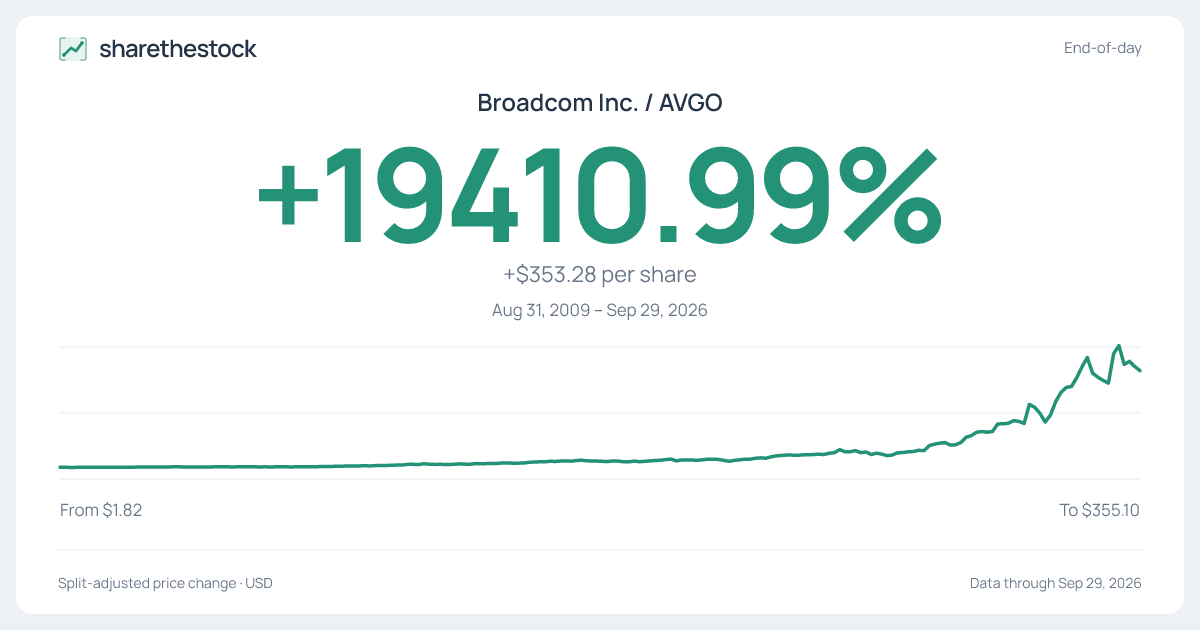
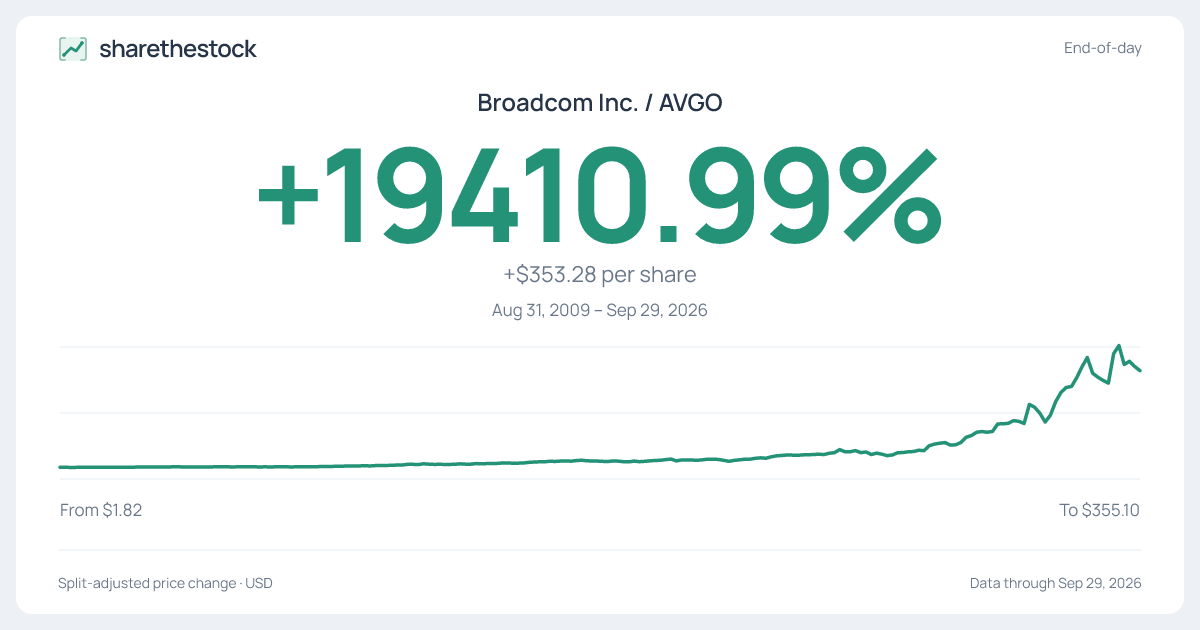
$1.82first monthly close, Aug 2009$355.10latest, Sep 29, 2026+19410.99%since Aug 2009$1,000 → $195,109.89first close to now
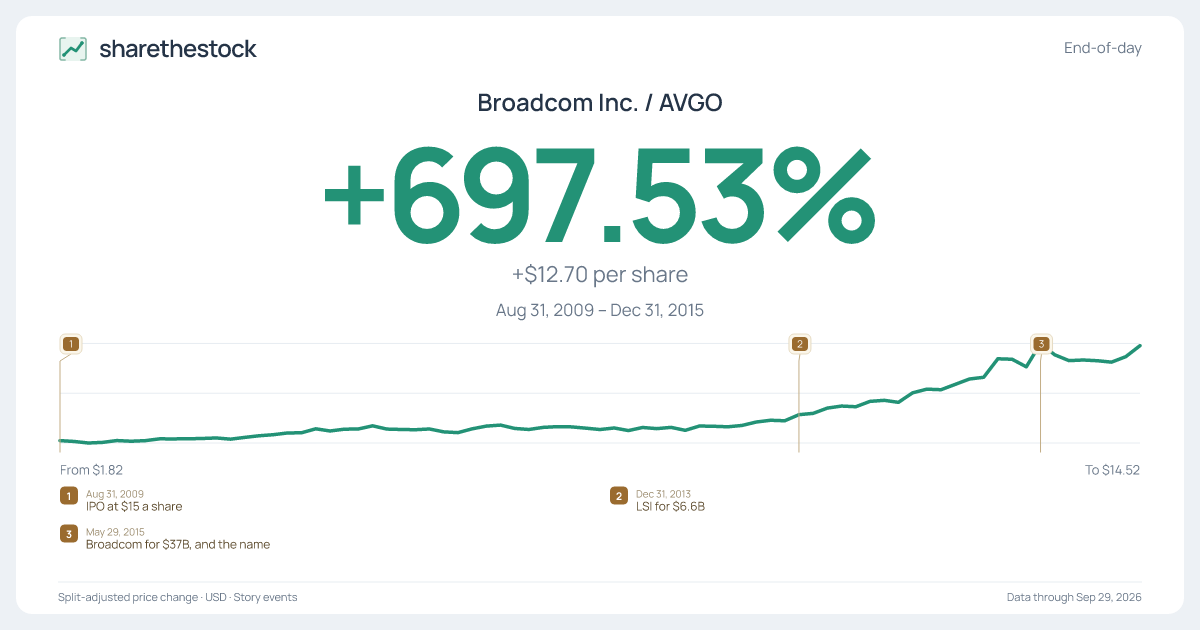
The business started as Hewlett-Packard’s semiconductor group, was sold to private equity in 2005 as Avago, and listed in 2009. Then it bought LSI, and then it bought a company nearly twice its size and took its name.
Founded as HP’s semiconductor divisionFounding
A components group inside Hewlett-Packard making optoelectronics and RF parts, which passes to Agilent in the 1999 split.
Private company — no public price yet
KKR and Silver Lake buy the unit for $2.66BDeal
The carve-out is renamed Avago, and Hock Tan is installed as chief executive. The private-equity playbook he brings never really leaves.
Private company — no public price yet
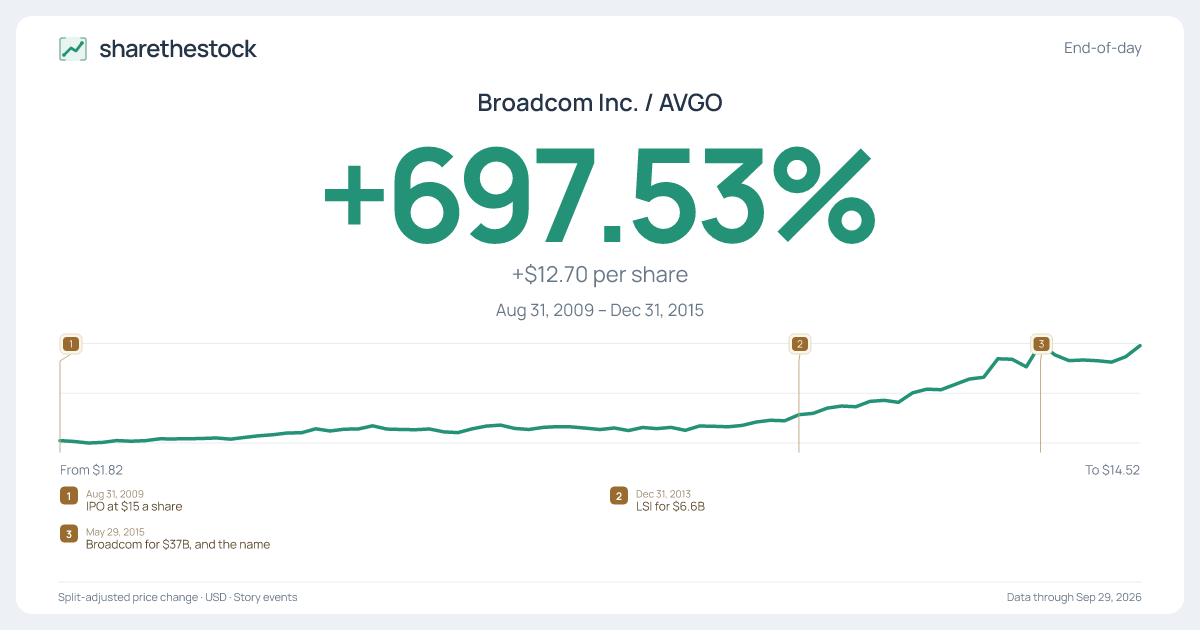
IPO at $15 a shareMarket
A components business with a modest valuation and, as it turns out, the best capital allocator in the industry running it.
Closed $1.82 that month
LSI for $6.6BDeal
The first large deal: storage and networking silicon, funded with debt, followed by immediate cuts to everything that is not a leading franchise.
Closed $5.29 that month
Broadcom for $37B, and the nameDeal
Avago buys a company larger than itself, takes its brand, and becomes one of the biggest semiconductor suppliers in the world in a single transaction.
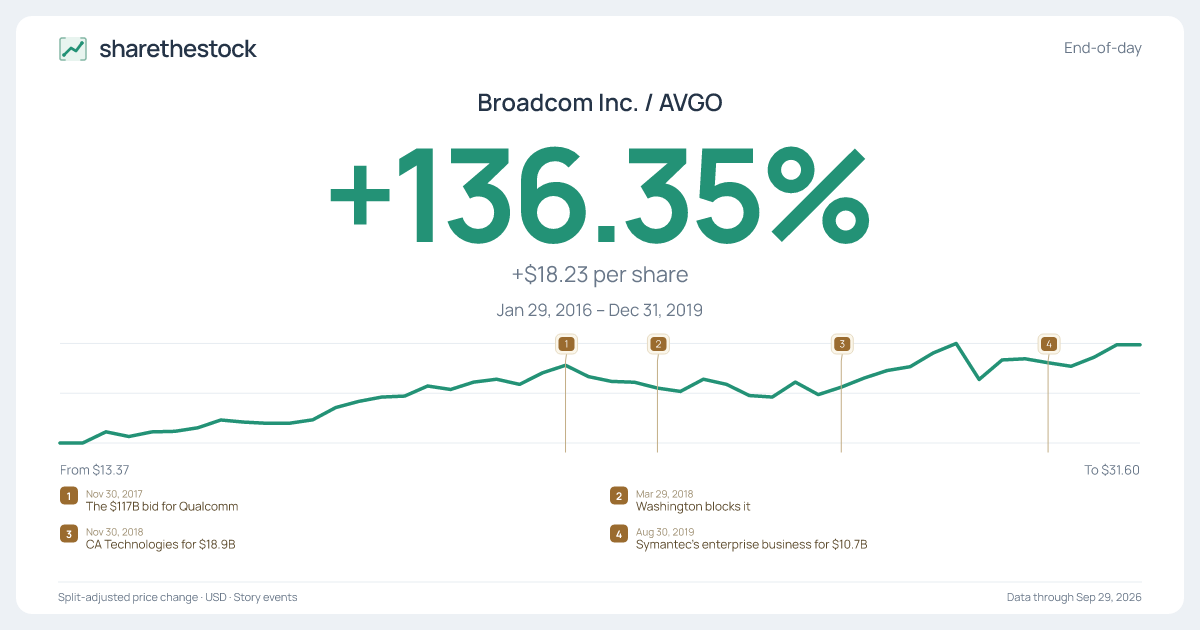
When Washington stopped the attempt to buy Qualcomm, Tan turned to enterprise software instead — CA and Symantec — on the theory that mainframe tools and security suites have exactly the kind of captive, high-margin renewal base he looks for in silicon.
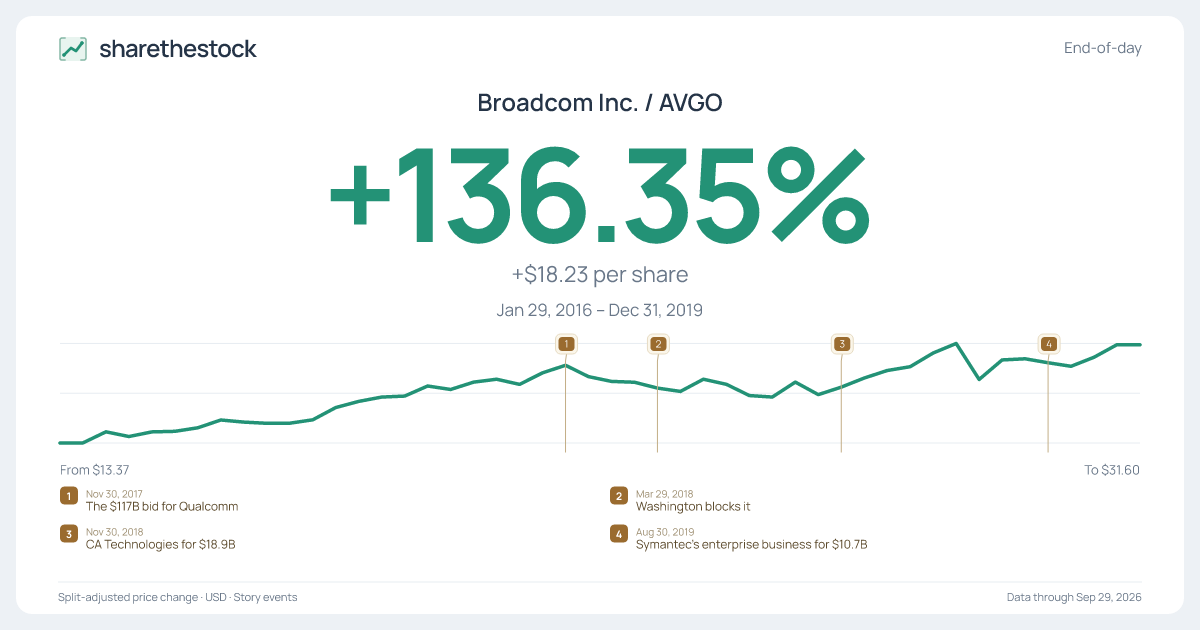
The $117B bid for QualcommCrisis
An unsolicited offer that would have been the largest technology acquisition ever attempted, pursued through a proxy fight for the target’s board.
Closed $27.79 that month
Washington blocks itCrisis
A presidential order stops the deal on national-security grounds. Broadcom redomiciles to the United States and redirects its ambitions to software.
Closed $23.57 that month
CA Technologies for $18.9BDeal
Mainframe software, bought by a chip company, to widespread investor confusion. The renewal economics turn out to be exactly what Tan said they were.
Closed $23.74 that month
Symantec’s enterprise business for $10.7BDeal
Another captive base with high switching costs. Broadcom raises prices, focuses on the largest accounts, and lets the rest go.
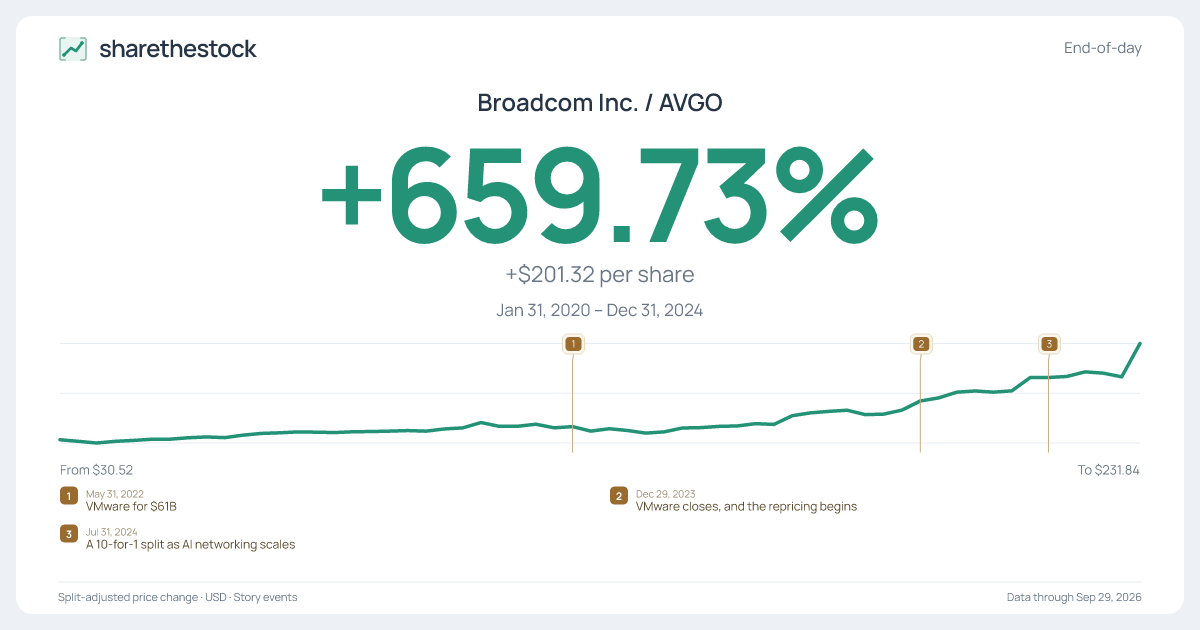
VMware, and the networking that the build-out needs
The $61B VMware deal was followed by immediate price and packaging changes that infuriated customers and delivered the margins promised to investors. At the same time, custom accelerators and switching silicon made Broadcom the second-largest beneficiary of AI infrastructure.
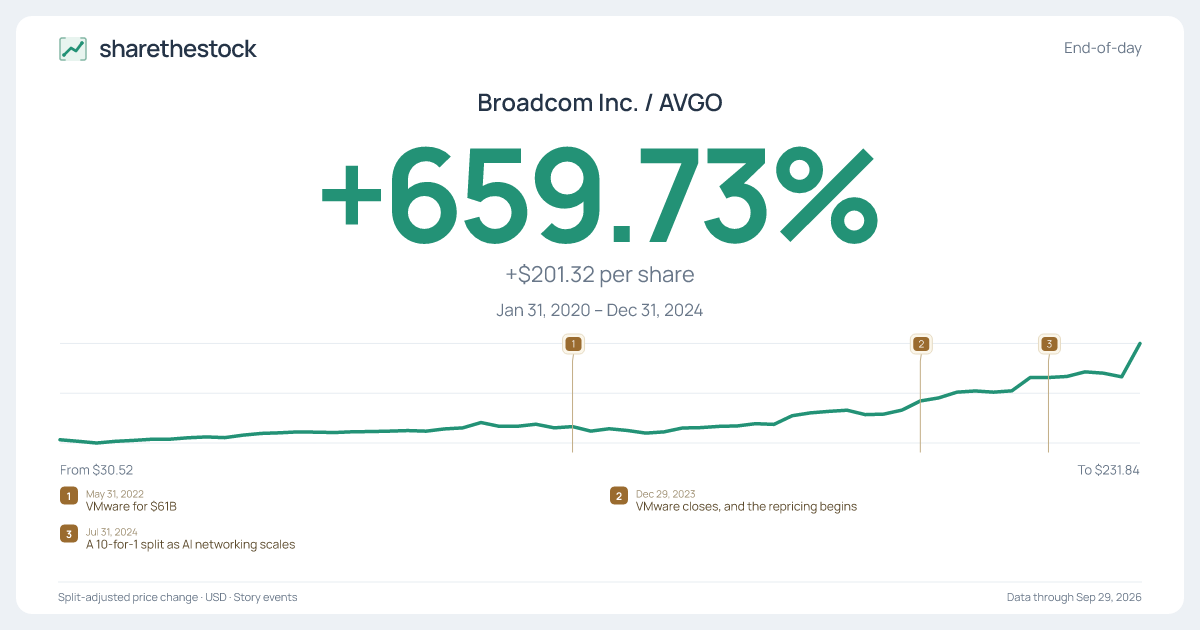
VMware for $61BDeal
Eighteen months of regulatory review for control of enterprise virtualisation — the layer nearly every private data center runs on.
Closed $58.01 that month
VMware closes, and the repricing beginsMarket
Perpetual licences end, bundles replace à la carte products, and customers publicly complain about increases of several multiples. Margins go where Broadcom told investors they would.
Closed $111.63 that month
A 10-for-1 split as AI networking scalesMarket
Custom accelerator programmes and Tomahawk switching make Broadcom the clearest AI infrastructure winner outside of NVIDIA, and the shares split to stay accessible.
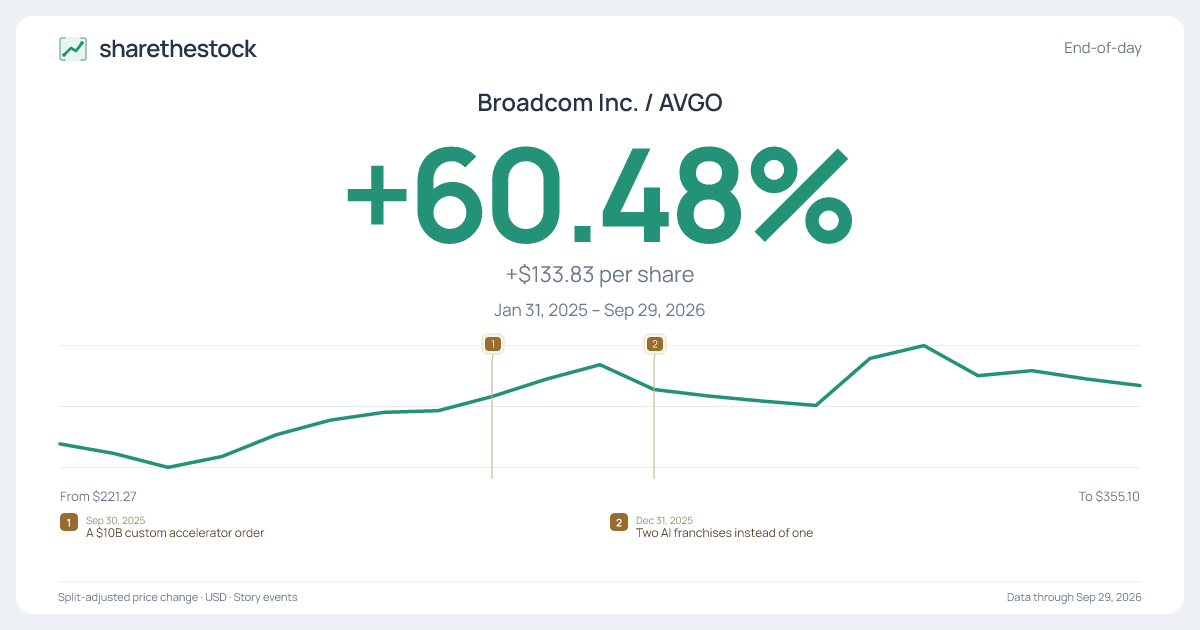
Every large cloud provider wants an alternative to buying merchant accelerators, and Broadcom is who they hire to build one. The stock now prices a business with two AI franchises — the accelerators it co-designs and the network that connects them.
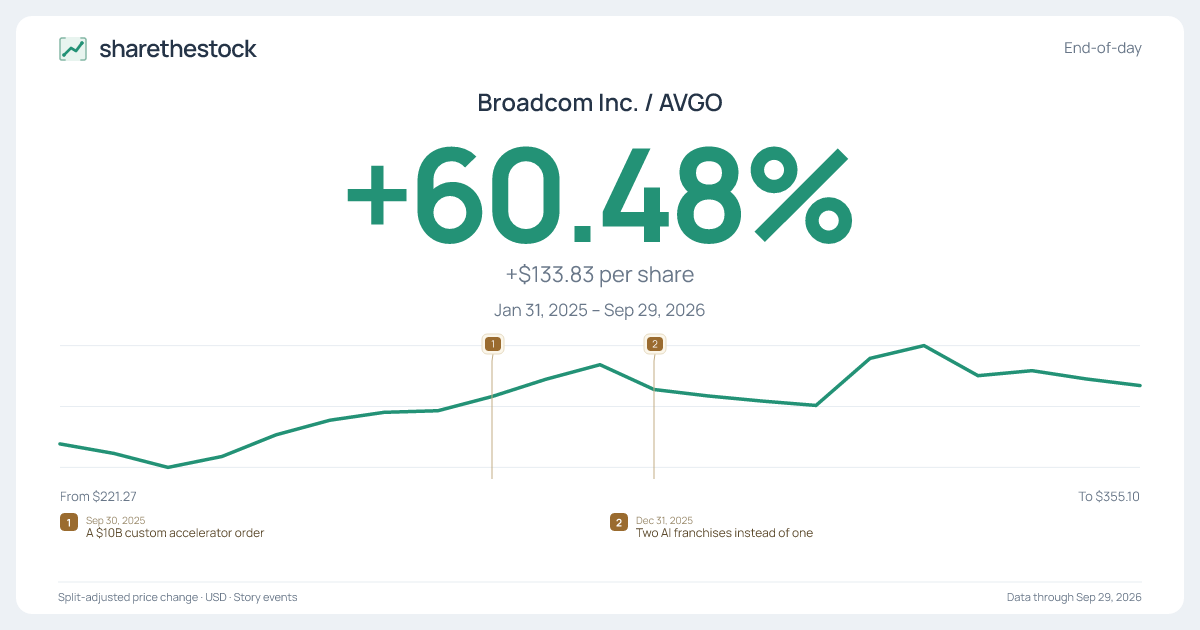
A $10B custom accelerator orderMarket
A single unnamed customer commits to a custom AI chip programme, confirming that hyperscalers intend to design around merchant silicon and that Broadcom is the partner they use to do it.
Closed $329.91 that month
Two AI franchises instead of oneProduct
Accelerators and the Ethernet fabric between them both compound at once, and Broadcom’s AI revenue becomes large enough to be discussed in the same terms as its entire pre-2023 business.