sharethestock

The company story

Amazon.com, Inc.

XNAS: AMZN · USD · split-adjusted

Amazon’s story is a single sentence repeated for thirty years: take the margin, give it to the customer, and let the free cash flow show up later.

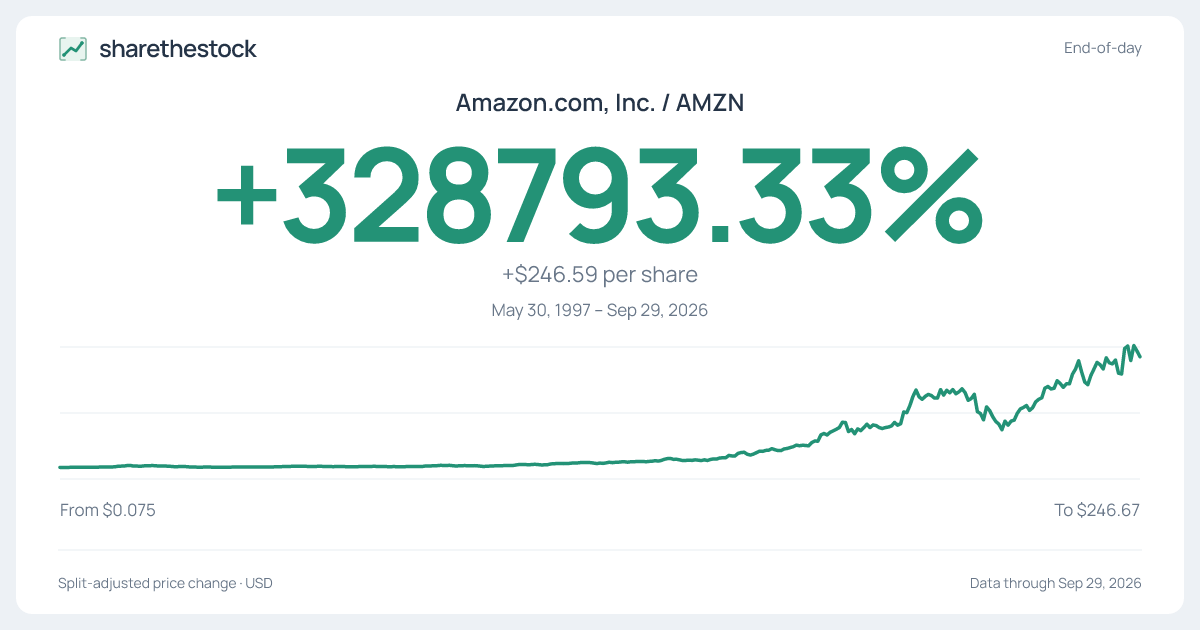
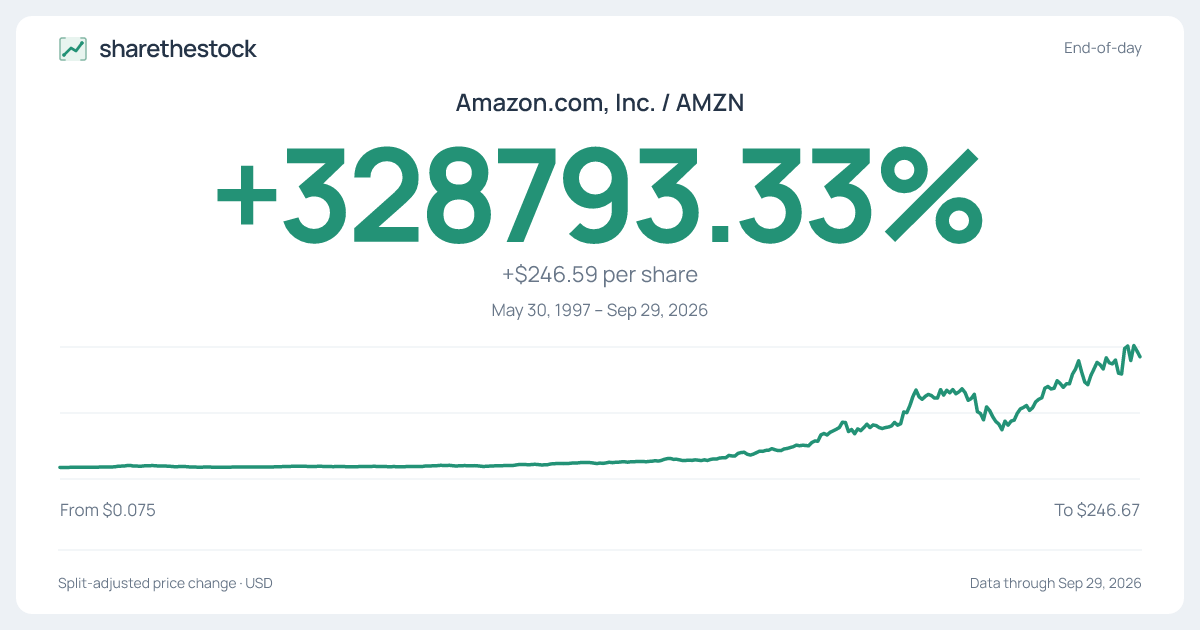
$0.075first monthly close, May 1997 $246.67latest, Sep 29, 2026 +328793.33%since May 1997 $1,000 → $3,288,933.31first close to now
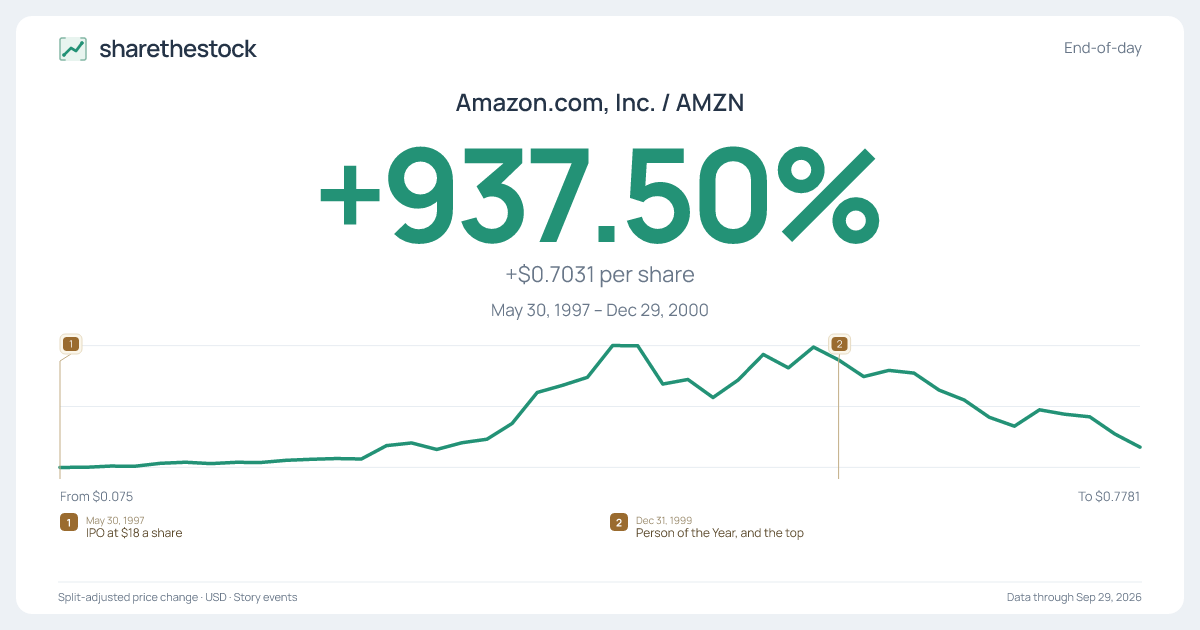
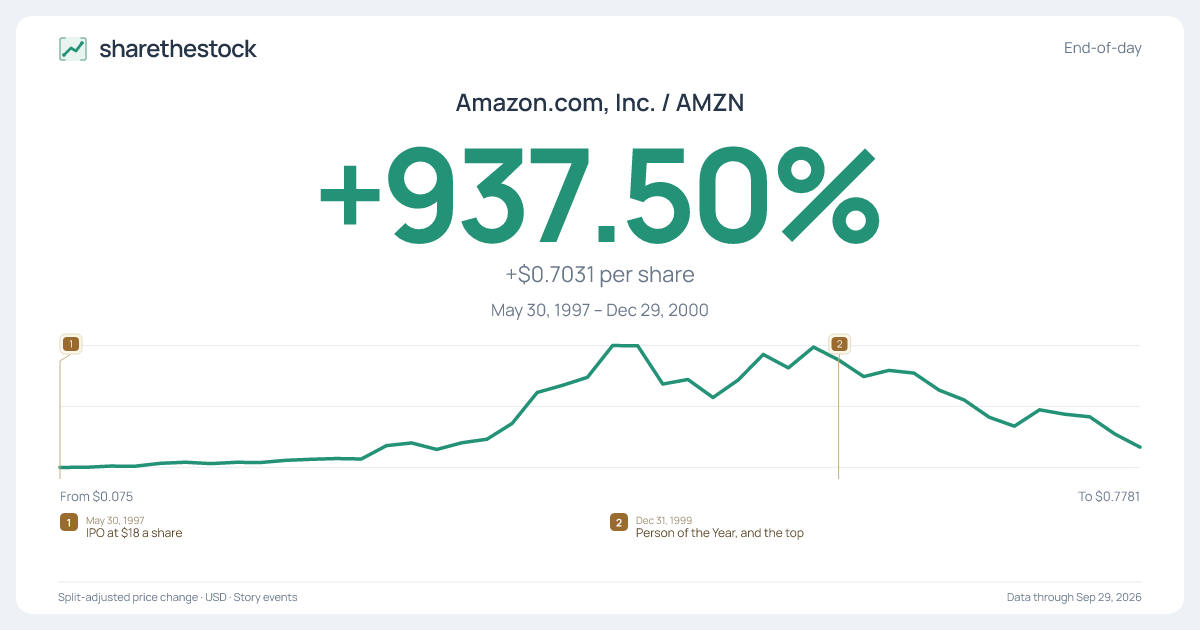
  1. 1Books, then the bubbleMay 1997 – Dec 2000+937.50%
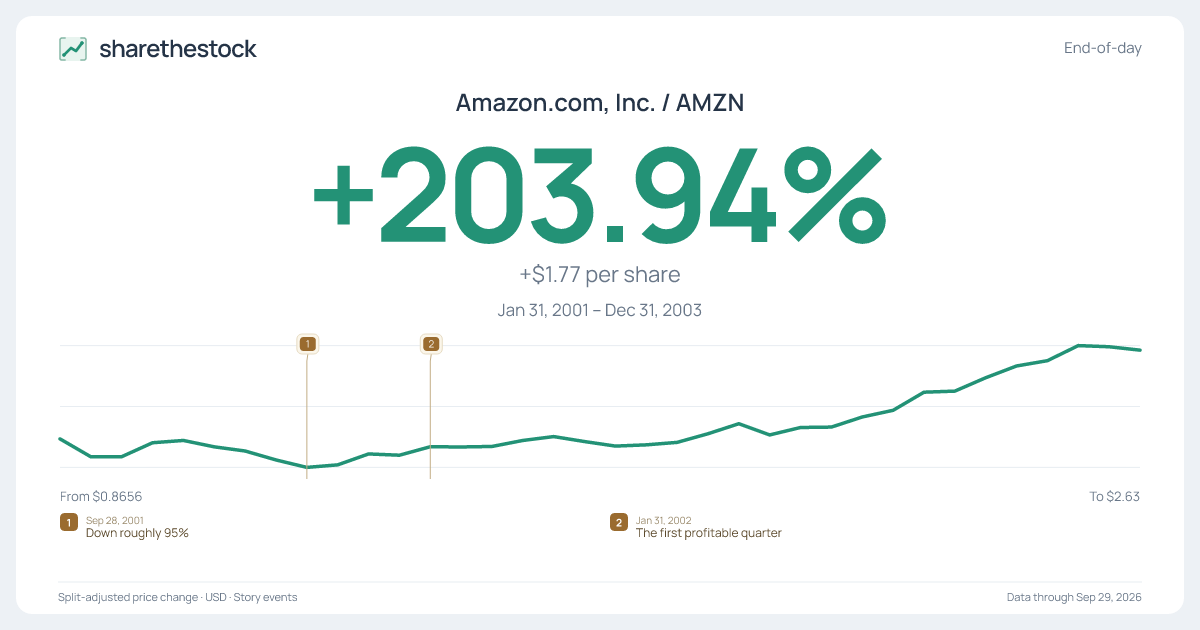
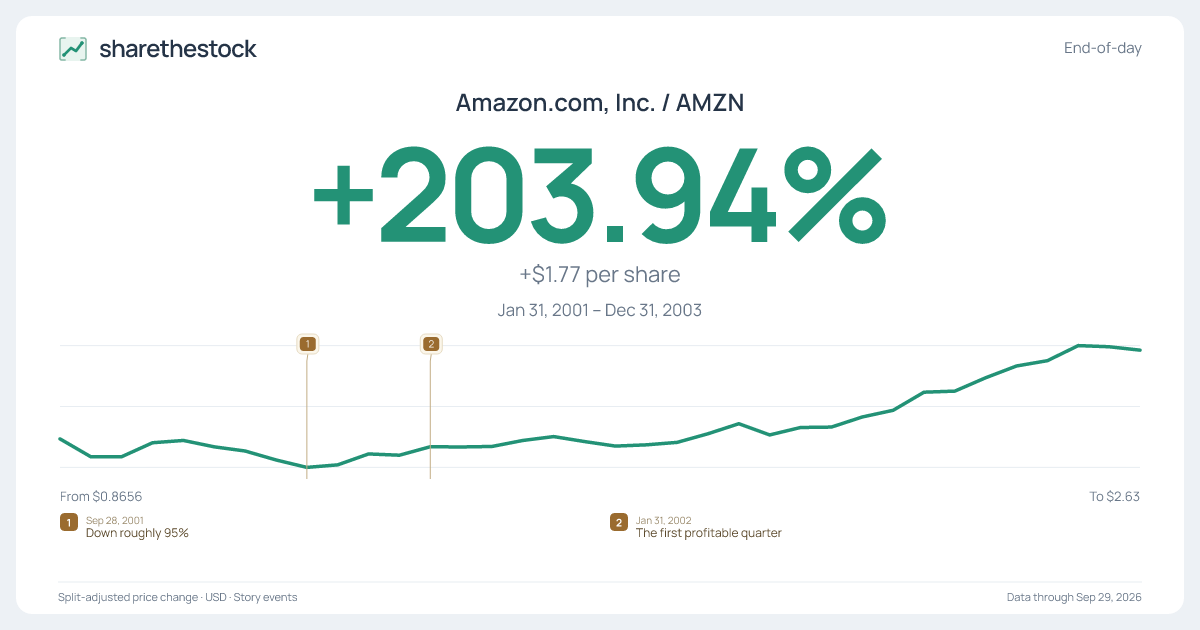
  2. 2The near-deathJan 2001 – Dec 2003+203.94%
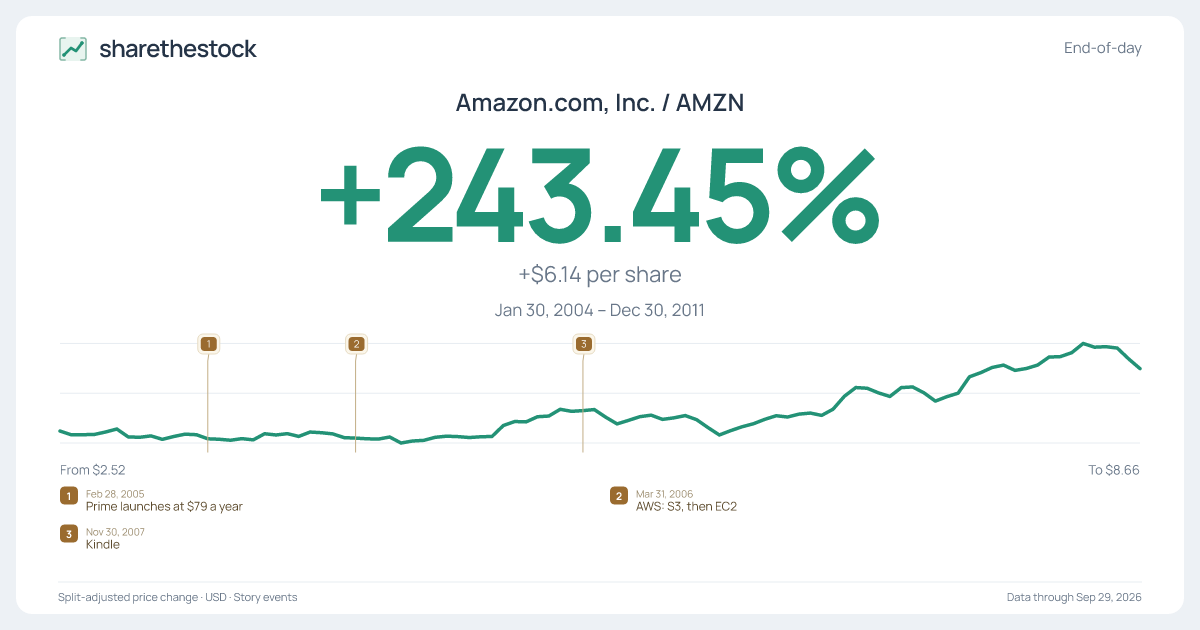
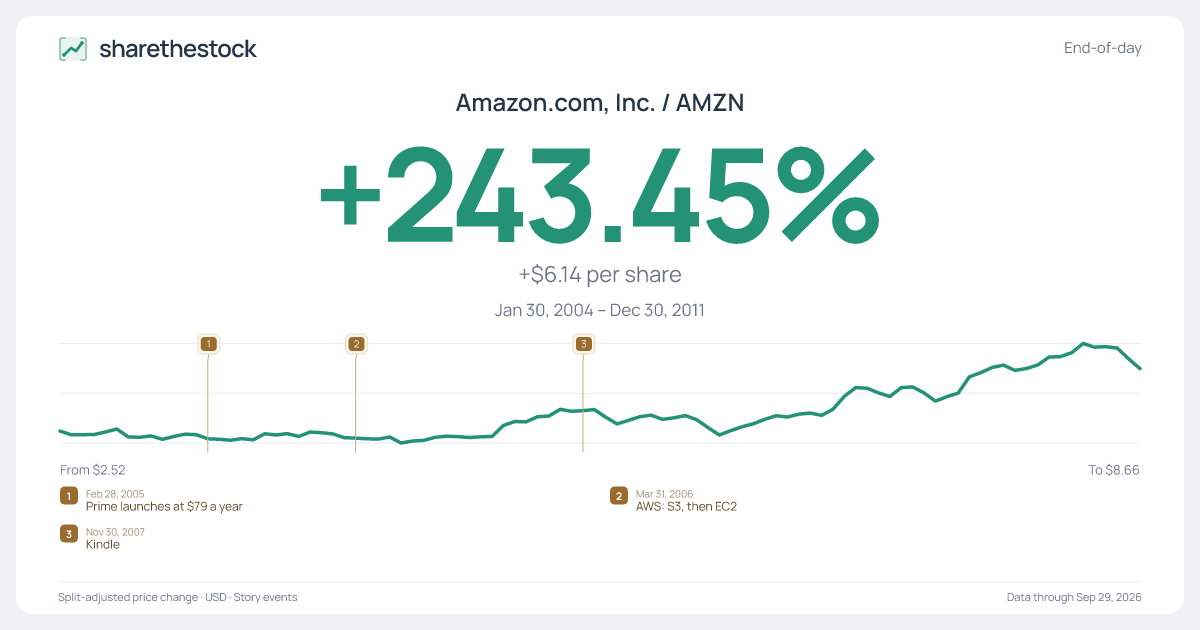
  3. 3Prime and AWSJan 2004 – Dec 2011+243.45%
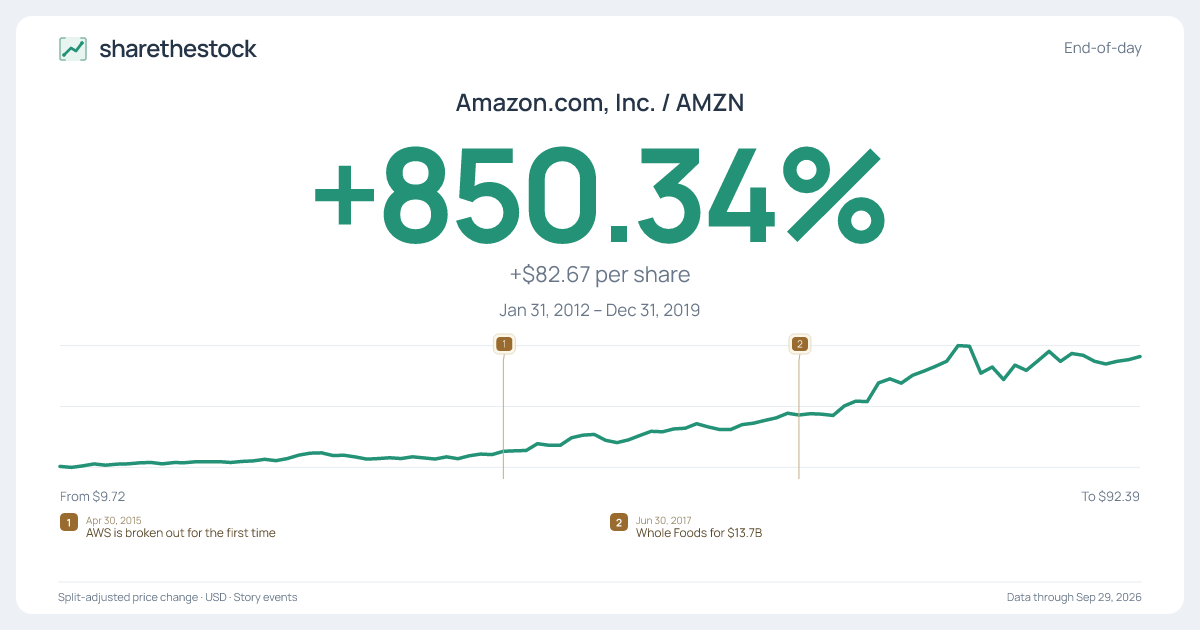
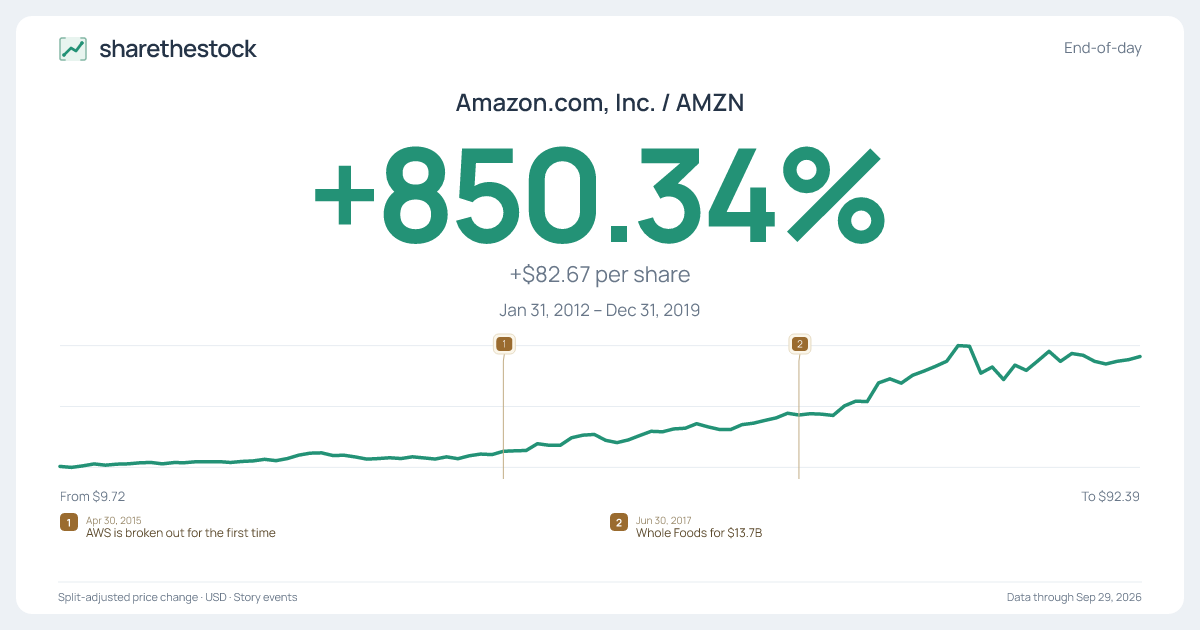
  4. 4The margin revealJan 2012 – Dec 2019+850.34%
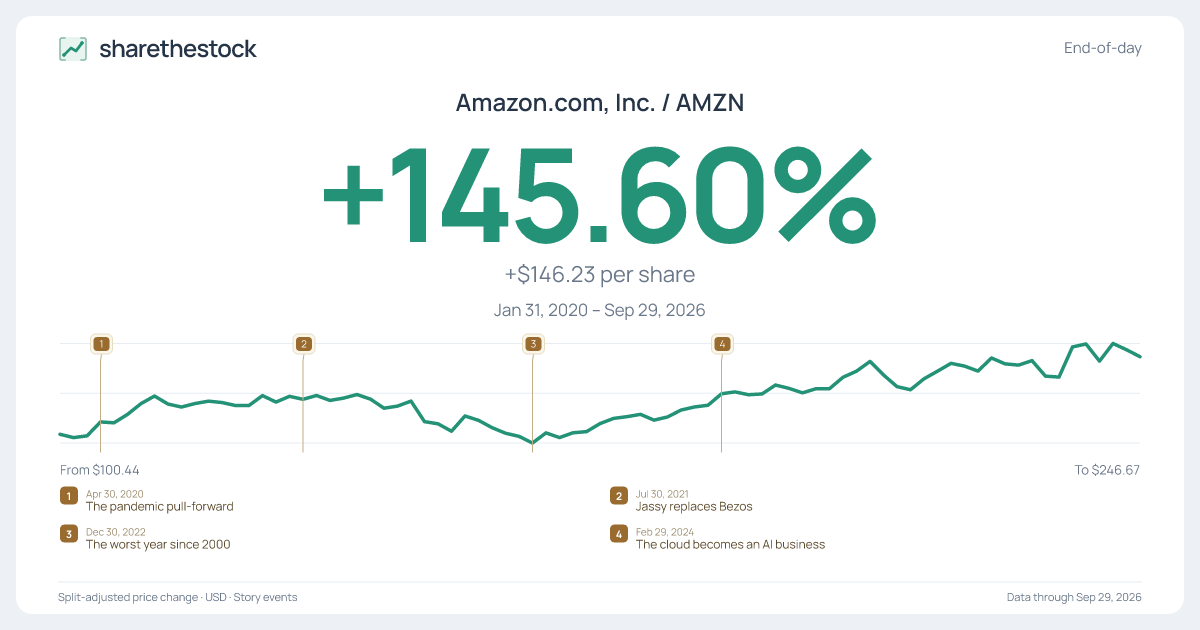
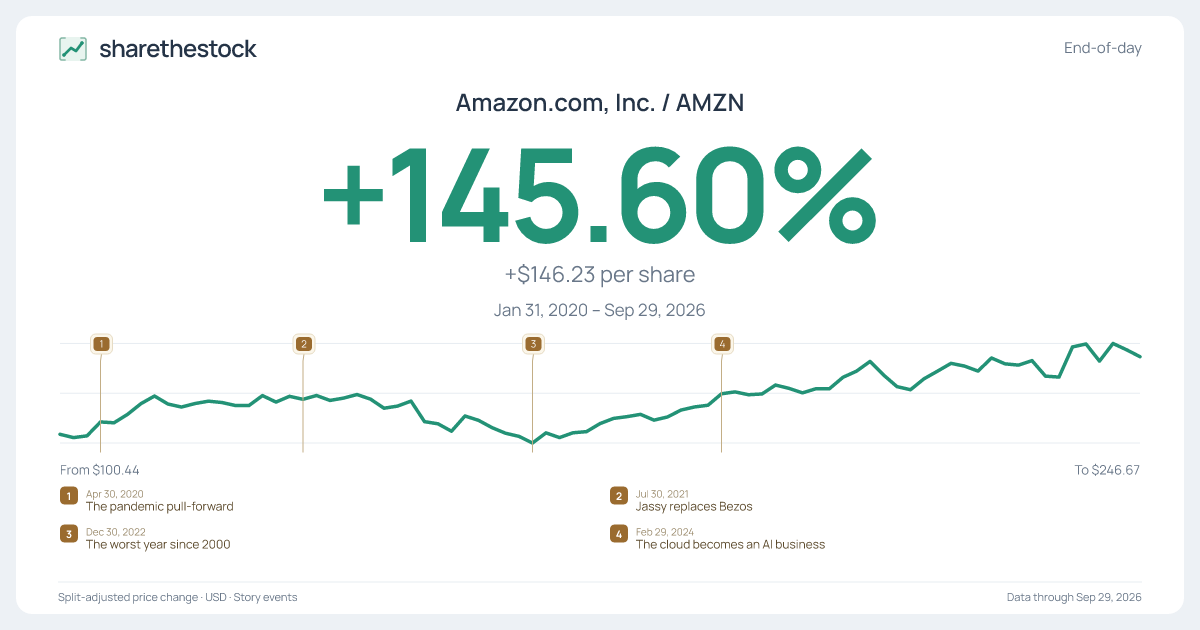
  5. 5Scale and disciplineJan 2020 – Sep 2026+145.60%

Get big fast

An online bookstore raised money on the idea that the catalogue, not the shop, was the product — and then rode the internet mania to a valuation with no relationship to its sales.

  1. IPO at $18 a share

    A roughly $438M valuation for a company with $16M of revenue and no profit. Adjusted for splits, the offer price is about 7.5 cents.

    Closed $0.075 that month
  2. Person of the Year, and the top

    Bezos on the cover of Time as shares peak near $107 split-adjusted. The stock will not see that level again for almost a decade.

    Closed $3.81 that month
Down 90%, and the first profitable quarter

The bubble burst, the bonds were rated junk, and the press wrote the obituary. Amazon cut costs, reported a small profit in the fourth quarter of 2001, and kept the flywheel language.

  1. Down roughly 95%

    Shares trade near $6. Barron’s has already run ‘Amazon.bomb’. The company holds the strategy and cuts everything else.

    Closed $0.2985 that month
  2. The first profitable quarter

    $5M of net income on $1.1B of sales — small, symbolic, and enough to change the financing conversation.

    Closed $0.7095 that month

Two decisions that made the modern company

A flat-fee shipping subscription that looked financially reckless, and a server-rental business that looked unrelated. Both were misread for years, largely because Amazon did not break out the numbers.

  1. Prime launches at $79 a year

    Internally modelled as a money-loser. It converts shipping cost into a membership habit and becomes the retail moat.

    Closed $1.76 that month
  2. AWS: S3, then EC2

    Amazon rents its own infrastructure to startups. For nearly a decade, the market treats it as a curiosity buried inside ‘other’.

    Closed $1.83 that month
  3. Kindle

    The company cannibalises its founding business before anyone else can.

    Closed $4.53 that month

When AWS finally showed its books

The 2015 disclosure that AWS was a large, fast-growing, highly profitable business re-rated the whole company. Retail kept reinvesting; the cloud paid for it.

  1. AWS is broken out for the first time

    A $5B business growing 49% with about 17% operating margins. The stock nearly doubles that year on information that had existed all along.

    Closed $21.09 that month
  2. Whole Foods for $13.7B

    Grocery, and 460 physical locations. Competing retailers lose tens of billions in market value on the announcement day.

    Closed $48.40 that month

Pandemic overbuild, then the correction

Two years of demand pulled forward, a doubled fulfilment network, the worst year for the stock since 2000, a new CEO cutting costs — and then AI making the cloud the story again.

  1. The pandemic pull-forward

    A decade of e-commerce adoption in months. Amazon doubles its fulfilment network in two years on the assumption it will last.

    Closed $123.70 that month
  2. Jassy replaces Bezos

    The person who built AWS takes the whole company, inheriting the overbuild.

    Closed $166.38 that month
  3. The worst year since 2000

    Shares roughly halve, the company takes its largest layoffs, and the pandemic capacity is written down or grown into.

    Closed $84.00 that month
  4. The cloud becomes an AI business

    Capacity constraints, not demand, become the reported limit on growth, and Amazon returns to record highs.

    Closed $176.76 that month

The whole arc

+328793.33% in 29 years

One chart, May 30, 1997 – Sep 29, 2026. Open it, drag a range, add your own markers — or take this card with you.