Fifty years as the second-best chip company, then five years that changed the order.
AMD spent most of its life defined by someone else: a second source for Intel’s designs, a price war it usually lost, a stock that traded in single digits for a decade. The turnaround is one of the largest in the history of American industry, and it happened in public.
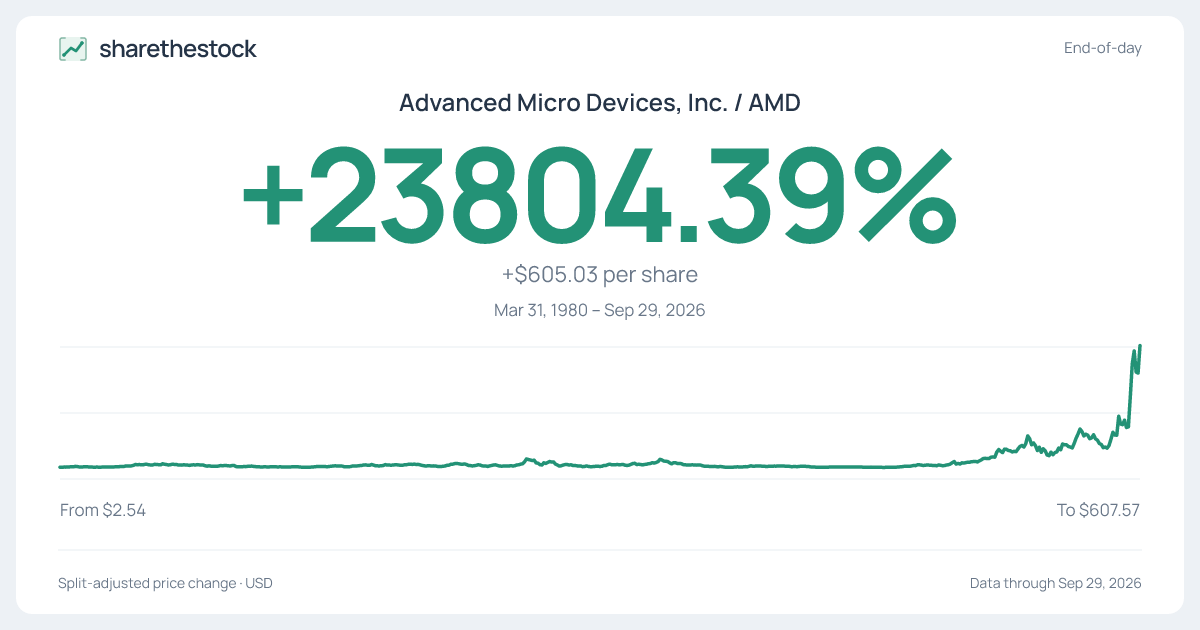
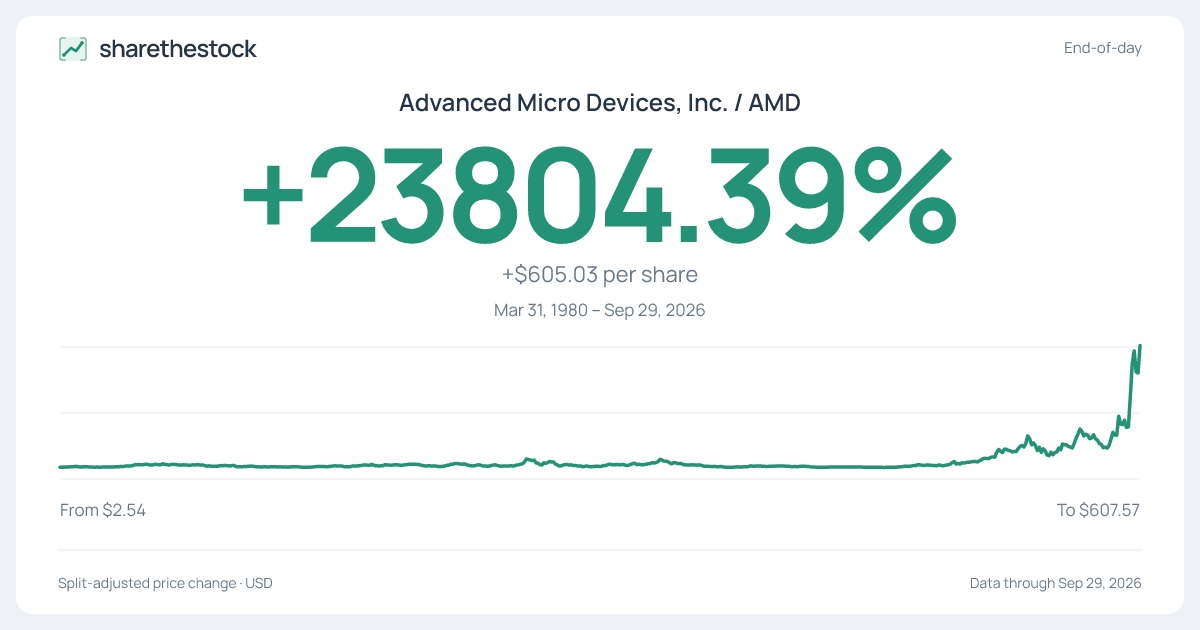
$2.54first monthly close, Mar 1980$607.57latest, Sep 29, 2026+23804.39%since Mar 1980$1,000 → $239,043.91first close to now
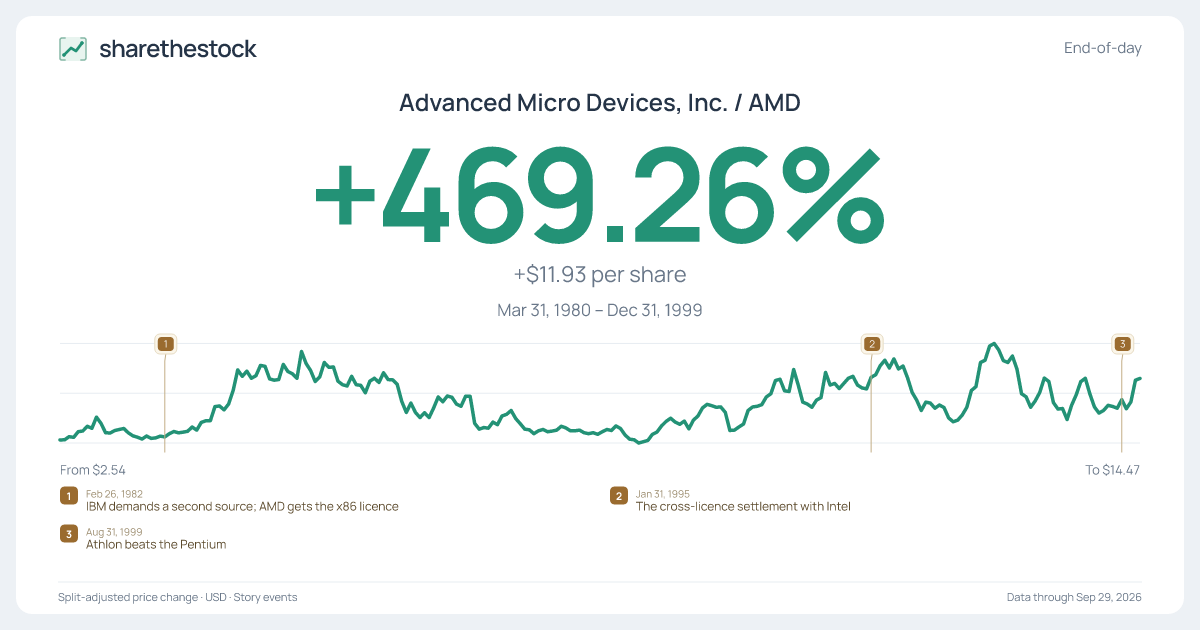
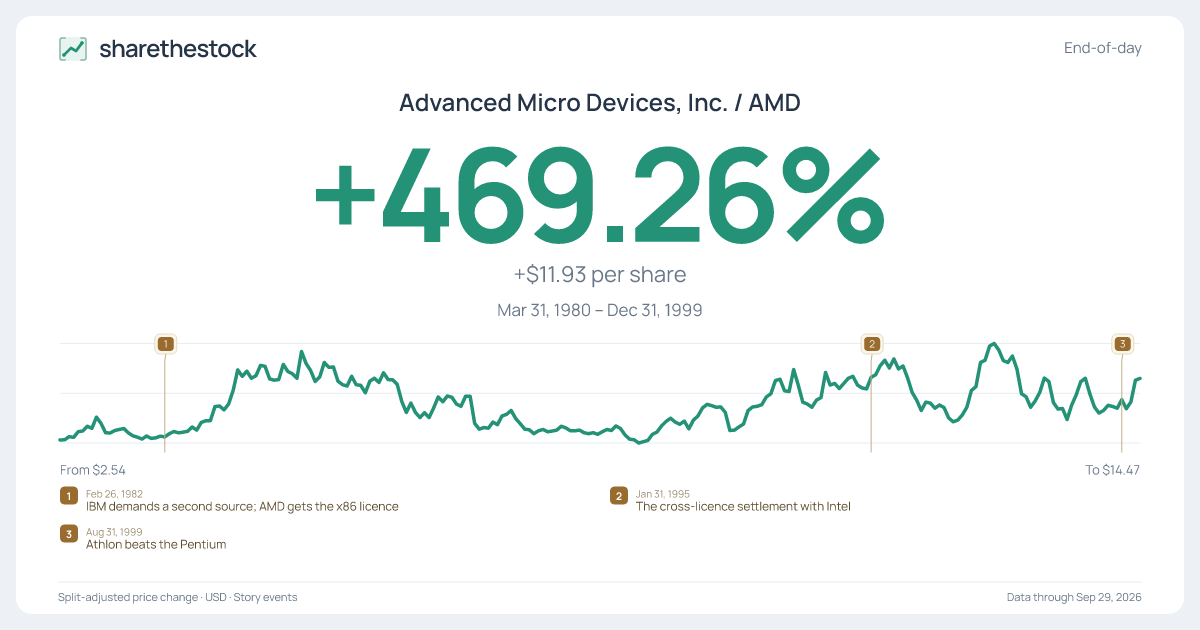
Jerry Sanders left Fairchild to build a chip company on a simple premise: large customers refuse to buy from a single supplier. IBM made that premise into a business when it demanded a second source for the x86 processor in the PC — and AMD spent the next three decades trying to convert a licence into an identity.
Founded by Jerry Sanders and seven colleagues from FairchildFounding
Sanders raises money in a Sunnyvale living room with a business plan built on being a reliable second source rather than an inventor — the strategy, and the constraint, for the next forty years.
Private company — no public price yet
IPO at $15 a shareMarket
A small offering for a company making rebadged versions of other people’s logic chips.
Before monthly price data begins
IBM demands a second source; AMD gets the x86 licenceDeal
Intel signs a technology exchange so IBM will ship the PC. That single contract makes AMD a processor company and starts a legal relationship that outlasts both founders.
Closed $3.13 that month
The cross-licence settlement with IntelDeal
Years of litigation over whether the licence covered the 386 and 486 end in a cross-licence that lets AMD design its own compatible chips instead of copying them.
Closed $14.69 that month
Athlon beats the PentiumProduct
For the first time, the fastest x86 processor is not made by Intel. AMD reaches 1GHz first in March 2000 and the market briefly treats it as a peer.
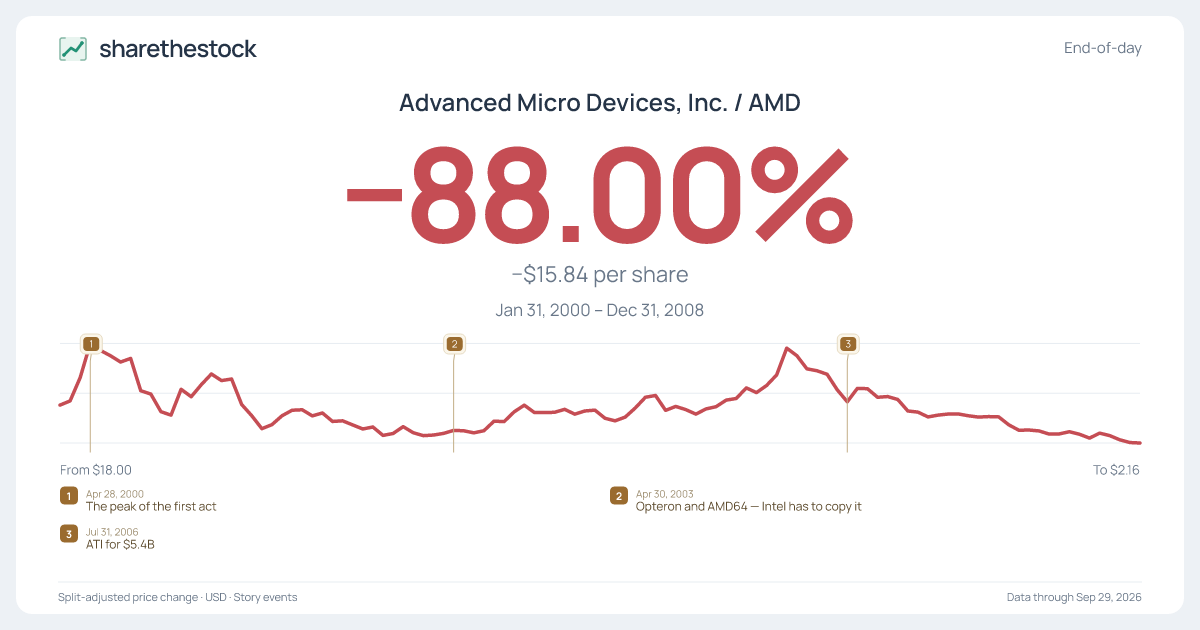
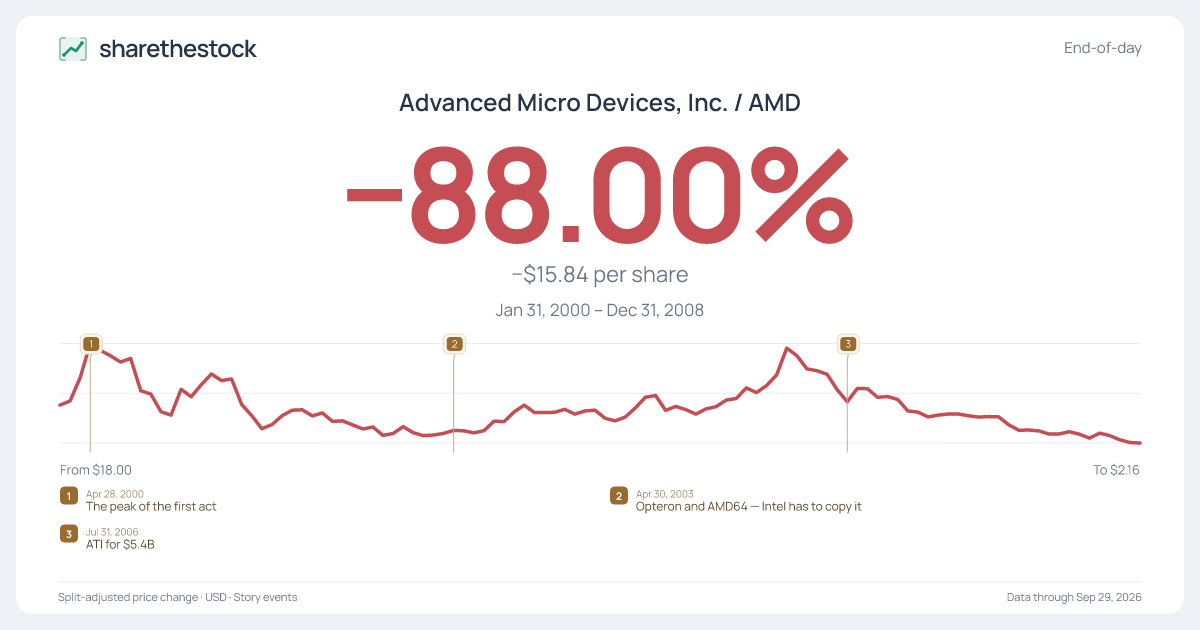
For a few years AMD was genuinely ahead: the first gigahertz processor, the first 64-bit x86 architecture, an instruction set Intel was eventually forced to copy. Then it paid $5.4B for ATI, took on debt into a recession, and handed the lead straight back.
The peak of the first actMarket
The dot-com top catches AMD at the height of the Athlon cycle. It will take twenty-one years to trade there again.
Closed $43.75 that month
Opteron and AMD64 — Intel has to copy itProduct
AMD extends x86 to 64 bits while Intel bets on an incompatible architecture. Microsoft supports AMD’s version, Intel adopts it, and AMD takes a quarter of the server market.
Closed $7.44 that month
ATI for $5.4BDeal
The debt that nearly ends the company, and the graphics business that eventually makes it. Both facts take a decade to become clear.
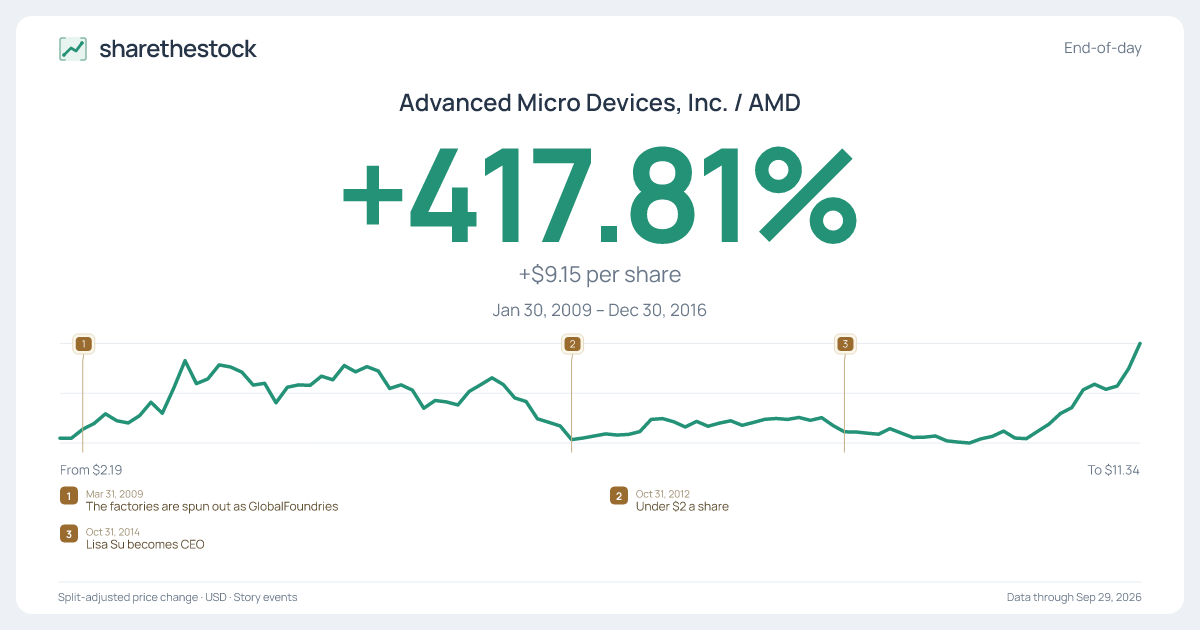
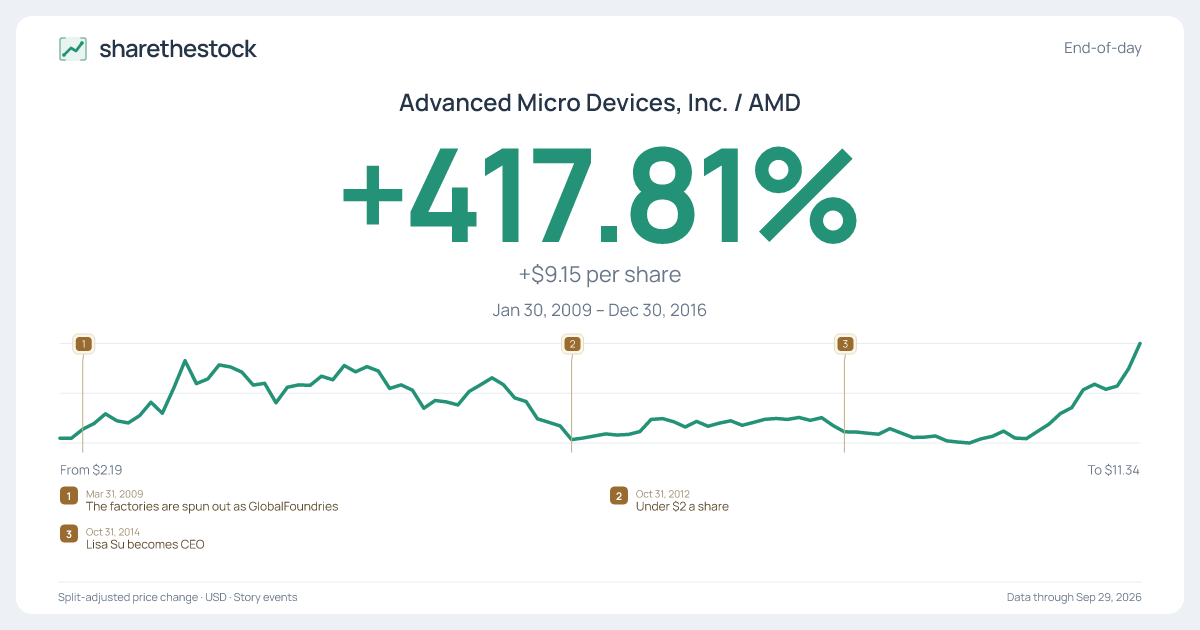
AMD sold its factories, missed mobile entirely, and traded under $2 a share while the market debated whether it would survive. What it did in those years — a clean-sheet CPU core and the consoles that funded it — was invisible on the chart.
The factories are spun out as GlobalFoundriesCrisis
AMD stops manufacturing its own chips — an admission of defeat that later becomes an advantage when it can simply buy the best process available from TSMC.
Closed $3.05 that month
Under $2 a shareCrisis
A quarter of the workforce is cut, the balance sheet is stretched, and analysts openly model bankruptcy. The Zen design team is already two years into the work.
Closed $2.05 that month
Lisa Su becomes CEOLeadership
An engineer takes over with a plan that is mostly refusal: no more chasing share with bad products, no more spreading thin. Ship one great core.
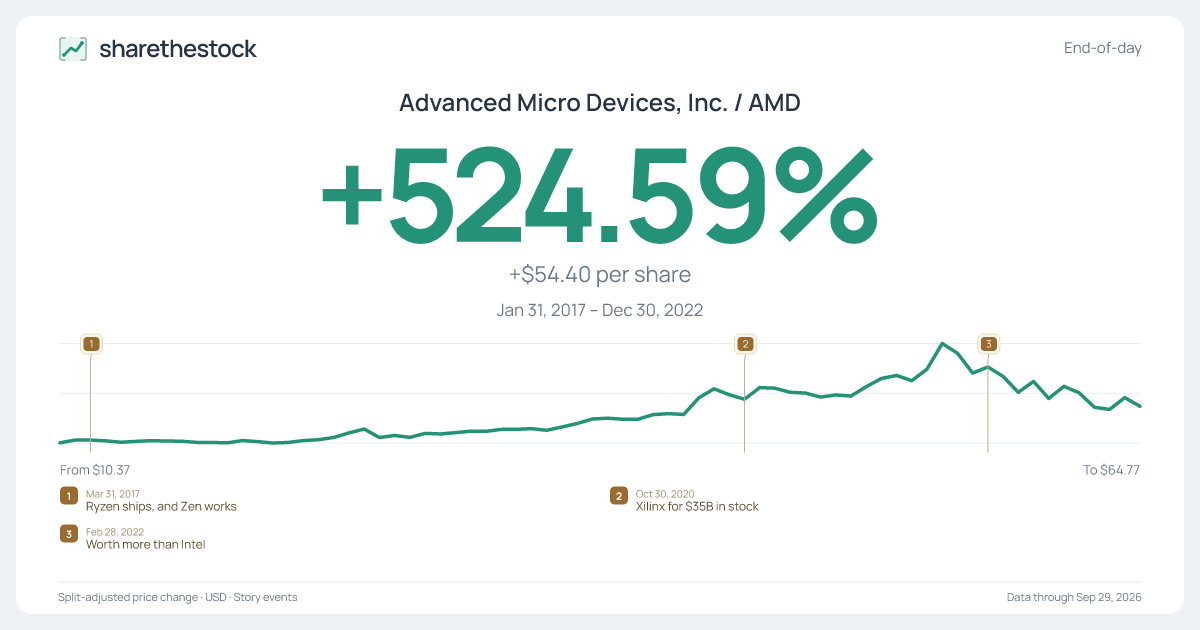
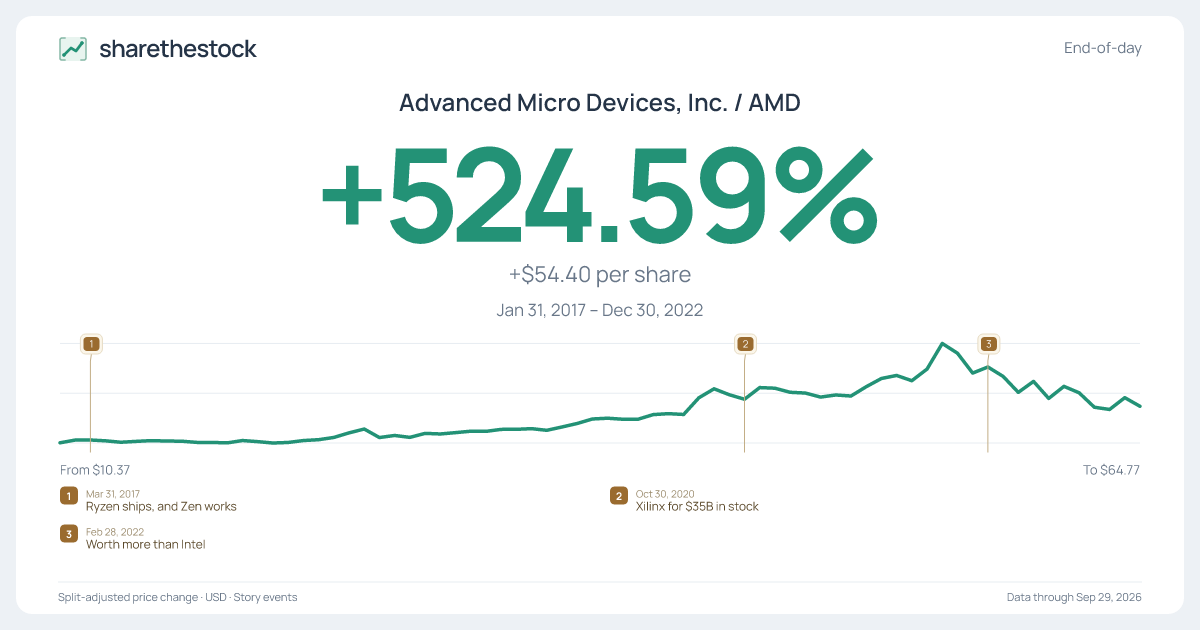
Ryzen arrived competitive, then better, at exactly the moment Intel’s manufacturing stalled. Server share went from nothing to meaningful, the company bought Xilinx for $35B, and for the first time in its history AMD was worth more than Intel.
Ryzen ships, and Zen worksProduct
Eight cores at half the price of Intel’s, on a core that turns out to scale for five straight generations. The stock’s twenty-year sideways chart ends here.
Closed $14.55 that month
Xilinx for $35B in stockDeal
Paid entirely in shares that had already multiplied, which is what made it affordable. It closes in February 2022 and gives AMD the data-center adjacencies it lacked.
Closed $75.29 that month
Worth more than IntelMarket
Fifty-three years after being founded as Intel’s second source, AMD passes it in market value — and then watches the whole sector de-rate anyway as rates rise.
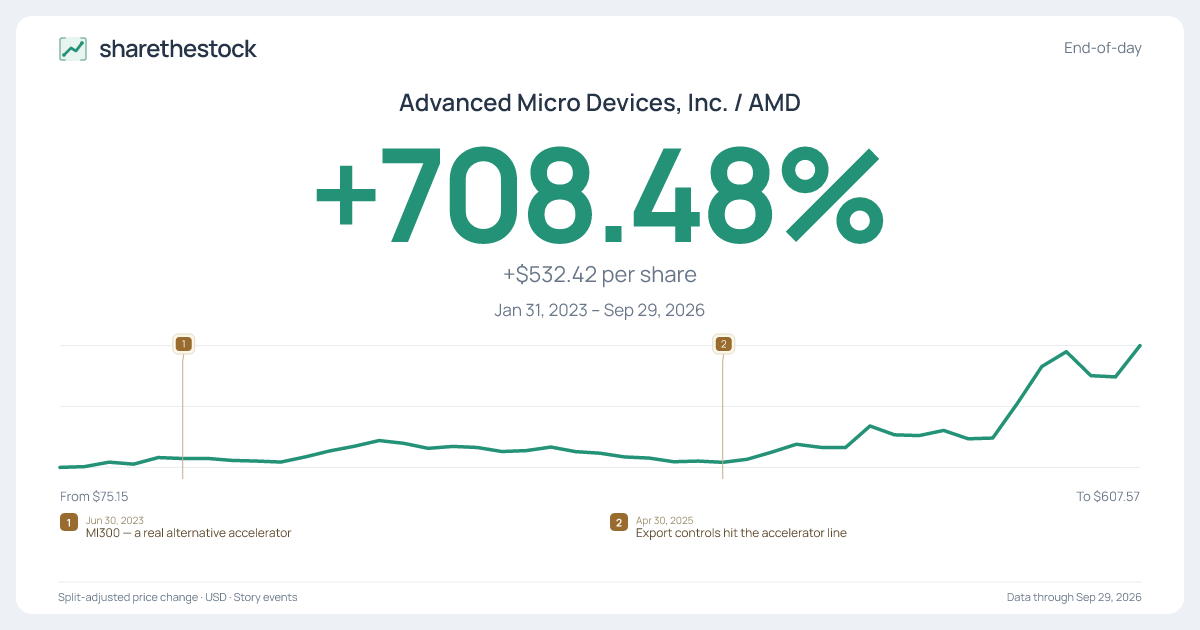
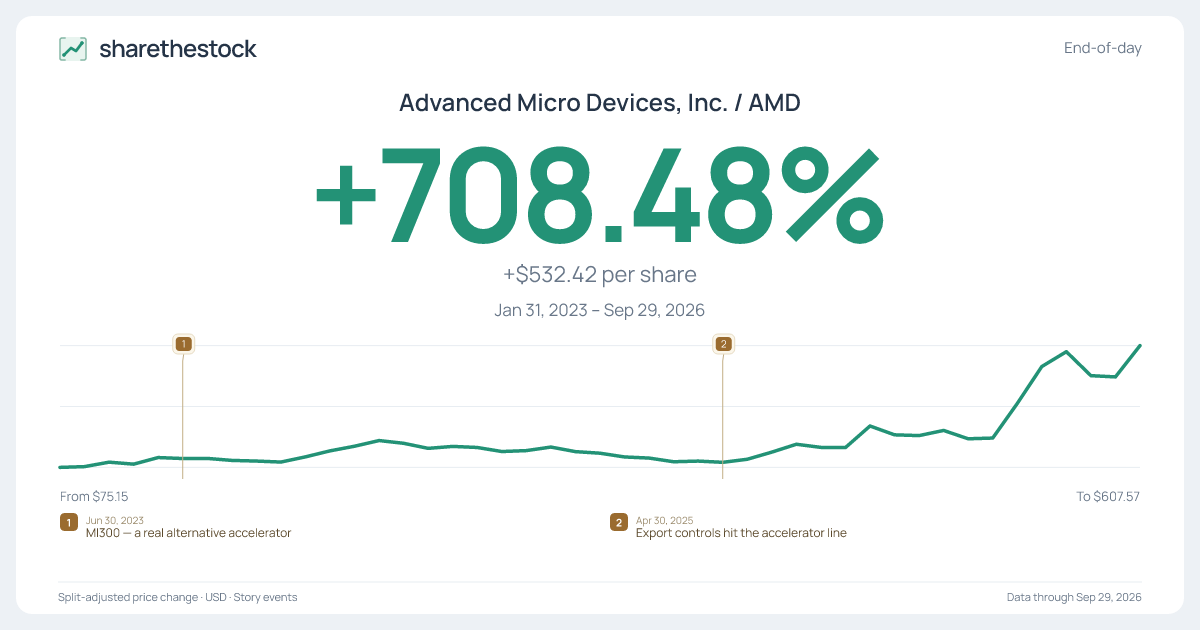
The only credible second source for the accelerator
The same argument that created AMD in 1969 became its largest opportunity: nobody wants one supplier for the most important component in the industry. The chart now prices it as the alternative rather than the also-ran.
MI300 — a real alternative acceleratorProduct
The first AMD part that hyperscalers evaluate seriously against NVIDIA. Software, not silicon, becomes the bottleneck the company spends the next three years attacking.
Closed $113.91 that month
Export controls hit the accelerator lineCrisis
China restrictions force a large inventory charge and remove a market AMD had been counting on, a reminder that the most important variable in chips is now policy.